Twenty-six centuries of evidence that people, taken together, leave the world better than they found it, from the first arguments in Athens to the engineers now teaching machines to think.
For almost all of history, families buried half their children and few could read, until people changed that in the last two centuries.
The world
Georges de La Tour painted the Magdalen lit by a single candle. Candles were costly in the 1600s, and most families spent their evenings in near darkness.Georges de La Tour, The Penitent Magdalen, ca. 1640. Oil on canvas. The Metropolitan Museum of Art, Gift of Mr. and Mrs. Charles Wrightsman, 1978. Public domain. Source
Anne, the last Stuart to rule Britain, was pregnant at least seventeen times.11 Anne, Queen of Great Britain, Wikipedia. https://en.wikipedia.org/wiki/Anne,_Queen_of_Great_Britain Only one of her children, William, Duke of Gloucester, lived past the age of two. He fell ill at his eleventh birthday party in July 1700 and died six days later. His physicians bled and blistered him but could not agree on what was wrong. They put his death down to “a malignant fever”.22 Prince William, Duke of Gloucester, Wikipedia. https://en.wikipedia.org/wiki/Prince_William,_Duke_of_Gloucester
A child born in 1800 could expect to live fewer than 30 years.33 Life expectancy globally, Our World in Data. https://ourworldindata.org/life-expectancy-globally For most of history, parents buried about half their children before the age of fifteen.44 Mortality in the past: every second child died, Our World in Data. https://ourworldindata.org/child-mortality-in-the-past Most families farmed, and most farmers grew barely enough to eat. The economic historian Michail Moatsos estimates that three in four people alive in 1820 could not afford a small room, a little heat and enough food to stave off malnutrition.55 Extreme poverty in brief, Our World in Data (Michail Moatsos’s cost-of-basic-needs estimates). https://ourworldindata.org/extreme-poverty-in-brief
Few of them could read.66 Literacy, Our World in Data. https://ourworldindata.org/literacy After dark, families lit their homes with tallow candles, rushlights or the fire. Candles and lamp oil cost so much that they used as little light as they could. The energy economist Roger Fouquet found that people in England in the 1300s paid about 16,000 times as much for each unit of light as people in Britain paid in 2023, after allowing for inflation.77 Light at Night, Our World in Data (after Roger Fouquet and Peter Pearson). https://ourworldindata.org/light-at-night
As late as 1800, people in every region of the world died, on average, before they turned 40.
Then people broke the pattern. The United Nations estimates that a child born in 2024 can expect to live 73.3 years.88 World Population Prospects 2024, press release, United Nations, 2024. https://www.un.org/sustainabledevelopment/blog/2024/07/press-release-wpp2024/ About 96 children in every hundred now live to fifteen. One person in ten lives below the World Bank’s extreme-poverty line of three dollars a day, and more than four in five can read.
under 30years a newborn could expect to live, world average, 1800
73.3years a newborn could expect to live, world average, 2024 (UN estimate)
Nobody handed these gains down from above, and nobody won them all at once. Greek doctors began to write down what they saw at the sickbed. Roman engineers piped clean water into a city of a million people. Monks copied books by hand until printers in Mainz and Venice made them cheap. Navigators charted the oceans, and natural philosophers in London and Paris tested their ideas against measurements. Mill owners in Lancashire, plant breeders in Mexico, chemists in Germany and programmers in California took what the generation before them knew and added to it.
The builders paid heavy costs, and often made others pay them. Athenians mined silver with slaves, Roman landowners worked their estates with captives, and British mill owners worked children for twelve hours a day and more. Physicists built the bomb as well as the power station. Historians can count those costs, and they can show that every generation, on balance, left more to the next than it found.
Every age had its prophets of decline. Hesiod put the golden age behind him. Malthus said population must always outrun food. Some of them were clever, and some were right about their own decade, but over the long run they were wrong. Since the Greeks began to argue in public, people have lived longer, eaten better, learned more, travelled further and governed themselves more freely, because each generation solved the problems in front of it and passed on what worked.
“Thereafter, would that I were not among the men of the fifth generation, but either had died before or been born afterwards. For now truly is a race of iron, and men never rest from labour and sorrow by day, and from perishing by night”
Demographers estimate that 110 million people lived on Earth three centuries before Hesiod and 230 million seven centuries after him. By 2023, 8.1 billion people lived on it.
Hesiod farmed at Ascra in Boeotia, in what he took to be the race of iron. A century or so after him, a few men in Miletus and the other Greek trading cities on the coast of what is now Turkey began to ask what the world was made of. They gave reasons for their answers and argued about them in public.
Greek thinkers began to explain nature without gods; the citizens of Athens learned to govern themselves by open argument.
c. 600–322 BC · Miletus, Cos and Athens
The world in
c. 600 BC
Life expectancy
No estimate
Cost of light
About 42 hours oil lamp, Babylonian estimate
Literacy
No estimate
Atlantic crossing
No regular crossing
Population
150 million estimate
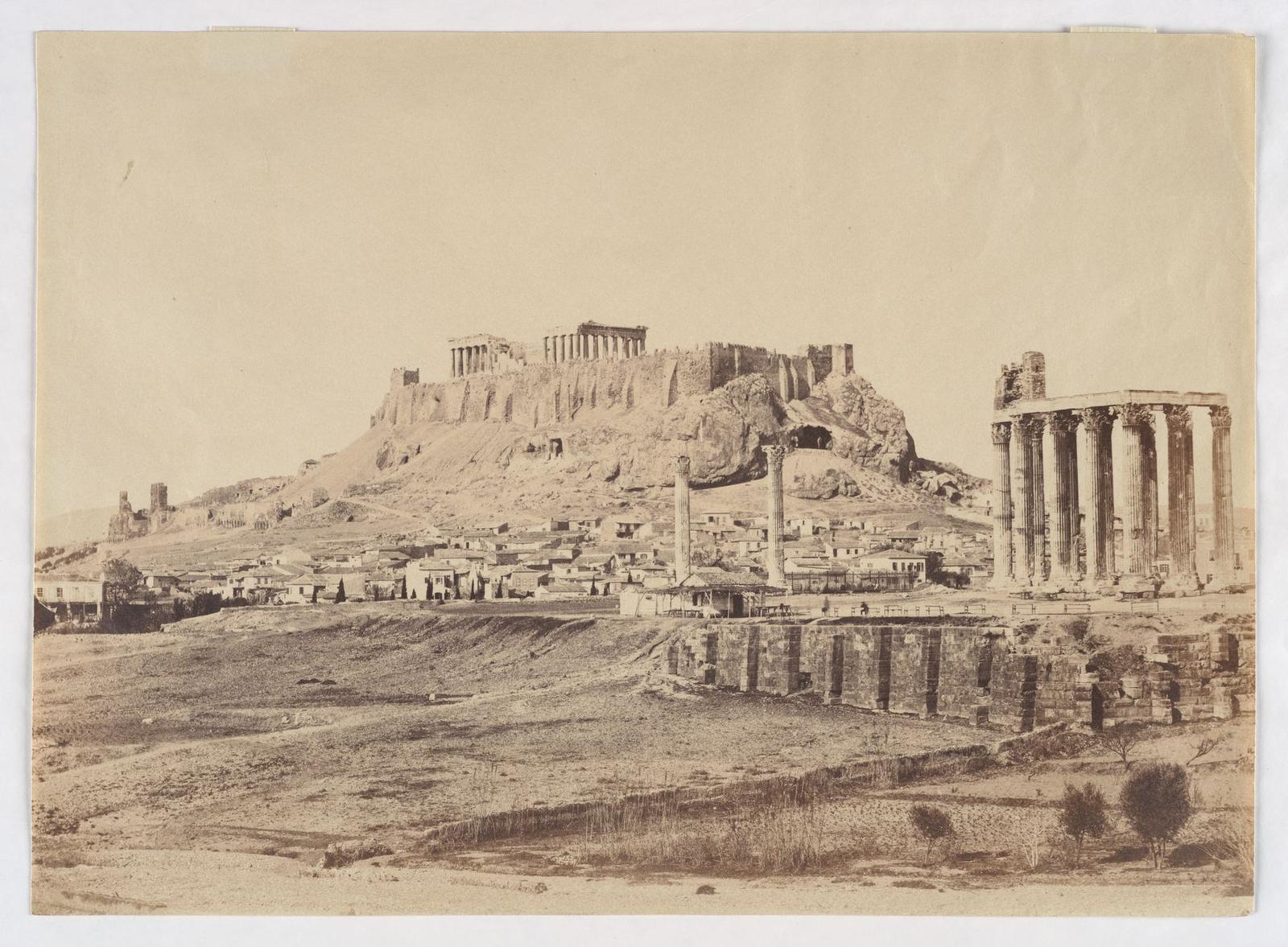
James Robertson photographed the Acropolis in the early 1850s from beside the ruined Temple of Olympian Zeus. Pericles paid for the Parthenon on the hilltop partly with the silver of Laurion and the tribute of Athens’s allies.James Robertson, Acropolis, Athens, Greece, early 1850s. Salted paper print. The Metropolitan Museum of Art, Gilman Collection, Museum Purchase, 2005. Public domain. SourceDates in this chapter10
c. 585 BCThales of Miletus, by Herodotus’s account, foretells a solar eclipse.
c. 530 BCPythagoras of Samos settles at Croton in southern Italy and gathers followers.
508–507 BCCleisthenes reorganises the citizens of Athens into ten tribes.
c. 483 BCThemistocles persuades the Athenians to spend a new strike of Laurion silver on 200 warships.
c. 460 BCHippocrates is born on the island of Cos.
431 BCPericles speaks at the public funeral for the first Athenians killed in the Peloponnesian War.
399 BCAn Athenian jury tries and condemns Socrates.
c. 387 BCPlato opens his school in the grove of the Academy.
335 BCAristotle returns to Athens and begins to teach at the Lyceum.
322 BCAristotle dies at Chalcis; the Macedonian general Antipater ends the Athenian democracy.
Water, air and the boundless
Herodotus wrote that Thales of Miletus foretold an eclipse of the sun. By his account the Lydians and the Medes saw the day turn to night in the middle of a battle, stopped fighting and made peace. Astronomers now date the eclipse to 28 May 585 BC.11 Eclipse of Thales, Wikipedia (quoting Herodotus 1.74). https://en.wikipedia.org/wiki/Eclipse_of_Thales Thales lived in Miletus, a trading port on the coast of what is now Turkey, whose merchants knew the ports of Egypt and the Levant. He taught that all things came from water but wrote nothing that later copyists preserved. Aristotle, writing more than two centuries after him, recorded what he had heard of his ideas.
His pupil Anaximander drew a map of the known world. He argued that water could not be the root of everything, and proposed instead a boundless stuff with no fixed nature. Anaximander’s pupil Anaximenes said it was air. All three gave wrong answers, but they looked for causes in nature. Each pupil felt free to tell his teacher he was mistaken.
Pythagoras of Samos settled at Croton in southern Italy around 530 BC and founded a brotherhood with its own rules of diet and silence. Later writers credited his followers with showing that a string half as long sounds an octave higher, and with teaching that people could explain the order of the world through number. Scholars still argue about how much mathematics Pythagoras himself did.22 Pythagoras, Wikipedia. https://en.wikipedia.org/wiki/Pythagoras Long after the brotherhood broke up, mathematicians kept its habit of describing nature with numbers.
The doctors of Cos
Hippocrates of Cos, born around 460 BC, took fees to train doctors. In Plato’s Protagoras, a young Athenian says that a pupil who paid Hippocrates would expect to come away a physician.33 Plato, Protagoras, trans. Benjamin Jowett, Project Gutenberg. https://www.gutenberg.org/ebooks/1591
Ancient editors gathered about sixty medical books under his name, written by many doctors over several generations.44 Hippocratic Corpus, Wikipedia. https://en.wikipedia.org/wiki/Hippocratic_Corpus The writers of these books disagreed with one another about treatments, but they all looked for the cause of a disease in the body, the diet, the water and the weather.
The author of On the Sacred Disease took on epilepsy, the illness that most Greeks believed the gods sent. He wrote that it “appears to me to be nowise more divine nor more sacred than other diseases, but has a natural cause”.55 Hippocrates, On the Sacred Disease, trans. Francis Adams, 1849, Wikisource. https://en.wikisource.org/wiki/On_the_Sacred_Disease He accused the healers who sold charms and purifications of using the gods to hide their own ignorance.
Other Hippocratic doctors kept case notes. In the first book of Epidemics, one of them followed a patient, Philiscus, “who lived by the Wall”, through six days of fever. He recorded his sweats, his urine and his sleep until the man died. The same writer gave doctors a short rule for the sickbed: “to do good or to do no harm”.66 Hippocrates, Epidemics I, in The Genuine Works of Hippocrates, trans. Francis Adams, 1849, Project Gutenberg. https://www.gutenberg.org/ebooks/72583 Another writer, in Airs, Waters, Places, told a doctor new to a strange city to study it before he treated anyone. He should note which way the city faced to the winds and the rising sun, whether its people drew soft water from marshes or hard water from rocky heights, and whether the people ate and drank too much or worked hard. Doctors from Alexandria and Rome to Baghdad and Salerno read these books for two thousand years.
The assembly
Cleisthenes broke up the four old tribes that the great families of Athens had run. In 508 and 507 BC he enrolled each citizen in his deme, his home village or city ward, and sorted about 140 demes into ten new tribes.77 Cleisthenes, Wikipedia. https://en.wikipedia.org/wiki/Cleisthenes Each tribe mixed men of the coast, the hills and the city. The Athenians extended his reforms over the next century until the citizens themselves made the laws.
Any adult male citizen could stand up and speak in the assembly, which met on the hill of the Pnyx forty times a year. Officials chose the Council of Five Hundred by lot, and every morning they drew hundreds of jurors for the day’s trials. Athenians paid jurors and, later, those who attended the assembly, so that a poor man could afford to take part. Clerks carved the assembly’s decrees on stone slabs and set them up in public places for any citizen to read. Once a year the citizens could vote to send a leading man into exile for ten years. To vote, a citizen scratched a name on a shard of pottery.
The Athenians paid for their fleet and their temples with silver from the state mines at Laurion, south of the city. Around 483 BC, miners struck a rich new vein. The citizens planned to share out the windfall at ten drachmas a head, but Themistocles persuaded the assembly to build 200 warships with it.88 Herodotus, Histories 7.144, trans. G. C. Macaulay, Project Gutenberg. https://www.gutenberg.org/ebooks/2456 Athenian crews rowed those ships against the Persian fleet at Salamis in 480 BC and won. Slaves dug the ore. The general Nicias alone leased a thousand of them to a mining contractor. Neither slaves nor women nor resident foreigners had a vote. Perhaps 30,000 men had full citizenship in the fourth century, out of a population many times that size.99 Athenian democracy, Wikipedia (citing Thorley and Hansen). https://en.wikipedia.org/wiki/Athenian_democracy
about 30,000adult male citizens entitled to vote in the Athenian assembly, fourth century BC
The assembly voted the money for the Parthenon in 447 BC. Builders finished the temple nine years later, and the sculptors under Phidias worked on its marble figures until 432 BC.1010 Parthenon, Wikipedia. https://en.wikipedia.org/wiki/Parthenon For a time the Athenians kept the treasury of their league of allies inside it, and they spent the allies’ tribute as they pleased.
Within those limits the citizens governed themselves by argument, and they were proud of it. Pericles spoke over the city’s dead in the winter of 431 BC, when the war with Sparta was a year old. The historian Thucydides wrote down a version of the speech.
Our public men have, besides politics, their private affairs to attend to, and our ordinary citizens, though occupied with the pursuits of industry, are still fair judges of public matters; for, unlike any other nation, regarding him who takes no part in these duties not as unambitious but as useless, we Athenians are able to judge at all events if we cannot originate, and, instead of looking on discussion as a stumbling-block in the way of action, we think it an indispensable preliminary to any wise action at all.
Draw a jury by lot
One allotment room of one tribe, as Aristotle describes it, with a turnout of 60 men. A white die seats the next row of tickets as jurors; a black one sends that row home.Aristotle, Constitution of the Athenians 63–64 and 68.1 (trans. F. G. Kenyon). https://www.gutenberg.org/ebooks/26095
The plague and the trial
A year after that speech, people in the crowded port of Piraeus began to fall sick with a plague. Soon the sick filled the upper city too. Pericles died of it in 429 BC. Thucydides caught it and lived to set down the signs of the disease, so that readers might know it “if it should ever break out again”. He left the question of its cause to others, much as a Hippocratic doctor would.
The Athenians did not welcome every new idea. Anaxagoras, a philosopher and friend of Pericles, taught that the sun was a mass of red-hot metal larger than the Peloponnese. By the later accounts of Plutarch and Diogenes Laertius, his enemies charged him with impiety, and he left Athens for Lampsacus on the Hellespont around 434 BC.1111 Anaxagoras, Wikipedia (citing Plutarch and Diogenes Laertius). https://en.wikipedia.org/wiki/Anaxagoras
Socrates, a stonemason’s son, owned no school and wrote nothing down. In the marketplace he asked politicians, poets and craftsmen to define justice or courage, then showed them that they could not. Young men of good family followed him around to watch, and some of their fathers resented it.
Thirty-two years after Pericles praised open discussion, Meletus, with Anytus and Lycon, charged Socrates with impiety and with corrupting the young. The Athenians had just lost the war with Sparta and lived through the rule of the Thirty Tyrants in 404 and 403 BC. Critias, a leader of the Thirty, had once been one of the young men around Socrates. A jury of about five hundred citizens heard the case in a single day in 399 BC.
The jurors convicted him, most likely by 280 votes to 221.1212 Trial of Socrates, Wikipedia. https://en.wikipedia.org/wiki/Trial_of_Socrates In Plato’s account, Socrates told them he was surprised the vote was so close, since thirty more votes the other way would have freed him. Under Athenian law, the prosecution proposed a penalty, the defendant proposed another, and the jury chose between them. Meletus asked for death. Socrates proposed free meals in the town hall, the honour Athens gave Olympic victors. He then offered a fine of one mina, all he could pay. His friends, Plato among them, offered to stand surety for thirty, but he would not propose exile.1313 Plato, Apology, trans. Benjamin Jowett, Project Gutenberg. https://www.gutenberg.org/ebooks/1656
Some one will say: Yes, Socrates, but cannot you hold your tongue, and then you may go into a foreign city, and no one will interfere with you? Now I have great difficulty in making you understand my answer to this. For if I tell you that to do as you say would be a disobedience to the God, and therefore that I cannot hold my tongue, you will not believe that I am serious; and if I say again that daily to discourse about virtue, and of those other things about which you hear me examining myself and others, is the greatest good of man, and that the unexamined life is not worth living, you are still less likely to believe me.
The jury chose death. Weeks later, in prison, the seventy-year-old Socrates drank hemlock with his friends around him.
Jacques-Louis David painted Socrates in 1787 reaching for the hemlock in mid-sentence. David drew on the Phaedo, in which Plato set down the last conversation in the prison.Jacques-Louis David, The Death of Socrates, 1787. Oil on canvas. The Metropolitan Museum of Art, Catharine Lorillard Wolfe Collection, Wolfe Fund, 1931. Public domain. Source
280 to 221the likely jury vote that convicted Socrates, 399 BC
The schools
Plato had watched the trial. Around 387 BC he began to teach in a grove outside the city walls named after the hero Academus. His students argued about geometry, ethics and the laws of a just city. Two mathematicians who worked with the Academy, Theaetetus and Eudoxus of Cnidus, proved results on irrational lengths and on ratios that Euclid later gathered into his Elements. Teachers of one kind or another kept a school called the Academy going in Athens, with breaks, until the emperor Justinian closed it in AD 529.
“this discovery of yours will create forgetfulness in the learners' souls, because they will not use their memories; they will trust to the external written characters and not remember of themselves.”
Copyists kept Plato’s dialogues, this warning among them, for more than two thousand years. In 1820 one person in eight worldwide could read and write. By 2024 almost nine in ten could.
Aristotle came to the Academy from Stagira, in northern Greece, at seventeen or eighteen and stayed for nearly twenty years. In time he broke with his teacher on central questions. Plato looked for truth in ideas, Aristotle in what he could see for himself. On the island of Lesbos he studied the fish and birds of the lagoon at Pyrrha. In all he recorded some five hundred kinds of animal. He described the insides of more than a hundred of them, dissected about thirty-five and noted that an octopus changes colour when someone disturbs it.1414 Aristotle’s biology, Wikipedia. https://en.wikipedia.org/wiki/Aristotle%27s_biology He also wrote the earliest systematic study of logic, listing the forms of argument in which, if the premises are true, the conclusion must be true as well. Logicians in Europe taught his rules, with little change, until the nineteenth century.
Giovanni Volpato engraved Raphael’s School of Athens around 1781. Raphael set Plato, pointing up, beside Aristotle, with his hand over the earth, to show the two ways of knowing that their students argued over for centuries.Giovanni Volpato, The School of Athens, after the fresco by Raphael in the Stanza della Segnatura, ca. 1781. Engraving and etching. The Metropolitan Museum of Art, Gift of Lucy Chauncey, in memory of her father, Henry Chauncey, 1935. Public domain. Source
Aristotle returned to Athens in 335 BC and began to teach at the Lyceum, a gymnasium east of the city. He built up a large collection of books. With his students he gathered the laws and histories of Greek cities and wrote up accounts of their constitutions. Scholars found a copy of one of them, the Constitution of the Athenians, on a papyrus roll from Egypt and published it in 1891. His colleague Theophrastus wrote an Enquiry into Plants, the founding book of botany, and took over the Lyceum when Aristotle left Athens.
Philip of Macedon and his son Alexander had made themselves masters of Greece. Philip had razed Stagira in 348 BC, and soon afterwards he hired Aristotle to tutor the teenage Alexander. By Plutarch’s account, Philip paid the fee by rebuilding Aristotle’s home town and bringing its scattered citizens back. When Alexander died in 323 BC, the Athenians rose against Macedon and lost. In 322 BC the general Antipater made them give up their fleet and their democracy, and Aristotle died in exile at Chalcis.
The students carried the habits of the schools with them. Demetrius of Phalerum, who had studied in Aristotle’s circle, governed Athens for Macedon and then fled to Egypt. In Alexandria, by some accounts, he helped a new king plan a library.
Josiah Ober, a historian at Stanford, estimates that between the ninth and fourth centuries BC the Greeks multiplied ten to twenty times over. By the fourth century they lived in houses with three and a half times the floor area of the old ones. The average Greek consumed one and a half to two times as much.1515 Josiah Ober, Economic development in antiquity: the Greek world, 800–300 BCE, Hoover Institution, table of proxy indicators (population ×10–20, house floor plan ×3.5, per capita consumption ×1.5–2, ninth to fourth century BC). https://www.hoover.org/sites/default/files/2023-01/Ober.pdf They also wrote far more. Thales left no writing that copyists kept, but by the end of the period Aristotle and his students had written up 158 constitutions, most likely as research for his Politics.1616 Constitution of the Athenians (Aristotle), Wikipedia. https://en.wikipedia.org/wiki/Constitution_of_the_Athenians_(Aristotle) With them Aristotle could compare how scores of Greek cities chose their officials and ran their courts without travelling to any of them. Within a generation the Ptolemies in Alexandria were paying scholars to gather every book they could find.
Josiah Ober, Economic development in antiquity: the Greek world, 800–300 BCE, Hoover Institution, table of proxy indicators (population ×10–20, house floor plan ×3.5, per capita consumption ×1.5–2, ninth to fourth century BC). https://www.hoover.org/sites/default/files/2023-01/Ober.pdf↑
Greek kings in Egypt paid scholars to gather every book they could find; Greek mathematicians measured the Earth, proved the law of the lever and built a geared calculator.
323–30 BC · Alexandria and Syracuse
The world in
323 BC
Life expectancy
25 years Athens, estimate
Cost of light
About 42 hours oil lamp, Babylonian estimate
Literacy
10% Greek and Roman world, estimate
Atlantic crossing
No regular crossing
Population
182 million estimate
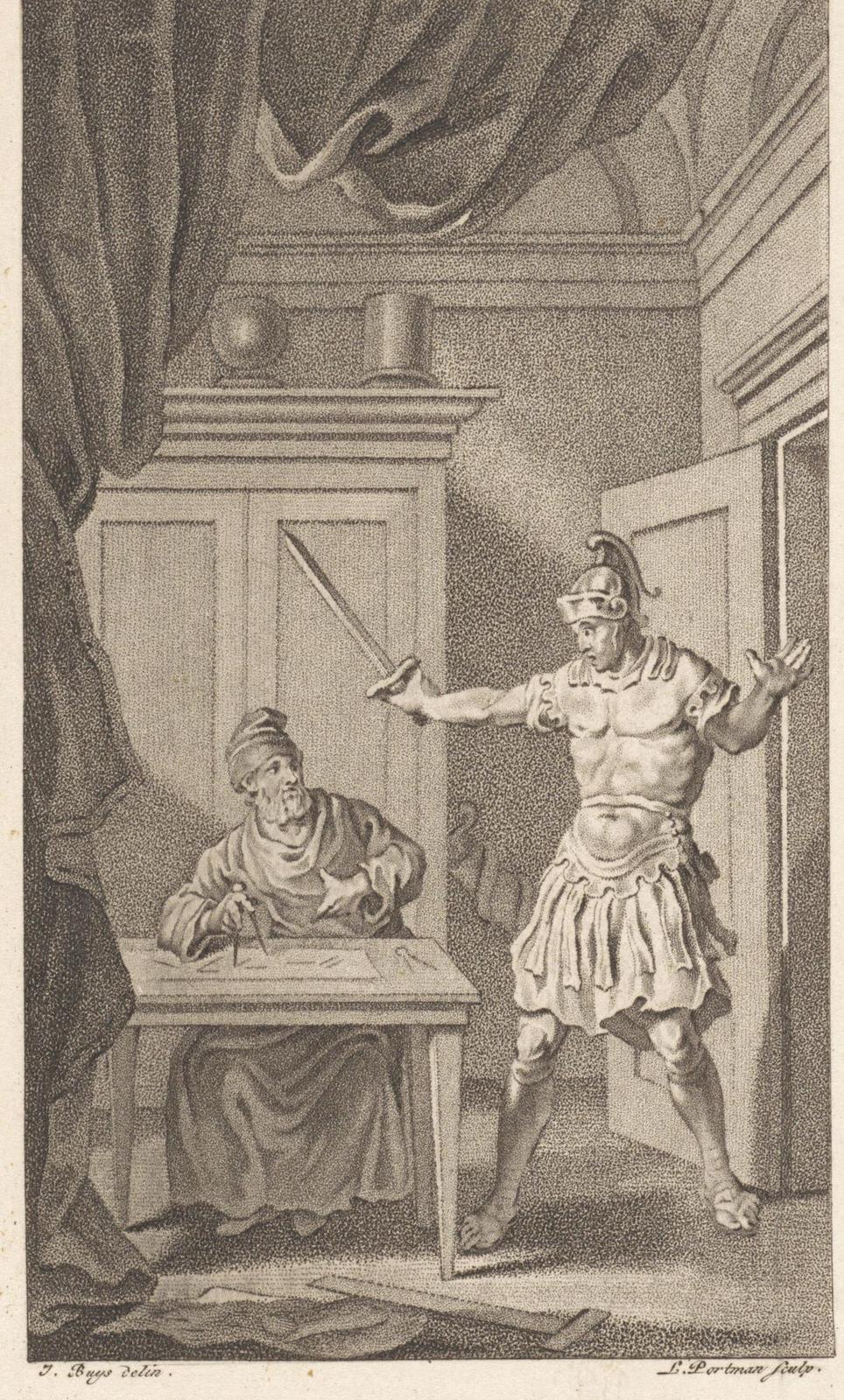
Jacobus Buys drew the death of Archimedes for a Dutch history of Rome in 1795, and Ludwig Gottlieb Portman engraved it. They followed Plutarch’s best-known version and left the dividers in the old man’s hand.Ludwig Gottlieb Portman after Jacobus Buys, The Death of Archimedes, 1795. Stipple etching and etching. Rijksmuseum, Amsterdam. Public domain. SourceDates in this chapter10
331 BCAlexander the Great founds Alexandria on the western edge of the Nile delta.
c. 300 BCEuclid writes the Elements, thirteen books of geometry and number built from a few axioms.
3rd century BCCtesibius, a barber’s son, builds a water clock with a regulated flow.
c. 245 BCPtolemy III summons Eratosthenes from Athens to run the Library.
c. 240 BCEratosthenes estimates the circumference of the Earth from the angle of a shadow.
212 BCA Roman soldier kills Archimedes during the sack of Syracuse.
145 BCPtolemy VIII purges Alexandria; scholars, among them the librarian Aristarchus, flee the city.
c. 70–60 BCSailors lose a ship carrying a geared bronze calculator off the island of Antikythera.
48 BCJulius Caesar’s men set fire to ships in Alexandria’s harbour and, by Seneca’s account, burn 40,000 scrolls.
30 BCCleopatra VII dies and Octavian makes Egypt a Roman province.
A city built for books
Alexander the Great laid out Alexandria in 331 BC on a strip of land between the sea and a lake, at the western edge of the Nile delta. By Plutarch’s account his men had no chalk to mark the plan on the black soil, so they marked the lines with flour.11 Plutarch, Life of Alexander, trans. John Dryden, rev. A. H. Clough, Project Gutenberg. https://www.gutenberg.org/ebooks/674 Alexander died in Babylon in 323 BC. One of his generals, Ptolemy, took Egypt for himself, and his family ruled it for almost three hundred years.
The Ptolemies were Greeks ruling a foreign country, and they wanted the best Greek minds around them. Ptolemy I and his son Ptolemy II founded the Museum, a shrine to the Muses where paid scholars did research, and beside it they built the Library. The geographer Strabo, who visited around 20 BC, described scholars who lived there with salaries, free meals and a common dining hall.
The kings collected books however they could. According to the physician Galen, officials searched every ship that docked in Alexandria, seized any books on board and had scribes copy them. The librarians kept the originals and gave the owners the copies. Ptolemy III asked the Athenians to lend him their official texts of Aeschylus, Sophocles and Euripides, and left fifteen talents of silver as a pledge. He had fine copies made and sent those back. He kept the originals and let the Athenians keep the silver.22 Library of Alexandria, Wikipedia (citing Galen). https://en.wikipedia.org/wiki/Library_of_Alexandria
Georg Braun and Frans Hogenberg printed this view of Alexandria in 1575, long after the Museum had gone. They showed the two harbours where, by Galen’s account, the Ptolemies’ officials searched every ship for books.Georg Braun and Frans Hogenberg, Map of Alexandria, 1575. Etching, hand coloured. The Metropolitan Museum of Art, Gift of Elaine and Lewis Dubroff, 2013. Public domain. Source
No one knows how many scrolls the librarians kept. Ancient writers give figures from 40,000 to 700,000, and modern scholars trust none of them. The poet Callimachus compiled the Pinakes, a catalogue in 120 books that listed authors by subject with their works.33 Library of Alexandria, Wikipedia. https://en.wikipedia.org/wiki/Library_of_Alexandria Zenodotus, the first head of the Library, had already compared copies of Homer line by line to fix a standard text. The librarians who followed him made the editions of Homer that schoolboys read for centuries.
Proofs and machines
Euclid opened Book I of his Elements with a list of definitions, five postulates and five common notions. From them he proved 48 propositions, one at a time, and ended the book with the theorem of Pythagoras and its converse.44 Euclid’s Elements, Wikipedia. https://en.wikipedia.org/wiki/Euclid%27s_Elements He taught in Alexandria around 300 BC, but historians know almost nothing else about his life. In thirteen books he covered geometry and the theory of numbers and proved each result from those before it. Euclid drew much of it from earlier mathematicians, including Eudoxus and Theaetetus at Plato’s Academy, and put it in an order in which a student could check every step.
over 1,000editions of Euclid’s Elements published since the first printed edition of 1482
Ctesibius, a barber’s son, probably became head of the Museum. Vitruvius tells how, as a young man, he hung a mirror in his father’s shop on a cord with a lead counterweight that slid down a narrow pipe. Ctesibius heard the air forced out of the pipe make a sound.55 Vitruvius, The Ten Books on Architecture, Book IX, trans. Morris Hicky Morgan, 1914, Project Gutenberg. https://www.gutenberg.org/ebooks/20239 He later built a force pump and an organ in which he used water to keep the air pressure steady. For his water clock he regulated the flow, so that its keepers could tell the hours with less error. In those decades the doctors Herophilus and Erasistratus cut open human bodies in Alexandria, one of the few places in the Greek world where the authorities allowed it. Herophilus told nerves from blood vessels and timed the pulse with a water clock. Later writers accused him of cutting open living prisoners as well, a charge that modern historians argue over.66 Herophilos, Wikipedia. https://en.wikipedia.org/wiki/Herophilos
Hero of Alexandria carried on Ctesibius’s line of work, probably in the first century AD. He described a temple machine from which a worshipper got a measure of holy water by dropping a coin in a slot, and the dioptra, a sighting instrument for surveyors. Nobody in his world put to work the ball he described, which a user could set spinning on its axis by boiling water and letting the steam escape through two bent pipes.
Eratosthenes measures the Earth
Ptolemy III summoned Eratosthenes of Cyrene from Athens around 245 BC to run the Library and tutor the heir to the throne. Eratosthenes wrote on geography and chronology as well as on poetry and number. Some critics nicknamed him Beta, the second letter, because he never came first in any one field. He devised the sieve of Eratosthenes, a way to pick out the prime numbers, and drew a map of the known world with lines of latitude.
Historians disagree about the length of the stade he used. By Pliny’s account, Eratosthenes counted 40 stades to the Egyptian schoenus. On that reading he used a stade of 157.5 metres and got 39,375 kilometres for the circumference. He fell 1.6 per cent short of the 40,008 kilometres round the poles. Paul Tannery, a French historian of science, put the stade at 185 metres. On his figure Eratosthenes overshot, at 46,250 kilometres, by about 16 per cent.77 Roberto Torretti, Eratosthenes, Biographical Encyclopedia of Astronomers, via MacTutor, University of St Andrews. https://mathshistory.st-andrews.ac.uk/BEA/eratosthenes_bea.pdf Either way, Eratosthenes found the size of the Earth with a pointer, a bowl, a theorem of Euclid’s and the distances that royal surveyors had paced out along the Nile.
Measure the Earth with a shadow
The angle of the shadow at Alexandria equals the angle between the two cities at the Earth's centre, so the circumference is the distance times 360 over the angle.Cleomedes, Caelestia 1.7 (7.2°, 5,000 stades, 250,000 stades); stade readings of 157.5 m and 185 m and their results from the Biographical Encyclopedia of Astronomers, St Andrews; polar circumference 40,007.863 km. https://mathshistory.st-andrews.ac.uk/BEA/eratosthenes_bea.pdf
Archimedes at Syracuse
Archimedes sent his proofs to the scholars of Alexandria as letters from Syracuse, the Greek city in Sicily where he lived. He addressed his Method to Eratosthenes. In it he showed how he found his results before he proved them. Readers know the Method from a single copy, which a scribe in Jerusalem scraped and washed in 1229 to write a prayer book over it. The Danish scholar Johan Heiberg made out the Greek beneath in Constantinople in 1906.88 Archimedes Palimpsest, Wikipedia. https://en.wikipedia.org/wiki/Archimedes_Palimpsest
Archimedes found the area of a circle. To bound it he drew regular polygons of 96 sides inside and outside the circle and calculated their perimeters. From them he showed that pi lies between 3 10/71 and 3 1/7.99 Measurement of a Circle, Wikipedia. https://en.wikipedia.org/wiki/Measurement_of_a_Circle He proved that a sphere has two thirds of the volume of the cylinder that encloses it, and asked for that figure to be carved on his tomb.
In the Sand Reckoner he wrote to Gelon, son of King Hiero, to show that he could express a number larger than the grains of sand needed to fill the universe. The Greeks had no counting words beyond a myriad myriads, a hundred million. Archimedes built a system of orders and periods on top of that. He then reckoned that a person could fill the universe of the astronomer Aristarchus with fewer than ten million units of the eighth order of grains, or ten to the sixty-third power.1010 Archimedes, The Sand-Reckoner, in The Works of Archimedes, trans. T. L. Heath, 1897. https://archive.org/details/worksofarchimede00arch
Aristarchus of Samos had argued, Archimedes reported, that the sun and the fixed stars stand still and that the Earth goes round the sun in a circle. Few astronomers accepted it. Archimedes himself raised objections to how Aristarchus put it. Copyists did not preserve Aristarchus’s book, and readers know of it mainly because Archimedes needed its size of the universe for a sum about sand.
There are some, king Gelon, who think that the number of the sand is infinite in multitude; and I mean by the sand not only that which exists about Syracuse and the rest of Sicily but also that which is found in every region whether inhabited or uninhabited. Again there are some who, without regarding it as infinite, yet think that no number has been named which is great enough to exceed its multitude.
Archimedes proved the law of the lever, and King Hiero put him to work. Plutarch, writing three centuries later, tells how Archimedes rigged a set of pulleys and, sitting at a distance, pulled a loaded ship out of the king’s dock by himself. When Marcellus attacked Syracuse with a Roman army and fleet in 213 BC, the defenders used Archimedes’s machines to throw stones and timbers on the attackers and lift their ships out of the water.
In the meantime huge poles thrust out from the walls over the ships, sunk some by the great weights which they let down from on high upon them; others they lifted up into the air by an iron hand or beak like a crane’s beak, and, when they had drawn them up by the prow, and set them on end upon the poop, they plunged them to the bottom of the sea; or else the ships, drawn by engines within, and whirled about, were dashed against steep rocks that stood jutting out under the walls, with great destruction of the soldiers that were aboard them.
Marcellus gave up the assault and settled down to starve the city. In 212 BC his troops broke in. Plutarch gives several versions of what happened next. In the best known, a soldier found Archimedes working on a diagram and ordered him to come to Marcellus. Archimedes refused to go before he finished his proof, and the soldier killed him.1111 Plutarch, Life of Marcellus, trans. John Dryden, rev. A. H. Clough, Project Gutenberg. https://www.gutenberg.org/ebooks/674 Marcellus, by Plutarch’s account, grieved and honoured the dead man’s family. Cicero wrote that Marcellus carried home to Rome two bronze spheres that Archimedes had built to show the motions of the sun, moon and planets. When Cicero served as a junior magistrate in Sicily in 75 BC, he found a neglected tomb near one of the city gates and knew it for Archimedes’s by the sphere and cylinder carved on it.
The mechanism and the stall
Hipparchus of Nicaea, working mostly on Rhodes in the second century BC, drew up tables of chords that later mathematicians built into trigonometry. He compared his star positions with those that Timocharis had recorded at Alexandria about a century and a half earlier. He found the bright star Spica two degrees from where Timocharis had placed it, measured from the point of the autumn equinox. From that he discovered the slow drift that astronomers call the precession of the equinoxes.1212 Hipparchus, Wikipedia. https://en.wikipedia.org/wiki/Hipparchus
Sponge divers working a Roman-era wreck off the island of Antikythera in 1900 and 1901 brought up bronze statues, glass and coins from a ship lost in the second quarter of the first century BC. They also hauled up a lump of corroded bronze about the size of a shoebox. In 1902 the politician Spyridon Stais, visiting the National Archaeological Museum in Athens, noticed a gearwheel in it.
Researchers have since used X-rays and, from 2005, computer scans to look inside the 82 fragments. The mechanism’s maker, working in the second or early first century BC, fitted at least 30 bronze gears into a wooden case.1313 Antikythera mechanism, Wikipedia. https://en.wikipedia.org/wiki/Antikythera_mechanism A user turned a handle to move pointers, and read from them the place of the sun and moon in the zodiac, the phase of the moon and the dates of coming eclipses. The maker followed a theory of Hipparchus’s and set a pin in one gear and a slot in the next, so that the moon’s pointer sped up and slowed down as the moon does in the sky. The maker cut teeth about a millimetre and a half apart and wrote an instruction manual in tiny letters on the case. Craftsmen in Europe built nothing so complex again until the astronomical clocks of the fourteenth century.
at least 30bronze gears still visible in the Antikythera mechanism
Albrecht Dürer made this chart of the northern sky in 1515, one of the first star charts printed in Europe. He drew Ptolemy of Alexandria in the upper right corner and, in the lower right, the Persian astronomer al-Sufi, who revised Ptolemy’s star catalogue in Arabic in the tenth century.Albrecht Dürer, The Celestial Map, Northern Hemisphere, 1515. Woodcut. The Metropolitan Museum of Art, Harris Brisbane Dick Fund, 1951. Public domain. Source
Historians offer several reasons why the Alexandrian scholars did not turn their ideas into an industry. Slaves did most of the heavy work, so masters had little reason to buy machines that saved labour. Kings paid for knowledge as a mark of prestige, but a king could withdraw his favour overnight. Scholars of the time often ranked pure proof above practical use. Plutarch, who wrote long afterwards, said that Archimedes himself looked down on his machines.
Ptolemy VIII withdrew that favour when he took Alexandria in 145 BC and purged those who had backed his rivals. The librarian Aristarchus of Samothrace fled to Cyprus and other scholars scattered. Those who stayed never regained their old standing. Julius Caesar’s men, besieged in the city in 48 BC, set fire to ships in the harbour. Seneca, quoting Livy, put the loss at 40,000 scrolls.1414 Library of Alexandria, Wikipedia (citing Seneca). https://en.wikipedia.org/wiki/Library_of_Alexandria Scholars kept working afterwards in the Library or its daughter collection in the temple of Serapis. When Cleopatra died in 30 BC, Octavian made Egypt a Roman province.
“at this day, in the blessed peace which we enjoy, under a prince who so greatly encourages the advancement of the arts, no new inquiries are set on foot, nor do we even make ourselves thoroughly masters of the discoveries of the ancients.”
Claudius Ptolemy made his observations in Alexandria between AD 127 and 141 and catalogued more than a thousand stars in the Almagest. Astronomers worked from it until about a century after Copernicus published his system in 1543.
Byzantine copyists and Arab translators saved many of the books that survived. Claudius Ptolemy wrote his great work of astronomy in Alexandria in the second century AD, and translators in Toledo later turned it from Arabic into Latin. Erhard Ratdolt printed Euclid’s Elements in Venice in 1482. Johann Herwagen printed the works of Archimedes in Greek and Latin at Basel in 1544, and Galileo studied them closely.
Greek astronomers and mathematicians measured with more precision as the period went on. Callippus of Cyzicus, working around 330 BC, took the year as 365¼ days, eleven minutes too long. Hipparchus, in the second century BC, took a three-hundredth of a day off that figure and got a year about six minutes too long.1515 Hipparchus, Wikipedia (Callippus’s year of 365¼ days, in or before 330 BC; Hipparchus’s 365¼ − 1/300 days, an error of about 6 minutes a year). https://en.wikipedia.org/wiki/Hipparchus Archimedes, working in the century between them, pinned pi between two fractions about two thousandths apart. Euclid gathered 465 propositions into his thirteen books, and mathematicians used them for the next two thousand years without proving them again. Isaac Newton followed Euclid’s plan in his Principia of 1687: definitions first, then axioms, then propositions proved from them.1616 Philosophiæ Naturalis Principia Mathematica, Wikipedia. https://en.wikipedia.org/wiki/Philosophi%C3%A6_Naturalis_Principia_Mathematica
Hipparchus, Wikipedia (Callippus’s year of 365¼ days, in or before 330 BC; Hipparchus’s 365¼ − 1/300 days, an error of about 6 minutes a year). https://en.wikipedia.org/wiki/Hipparchus↑
Roman engineers built roads, aqueducts and concrete domes that people used for centuries; Roman jurists wrote laws that European judges applied long after the last emperor in Italy fell.
509 BC–AD 476 · Rome and its provinces
The world in
509 BC
Life expectancy
No estimate
Cost of light
About 42 hours oil lamp, Babylonian estimate
Literacy
No estimate
Atlantic crossing
No regular crossing
Population
159 million estimate
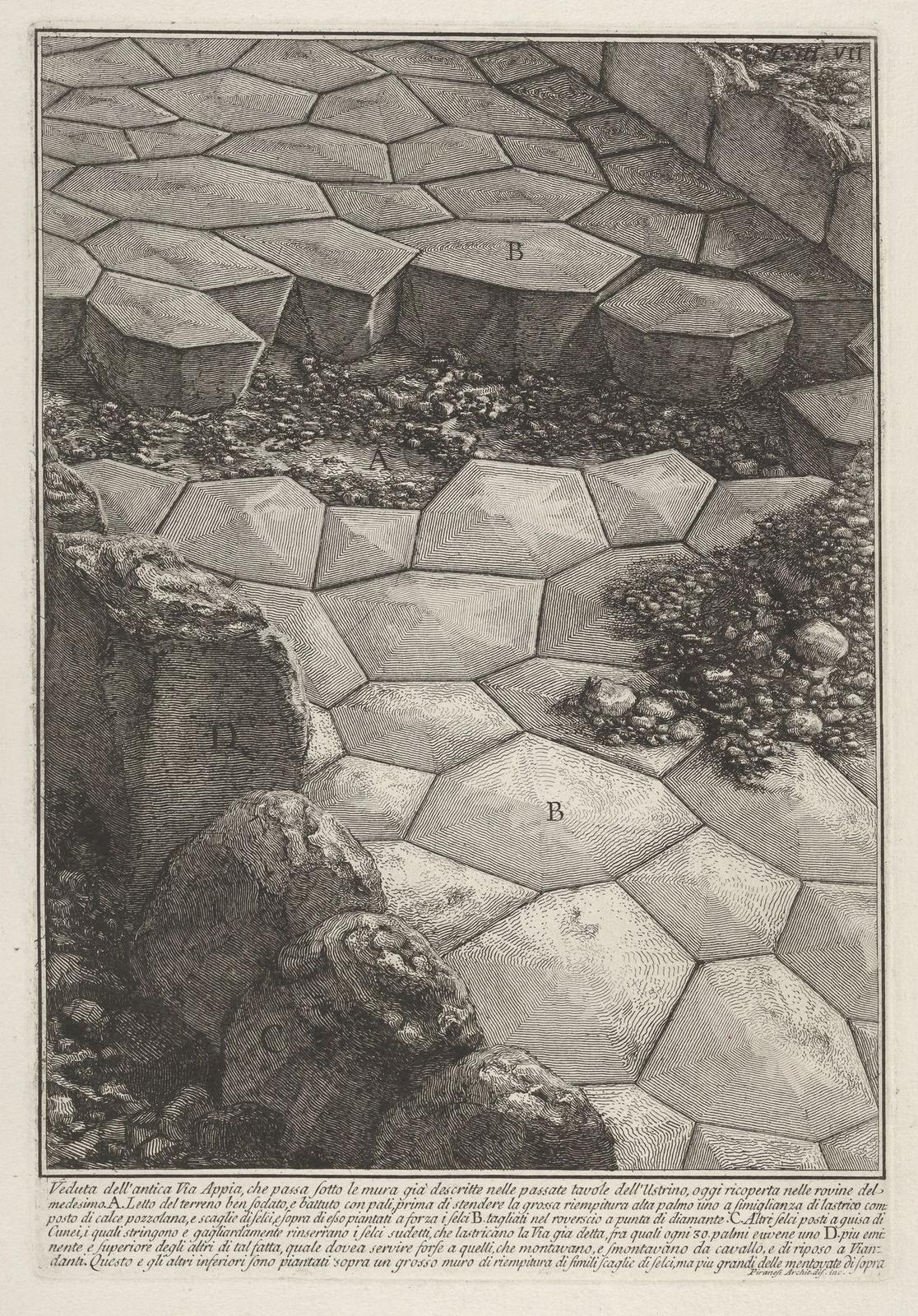
Giovanni Battista Piranesi drew this cutaway of the Appian Way in 1756 and lettered each layer, from the packed bed to the fitted paving blocks on top.Giovanni Battista Piranesi, View of the stone pavement of the Appian Way, from Le Antichità Romane, 1756. Etching. The Metropolitan Museum of Art, Bequest of Phyllis Massar, 2011. Public domain. SourceDates in this chapter10
509 BCBy Roman tradition, the nobles expel the last king, Tarquin the Proud, and elect two consuls each year.
c. 450–449 BCA board of ten men writes the Twelve Tables, Rome’s first written laws, and officials post them in the Forum.
312 BCThe censor Appius Claudius begins the Appian Way and the Aqua Appia, Rome’s first aqueduct.
27 BCOctavian takes the name Augustus and rules as the first emperor.
c. 25 BCVitruvius dedicates his Ten Books on Architecture to Augustus.
AD 97Nerva makes Frontinus water commissioner of Rome.
c. AD 126Hadrian dedicates the rebuilt Pantheon under its concrete dome.
AD 212Caracalla grants Roman citizenship to all free men of the empire.
AD 476Odoacer deposes Romulus Augustulus, the last emperor of the western provinces.
AD 529–534Justinian’s lawyers in Constantinople compile the Code and the Digest of Roman law.
The road south
Appius Claudius, censor of Rome in 312 BC, began two projects that later Romans kept in use for centuries. He laid out a military road south from the city towards Capua and brought water into Rome through a channel about 16 kilometres long, almost all of it underground. The Greek historian Diodorus wrote that Appius spent all the state’s revenue on the two works without a decree of the Senate.11 Diodorus Siculus, Library of History 20.36, Loeb trans., LacusCurtius. https://penelope.uchicago.edu/Thayer/E/Roman/Texts/Diodorus_Siculus/20B*.html Later Romans named both after him, the Appian Way and the Aqua Appia.
Rome was then a republic of farmers and soldiers. By Roman tradition, the nobles had driven out their last king in 509 BC and handed his powers to two consuls, elected for a year at a time so that neither could make himself king. In 312 BC the Romans were at war with the Samnites for control of central Italy, and their legions could march down the new road to the front in all weathers. Engineers later pushed it on to Brundisium on the heel of Italy, the port for Greece. Builders dug a trench, packed it with layers of stones and gravel, and topped it with large, close-fitted blocks of hard volcanic stone. Road crews set up milestones, stone columns about five feet tall, to count the miles from the city.
The Romans kept building. At the empire’s height they had laid more than 400,000 kilometres of roads and paved more than 80,000 of them with stone.22 Roman roads, Wikipedia. https://en.wikipedia.org/wiki/Roman_roads Merchants and tax collectors, couriers and armies travelled them from Scotland to Syria.
400,000 kmof roads across the Roman empire at its height, more than 80,000 km of them paved
Water for a million
The praetor Quintus Marcius Rex built the Aqua Marcia in the 140s BC to bring cold, clear water into Rome from springs in the hills to the east. The Senate paid for it largely with the spoils of Corinth and Carthage, both sacked in 146 BC. At 91 kilometres, it was the longest of Rome’s aqueducts.33 Aqua Marcia, Wikipedia. https://en.wikipedia.org/wiki/Aqua_Marcia Magistrates and emperors built new ones over the next four centuries, eleven in all by the third century AD, for a city of perhaps a million people. Romans drew most of the water at public fountains and used it in the baths. Only rich householders paid for a private pipe. Agrippa built the Aqua Virgo in 19 BC to feed his public baths. Romans still draw its water at the Trevi Fountain.
Roman engineers moved water by gravity alone. They had to keep a channel falling steadily for dozens of kilometres, neither too steep nor too flat. Vitruvius, who had built artillery for the army before he wrote ten books on architecture for Augustus, described the instrument they used to take levels.
The builders carried that channel over the river Gardon on the Pont du Gard, three tiers of limestone arches 48.8 metres above the water. The masons cut the blocks, some weighing six tonnes, to fit so closely that they needed no mortar. The engineers sent an estimated 40,000 cubic metres of water a day across it to Nîmes, a town of about 50,000 people.44 Pont du Gard, Wikipedia. https://en.wikipedia.org/wiki/Pont_du_Gard
Édouard Baldus photographed the Pont du Gard around 1861. The Roman builders ran the water along the top tier, inside a covered stone conduit.Édouard Baldus, Pont du Gard, ca. 1861. Albumen silver print from glass negative. The Metropolitan Museum of Art, Gilman Collection, Gift of The Howard Gilman Foundation, 2005. Public domain. Source
The emperor Nerva made Sextus Julius Frontinus water commissioner of Rome in AD 97. Frontinus had been consul and governor of Britain, where he fought the Silures of South Wales. He wrote a report on the system for himself and his successors and listed each aqueduct’s source, length and flow. He had the channels mapped, and by measuring the intake against the outflow he found the frauds. Some of the water men, he wrote, had laid secret pipes under the pavements and sold the water to shops along the route, so that people at the public fountains got only a little.55 Frontinus, The Aqueducts of Rome, Book II, trans. Charles E. Bennett, 1925, LacusCurtius. https://penelope.uchicago.edu/Thayer/E/Roman/Texts/Frontinus/De_Aquis/Bennett/2*.html
The conduit of New Anio measures 58,700 paces, of which 49,300 are in an underground channel, 9,400 paces above ground on masonry; of these, at various points in the upper reaches are 2,300 paces on substructures or arches; while nearer the City, beginning at the seventh milestone, are 609 paces on substructures, 6,491 paces on arches. These are the highest arches, rising at certain points to 109 feet. With such an array of indispensable structures carrying so many waters, compare, if you will, the idle Pyramids or the useless, though famous, works of the Greeks!
Set the fall of an aqueduct
The speeds come from a simple model with a steady flow of 35,000 cubic metres a day.Nîmes channel: 49.7 km, 12.6 m fall, about 25 cm per km, 1.2 × 1.8 m conduit (fr.wikipedia.org/wiki/Pont_du_Gard); Pont du Gard 2.5 cm in 456 m; 0.67 m per km above the bridge (en.wikipedia.org/wiki/Pont_du_Gard); flow 35,000 m³ a day and friction factor 0.02–0.04 for mortar-lined channels (H. Chanson, La Houille Blanche 2002 and AJA 104, 2000); lime crust over 1 mm a year (Hauck and Novak, J. Hydraulic Eng. 1987); Vitruvius VIII.6.1. https://staff.civil.uq.edu.au/h.chanson/rom_aq.html
Concrete and the dome
King Herod’s builders at Caesarea, on the coast of Judaea, shipped more than 24,000 cubic metres of volcanic ash from Pozzuoli in Italy and sank wooden forms into the sea to cast the breakwaters of a new harbour.66 Caesarea Maritima, Wikipedia. https://en.wikipedia.org/wiki/Caesarea_Maritima Vitruvius described this powder from near Baiae and the towns round Mount Vesuvius. Builders mixed it with lime and rubble to cast piers that hardened even under the sea. Engineers now call it pozzolana, after the town of Pozzuoli. The Romans used it to build harbour walls in the open sea, vaults over their baths and domes over their halls. They cast the wet mix in wooden frames and faced it with brick or stone.
Scientists at MIT reported in 2023 that Roman builders probably mixed in quicklime hot and so left small white lumps of lime through the concrete. When the researchers let water into a crack, some of this lime dissolved and set again as calcium carbonate. They cracked samples made this way and ran water through them, and the cracks closed in two weeks.77 Riddle solved: Why was Roman concrete so durable?, MIT News, 2023. https://news.mit.edu/2023/roman-concrete-durability-lime-casts-0106
There is also a kind of powder which from natural causes produces astonishing results. It is found in the neighbourhood of Baiae and in the country belonging to the towns round about Mt. Vesuvius. This substance, when mixed with lime and rubble, not only lends strength to buildings of other kinds, but even when piers of it are constructed in the sea, they set hard under water.
Hadrian’s builders put up the largest Roman dome of all. Agrippa, Augustus’s general, had built a temple to all the gods in the Campus Martius. After it burned, Hadrian rebuilt it and dedicated the new Pantheon around AD 126, but he had Agrippa’s old dedication carved on the porch instead of his own. His builders gave the dome a span of 43.3 metres, the same as its height from the floor to the opening at the top.88 Pantheon, Rome, Wikipedia. https://en.wikipedia.org/wiki/Pantheon,_Rome They poured heavy aggregate of travertine near the base, then broken tile, then light volcanic tufa and pumice near the top. They thinned the shell from 6.4 metres at the base to 1.2 metres at the rim of the oculus. That open circle, nine metres (30 Roman feet) across, is the building’s only source of daylight. Nobody in the nineteen centuries since has built a larger dome of unreinforced concrete.
Giovanni Paolo Panini painted the inside of the Pantheon around 1734, with the sky showing through the oculus. Roman builders cast the dome with five rings of 28 sunken panels to make it lighter.Giovanni Paolo Panini, Interior of the Pantheon, Rome, c. 1734. Oil on canvas. National Gallery of Art, Washington, Samuel H. Kress Collection. Public domain (NGA Open Access, CC0). Source
43.3 mspan of the Pantheon’s dome, still the world’s largest of unreinforced concrete, c. AD 126
Books and law
Pliny the Elder, who commanded the imperial fleet at Misenum, worked at night on a Natural History in 37 books. In it he gathered what Greek and Roman writers had said about the stars, the earth, plants, animals, drugs, metals and art. His nephew wrote that he began work at midnight or one in the morning, had books read to him at meals and in the bath, and took notes on all of them. He left 160 volumes of extracts, written on both sides in a tiny hand.99 Pliny the Younger, Letters III.5, trans. William Melmoth, rev. F. C. T. Bosanquet, Project Gutenberg. https://www.gutenberg.org/ebooks/2811 He published the first ten books in AD 77. Two years later he sailed across the bay towards the erupting Vesuvius to rescue people and died on the shore at Stabiae.
Galen of Pergamon, a Greek doctor born in AD 129, served as physician to the gladiators of his home city before moving to Rome. Five gladiators died in his years with them, against sixty under the doctor before him.1010 Galen, Wikipedia. https://en.wikipedia.org/wiki/Galen In Rome he cut open apes and pigs. He silenced a living pig’s squeal by cutting a nerve in its neck, and showed that the voice depends on the larynx and on nerves from the brain. He wrote so much that doctors in Europe and the Muslim world took his books as their standard for more than 1,300 years.
Romans took more pride in their law than in almost anything else they made. Around 450 BC the plebeians, the common citizens, forced the patricians to put the laws in writing, and a board of ten men drew up the Twelve Tables. Officials posted them in the Forum. Cicero recalled learning them by heart as a schoolboy. For the next seven centuries praetors, the officials who ran the courts, issued yearly edicts on how they would hear cases, and trained jurists wrote opinions on hard ones. Jurists such as Papinian and Ulpian developed rules on contracts, property, inheritance and wrongs that judges could apply to strangers as well as citizens. Gaius wrote a short textbook, the Institutes, in which he set all of private law in order under persons, things and actions. Ulpian, a jurist from Tyre, drew up a schedule by age that officials used to value a yearly allowance or any other legacy paid out for life when they taxed an inheritance. Historians of insurance read it as the earliest surviving life table.
The emperor Caracalla made every free man in the empire a Roman citizen in AD 212. A merchant in Alexandria and a farmer in Gaul now stood under the same law. The senator Cassius Dio, who lived through it, wrote that Caracalla did it for the money. Non-citizens paid few of the taxes on inheritances and on freeing slaves, and Caracalla had doubled both, from a twentieth to a tenth.1111 Cassius Dio, Roman History 78.9, trans. Earnest Cary, LacusCurtius. https://penelope.uchicago.edu/Thayer/E/Roman/Texts/Cassius_Dio/78*.html Merchants had traded across the Mediterranean with one coinage and one body of law through the Pax Romana, the long peace that historians date from Augustus in 27 BC to the death of Marcus Aurelius in AD 180.
“let him follow in his thoughts their morals, at first as slightly giving way, anon how they sunk more and more, then began to fall headlong, until he reaches the present times, when we can neither endure our vices, nor their remedies.”
Augustus counted 4,063,000 Roman citizens at his census of 28 BC and 4,937,000 at his last, in AD 14. Augustus recorded that the Romans shut the temple of Janus only when they had won peace on land and sea. They had shut it just twice between the founding of the city and his birth, and the Senate ordered it shut three times during his rule.
The Romans built all this on conquest and on slaves. Julius Caesar wrote that he sold 53,000 people of one Gallic town to slave dealers on the spot. Historians estimate that by the end of the first century BC masters kept one to two million slaves in Italy, between a fifth and a third of its people. Many of them worked the great estates and the mines.1212 Slavery in ancient Rome, Wikipedia (citing Caesar, Gallic War II.33). https://en.wikipedia.org/wiki/Slavery_in_ancient_Rome Owners freed slaves often, and a slave freed by a citizen became a citizen. Masters kept the rest at work by force.
What fell, and what lasted
The general Odoacer deposed the last western emperor, a boy called Romulus Augustulus, in 476 and sent the imperial regalia to Constantinople. He spared the boy and sent him to live in a fortified villa on the Bay of Naples on a pension of 6,000 gold solidi a year, a rich senator’s income.1313 Romulus Augustulus, Wikipedia. https://en.wikipedia.org/wiki/Romulus_Augustulus
Romans had fought civil wars among themselves while foreign armies pressed on the frontiers. Through the fifth century the emperors who ruled from Italy lost their provinces one by one. Germanic peoples crossed the Rhine in 406, and Goths sacked Rome in 410. Emperors in Constantinople ruled the eastern half for another thousand years.
Italians lost the empire’s works in stages. When the Goths besieged Rome in 537, they cut the aqueducts. The millers on the Janiculum hill, who ground grain with aqueduct water, had to stop. Belisarius, defending the city, had his men set up mills on the Tiber in their place. By the end of the sixth century around 30,000 people lived where a million had lived before. They crowded near the Tiber, where they could draw water. Builders in Italy and the western provinces stopped making concrete. No builder in Europe raised a wider dome until 1436, when Filippo Brunelleschi, who had studied the Pantheon, closed the brick dome of Florence cathedral at 45.5 metres across inside.
Churchmen and lawyers saved much of the rest. The emperor Phocas gave the Pantheon to Pope Boniface IV in 609. The pope consecrated it as a church, and later clergy kept it roofed and in use. Monks copied Vitruvius in dozens of manuscripts. The Florentine scholar Poggio Bracciolini found a fine copy in the abbey library of St Gall around 1416, and a manuscript of Frontinus at Monte Cassino in 1429. Justinian’s lawyers in Constantinople, led by Tribonian, gathered extracts from 39 jurists into the fifty books of the Digest and finished it in 533. Scholars at Bologna began teaching from it in the eleventh century, and lawyers across most of continental Europe based their civil law on those lectures.
The board of ten had written Rome’s laws on twelve tablets around 450 BC. By Justinian’s time the jurists had written about two thousand books of law, more than 3,000,000 lines. Tribonian’s commissioners read them and kept 150,000 lines, one in twenty, in the fifty books of the Digest.1414 Pandectae, in William Smith, A Dictionary of Greek and Roman Antiquities, 1875, LacusCurtius. https://penelope.uchicago.edu/Thayer/E/Roman/Texts/secondary/SMIGRA*/Pandectae.html When Florentine troops took Pisa in 1406, they carried off a copy that scribes had made soon after 533, now in the Laurentian Library in Florence.1515 Pandectarum codex Florentinus, History of Information (written between 533 and 557; taken from Pisa to Florence after the war of 1406; Biblioteca Medicea Laurenziana). https://historyofinformation.com/detail.php?id=165 Justinian’s lawyers also issued a short textbook, the Institutes, which they took largely from Gaius and arranged in his order. Napoleon’s lawyers drew the categories of the French Civil Code of 1804 from it.1616 Napoleonic Code, Wikipedia. https://en.wikipedia.org/wiki/Napoleonic_Code
Pandectarum codex Florentinus, History of Information (written between 533 and 557; taken from Pisa to Florence after the war of 1406; Biblioteca Medicea Laurenziana). https://historyofinformation.com/detail.php?id=165↑
After the last emperor in Italy lost his throne, monks, farmers, masons and scholars rebuilt Europe’s stock of books and tools, then added machines the ancients never had.
476–1350 · Monte Cassino, Toledo, Paris, Bologna, Oxford, Pisa
The world in
476
Life expectancy
No estimate
Cost of light
About 42 hours oil lamp, Babylonian estimate
Literacy
No estimate
Atlantic crossing
No regular crossing
Population
256 million estimate
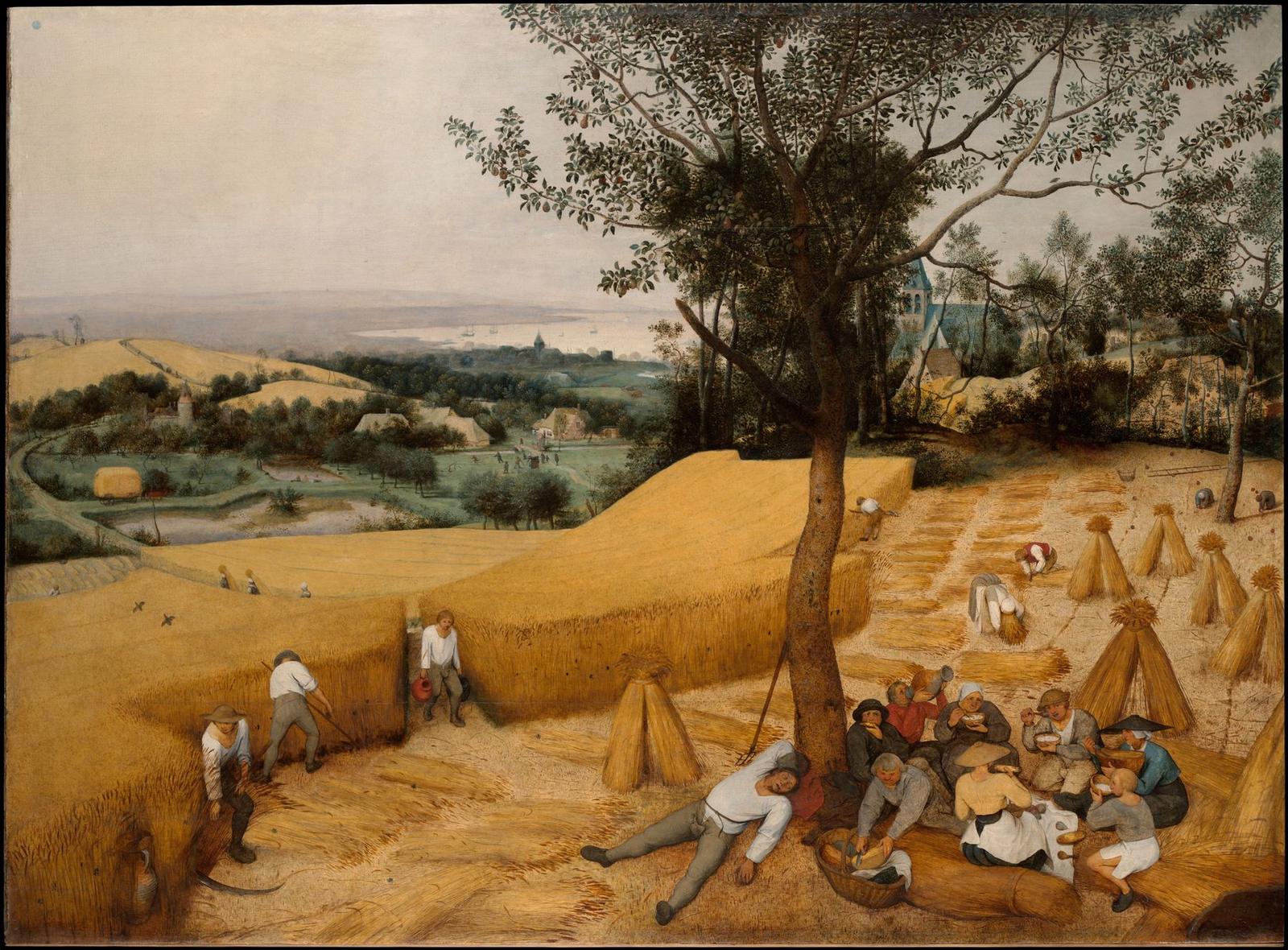
Bruegel painted these harvesters in 1565, but peasants had worked this way for centuries. They reap one great open field by hand, with sickles and scythes, and stack the sheaves to dry.Pieter Bruegel the Elder, The Harvesters, 1565. Oil on wood. The Metropolitan Museum of Art, Rogers Fund, 1919. Public domain. SourceDates in this chapter10
c. 530Benedict of Nursia writes his Rule for the monks of Monte Cassino.
782Charlemagne brings Alcuin of York to run his palace school at Aachen.
1085Alfonso VI of Castile takes Toledo and its libraries of Arabic books.
1086William I’s commissioners finish the Domesday survey of England.
1088By tradition, students and teachers found the university at Bologna.
1144Abbot Suger dedicates the rebuilt choir of Saint-Denis, with pointed arches, ribbed vaults and wide windows.
c. 1175Gerard of Cremona finishes his Latin translation of Ptolemy’s Almagest in Toledo.
1283The canons of Dunstable Priory install a large clock above their rood screen.
1306Giordano da Pisa tells a Florentine congregation that eyeglasses are less than twenty years old.
1336Clockmakers in Milan build a clock that strikes every hour.
The Rule
Benedict of Nursia wrote a short rulebook around 530 for the monks of Monte Cassino, a hilltop between Rome and Naples. A Germanic general had deposed the last western emperor two generations earlier. Roman aristocrats had seldom worked with their hands. Benedict asked his monks to do it every day, and to read every day too.
He fixed the hours in the Rule. From Easter to October the brothers worked from the first hour to the fourth, read until the sixth, ate, rested, and worked again until Vespers. Benedict wanted water, a mill, a garden and a bakery inside every monastery, so that no monk had cause to wander outside the walls.
Idleness is the enemy of the soul. And therefore, at fixed times, the brothers ought to be occupied in manual labour; and again, at fixed times, in sacred reading. … But, if the exigency or poverty of the place demands that they be occupied by themselves in picking fruits, they shall not be dismayed: for then they are truly monks if they live by the labours of their hands; as did also our fathers and the apostles. Let all things be done with moderation, however, on account of the faint-hearted.
Monks who kept the Rule founded houses across Europe. Every house needed books for the hours of reading. Copyists in the scriptorium made them by hand, a page at a time.
Abbot Ceolfrith of Monkwearmouth and Jarrow, in Northumbria, ordered three complete Bibles in 692. The one that survives, the Codex Amiatinus, has more than a thousand parchment leaves and weighs over 34 kilograms. The book historian Christopher de Hamel reckons the parchment took the skins of 515 cattle.11 Codex Amiatinus, Wikipedia. https://en.wikipedia.org/wiki/Codex_Amiatinus Ceolfrith set out to carry it to the pope in 716 and died on the road, at Langres in Burgundy.
Charlemagne brought Alcuin of York to run his palace school at Aachen in 782. The scribes of his reign settled on the clear, rounded hand with spaces between words that scholars now call Carolingian minuscule.
Librarians today keep more than 7,000 manuscripts in that script from the eighth and ninth centuries alone.22 Carolingian minuscule, Wikipedia. https://en.wikipedia.org/wiki/Carolingian_minuscule Modern readers owe most of the classical Latin they have to copies those scribes made of older books, many of them pagan poems and histories that the copyists had no religious reason to keep.
Water, iron and oxen
William the Conqueror sent commissioners into almost every English county in 1086 to find out who had what. They wrote down ploughs, meadows, woods, pigs and mills. The writer of the Anglo-Saxon Chronicle for that year complained that there was “not even an ox, nor a cow, nor a swine” left out of the king’s survey, and that it was “shameful to tell, though he thought it no shame to do it”.33 The Anglo-Saxon Chronicle, entry for 1085, trans. James Ingram, 1823. Project Gutenberg. https://www.gutenberg.org/ebooks/657 Historians long cited a count of 5,624 mills from the returns. Later scholars, working county by county, found more than 6,000, or about one mill for every 40 households.44 From quern to computer: the history of flour milling, The Mills Archive, 2016. https://millsarchive.org/2016/09/06/from-quern-to-computer-the-history-of-flour-milling/6/
5,624mills in the classic count of England’s Domesday Book, 1086 (later counts top 6,000)
Before the mill, families ground grain at home a few handfuls at a time, between the two stones of a hand quern. A miller used the river to turn his stones and ground grain for the village. Lords charged a share of the flour for the service, and many forbade their tenants to grind at home. Over the next two centuries millwrights used waterwheels to drive hammers for fulling cloth and, by the thirteenth century, saws. Millers on flat land with slow streams began building windmills about a century after Domesday.
On the heavy, wet clay of northern Europe, farmers with a light Roman scratch plough could barely break the ground. They turned to a heavy plough with three working parts: a coulter, an iron knife for cutting down into the turf; a share, for slicing it flat underneath; and a mouldboard, a curved board for turning the slice over. A ploughman needed four to eight oxen to draw it, more than most families owned, so neighbours pooled their teams.
Ploughmen found a big team hard to turn at the end of a field, so they cut long, narrow strips. English farmers named the furlong, a furrow long, after the length of one of those strips. Many of the people who ploughed them were serfs, bound to the land and owing their lord days of labour each week.
Chinese harness makers had made a padded horse collar by the end of the fifth century, and European farmers used it widely by the twelfth. Harness makers set the collar on the horse’s shoulders, clear of its windpipe, so a farmer could hitch a horse to a plough without choking it. A farmer who fed his horses on oats from the spring field could plough about half again as fast as one with oxen.
Families raised more children on the extra grain. By one standard estimate, Europeans numbered 56 million around the year 1000 and 79 million by 1300.55 Medieval demography, Wikipedia (Urlanis estimate). https://en.wikipedia.org/wiki/Medieval_demography
Two fields against three
With two fields villagers kept half their land in crops each year; with three they kept two-thirds, and on the new spring field they grew oats for horses and peas and beans for people and soil.Britannica, "Three-field system" (half sown under two fields, a third fallow under three; autumn wheat or rye, spring oats and legumes). https://www.britannica.com/topic/three-field-system
Stone and light
Abbot Suger of Saint-Denis, just north of Paris, rebuilt the east end of his abbey church and dedicated it on 11 June 1144. His masons brought together pointed arches, ribbed vaults and buttresses outside the walls. Because they carried the weight down ribs and piers, they could open the walls into tall windows. Suger wrote that he wanted the church to shine with “the wonderful and uninterrupted light of most luminous windows.”66 Basilica of Saint-Denis, Wikipedia. https://en.wikipedia.org/wiki/Basilica_of_Saint-Denis
Bishops and town councils at Chartres, Reims, Amiens and Beauvais then competed to build higher. The builders at Beauvais began in 1225 and raised the choir vault to 48 metres. They watched part of it fall in 1284 and rebuilt it with extra piers.77 Beauvais Cathedral, Wikipedia. https://en.wikipedia.org/wiki/Beauvais_Cathedral
Masons learned the trade on site, from master to apprentice, and took it from city to city. Villard de Honnecourt, a draughtsman from northern France, kept a sketchbook between about 1225 and 1235. On its 33 sheets of parchment he made some 250 drawings: a tower at Laon, a chapel at Reims, a trebuchet, lifting gear, a saw driven by water and a perpetual-motion wheel, which could never have worked.88 Villard de Honnecourt, Wikipedia. https://en.wikipedia.org/wiki/Villard_de_Honnecourt Scholars argue over whether Villard built anything himself. He recorded in the sketchbook the buildings and machines that caught a draughtsman’s eye in his day.
Books from Toledo
Alfonso VI of Castile took Toledo from its Muslim rulers in 1085. The city’s scholars kept libraries of Arabic books, many of them translations of Greek science with commentaries written in Baghdad, Cairo and Córdoba. Raymond, archbishop from 1126 to 1151, gathered Mozarab Christians, Jewish scholars and monks to put these books into Latin. Sometimes one man read the Arabic aloud in Castilian and another wrote it down in Latin.
Gerard of Cremona came from Italy to read Ptolemy’s Almagest, the great handbook of Greek astronomy. He could not find it in Latin, so he learned Arabic in Toledo and stayed. Before he died there in 1187, he had put 87 books into Latin, among them the Almagest, Euclid’s Elements and al-Khwarizmi’s algebra.99 Gerard of Cremona, Wikipedia. https://en.wikipedia.org/wiki/Gerard_of_Cremona Latin readers met the Indian numerals and the zero in translations of al-Khwarizmi. Leonardo of Pisa, known as Fibonacci, taught them to Italian merchants in his Liber Abaci of 1202.
Students needed somewhere to read these books together. At Bologna students formed a guild and hired and paid their teachers. In 1158 the Emperor Frederick I granted travelling scholars legal protection. At Paris the masters formed the guild, and Pope Gregory IX confirmed its rights in 1231. Masters taught at Oxford by 1096. Students crowded into the town after Henry II barred English students from Paris in 1167.
Romans had used the word universitas for any guild or corporation. Scholars ran theirs like any other trade, with rules of entry, fees, set books and a final test. A student who passed won the licence to teach, the master’s degree.
Lenses and clocks
On 23 February 1306 the Dominican friar Giordano da Pisa told a congregation at Santa Maria Novella in Florence that the craft of making eyeglasses was not yet twenty years old.1010 Glasses, Wikipedia. https://en.wikipedia.org/wiki/Glasses He said he had met and talked with the man who first made them. Craftsmen in Pisa or Florence made the earliest known pairs around 1290: two convex lenses set in frames, for people who could no longer read close up. Another Pisan friar, Alessandro della Spina, learned to make them and showed others how.
Scribes, notaries and merchants who wore spectacles could keep doing close work into old age. By 1301 the officials who oversaw the crafts of Venice let any craftsman make glass lenses for reading, so long as he sold them as glass and not as rock crystal.1111 Venice regulates the making of reading glasses, History of Information. https://historyofinformation.com/detail.php?id=2217
Stradanus imagined the first spectacle shop around 1600. Everyone in the street who does close work, from the scholar with his book to the woman at her sewing, wears the new lenses.Jan Collaert I after Jan van der Straet (Stradanus), The Invention of Eyeglasses, plate 15 of Nova Reperta, published by Philips Galle, c. 1600. Engraving. The Metropolitan Museum of Art, The Elisha Whittelsey Collection, The Elisha Whittelsey Fund, 1949. Public domain. Source
Monks needed to know the hours for prayer, and for centuries they used sundials and water clocks. During a fire at Bury St Edmunds in 1198, the monks ran to their water clock for water to throw on the flames. Late in the thirteenth century, a clockmaker no one recorded found a way to drive a wheel one tooth at a time with a falling weight. He used two small paddles on a rocking rod, the verge, to catch the teeth and release them in turn. The keeper set the pace by sliding small weights along a crossbar on top, the foliot.
The canons of Dunstable Priory installed a large clock above their rood screen in 1283. Richard of Wallingford, a blacksmith’s son who became abbot of St Albans in 1327, designed an astronomical clock with a great dial. On it the monks could read the phases of the moon and the height of the tide at London Bridge. William of Walsham finished it about twenty years after Richard died in 1336. In Milan, the year Richard died, clockmakers built a tower clock for the Visconti lords and made it strike each of the twenty-four hours. Galvano Fiamma, a friar who wrote for the Visconti, judged it “exceedingly necessary for people of all estates.”1212 Galvano Fiamma on the Milan clock, Lapham’s Quarterly. https://www.laphamsquarterly.org/node/591
Keepers reset these clocks against sundials and often found them as much as an hour out in a day.
Town councils bought them anyway. Townspeople began to count the day in equal hours, instead of the church hours that clergy lengthened and shortened with the seasons.
Under this print the engraver set a Latin verse scolding anyone who thinks the ancients invented water mills. Romans did build them, but medieval millers built them in every valley, and Stradanus drew the busy mill they knew.Jan Collaert I after Jan van der Straet (Stradanus), The Invention of the Watermill, plate 10 of Nova Reperta, published by Philips Galle, c. 1600. Engraving. The Metropolitan Museum of Art, The Elisha Whittelsey Collection, The Elisha Whittelsey Fund, 1949. Public domain. Source
Roger Bacon, an English Franciscan, sent his Opus Majus to Pope Clement IV in 1267. He argued that scholars should test claims against the evidence of the senses, aided by instruments. In a letter long credited to him, Bacon, or someone writing in his name, listed machines that no one had yet built.
It is possible that great ships and sea-going vessels shall be made which can be guided by one man and will move with greater swiftness than if they were full of oarsmen. It is possible that a car shall be made which will move with inestimable speed, and the motion will be without the help of any living creature. … It is possible that a device for flying shall be made such that a man sitting in the middle of it and turning a crank shall cause artificial wings to beat the air after the manner of a bird’s flight. … I am acquainted with them explicitly, except with the instrument for flying which I have not seen. And I know no one who has seen it. But I know a wise man who has thought out the artifice.
From 1346 to 1353, between 30 and 60 per cent of Europeans died of plague.1313 Black Death, Wikipedia. https://en.wikipedia.org/wiki/Black_Death The survivors kept the mills, ploughs, spectacles, clocks and libraries. Students at the universities carried on reading Ptolemy and Euclid in Gerard’s Latin.
“But as the end of the world draws near, many things are about to come upon us which were not before, to wit, changes in the air, and terrors from heaven, and tempests out of the order of the seasons, wars, famines, pestilences”
Gregory died in 604. By the long-run estimates that Our World in Data publishes, Europeans numbered 25 million in 600 and 83 million in 1300. After the plague they fell to 61 million in 1400, then passed 100 million by 1600.
The economic historians Eltjo Buringh and Jan Luiten van Zanden estimate that scribes in Latin Europe copied 13,500 manuscripts in the sixth century, when Benedict wrote his Rule, and 2.7 million in the fourteenth, two hundred times as many.1414 Manuscript production per century, 6th to 15th century, Our World in Data (data from Buringh and van Zanden, 2009). https://ourworldindata.org/grapher/manuscript-production-century Papermakers at Fabriano, in central Italy, were at work by 1276.1515 Fabriano, Wikipedia. https://en.wikipedia.org/wiki/Fabriano They took the waterwheel from the fulling mill and set it to lift three wooden hammers in each trough and pound old rags into pulp. Italian papermakers had brought paper down to about a sixth of the price of parchment by the end of the century.1616 History of paper, Wikipedia. https://en.wikipedia.org/wiki/History_of_paper When Gutenberg printed his Bible in the 1450s, he put three copies in four on paper.
A Mainz metalworker found a way to cast letters in metal, and by 1500 printers in some 280 towns had turned out millions of books.
1440–1520 · Mainz, Venice, Florence, Milan
The world in
1440
Life expectancy
No estimate
Cost of light
About 42 hours oil lamp, Babylonian estimate
Literacy
No estimate
Atlantic crossing
No regular crossing
Population
466 million estimate
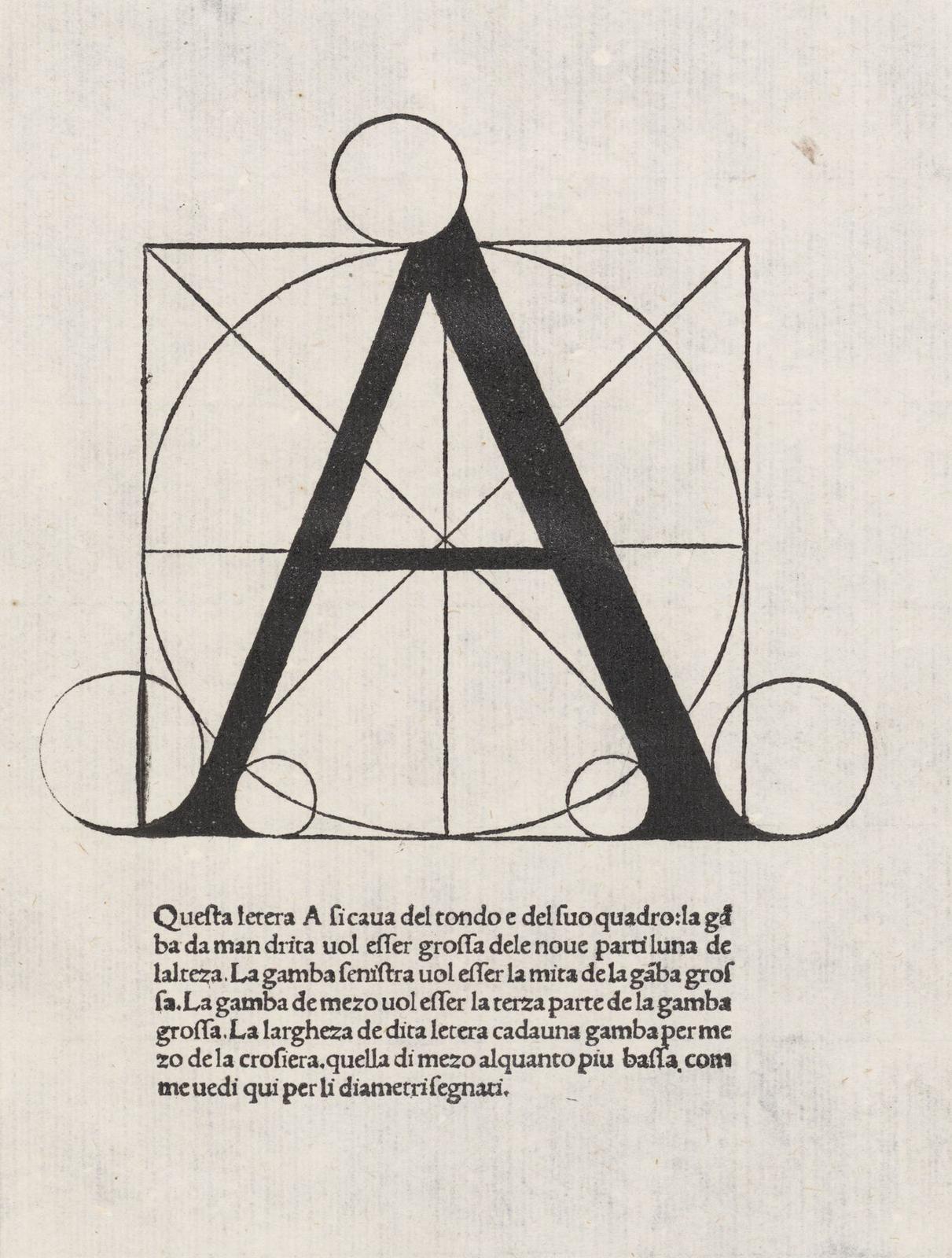
Pacioli built this A from a circle and a square and gave its proportions in the lines beneath. A stonecutter or printer anywhere who owned the book could copy the letters of Roman inscriptions.Luca Pacioli, the letter A from Divina proportione, printed by Paganino Paganini, Venice, 1509. Woodcut. The Metropolitan Museum of Art, Rogers Fund, 1919. Public domain. SourceDates in this chapter10
c. 1440Johannes Gutenberg experiments with printing in Strasbourg.
March 1455Enea Silvio Piccolomini writes that he has seen sheets of Gutenberg’s Bible at Frankfurt.
1457Fust and Peter Schöffer print the Mainz Psalter, the first book with a printer’s name and date.
1462The archbishop’s troops sack Mainz and its printers scatter.
1469Johann of Speyer opens the first press in Venice.
1494Luca Pacioli publishes the Summa de arithmetica, with its guide to double-entry books.
1495Aldus Manutius issues his first book in Venice and begins his Greek Aristotle.
1501Aldus prints a pocket Virgil in italic type, 1,000 copies.
1517Printers in Basel, Leipzig and Nuremberg print Martin Luther’s Ninety-five Theses before the year is out.
1519Leonardo da Vinci dies at Amboise, leaving thousands of pages of notes.
Letters in metal
Johannes Gutenberg and his partners in Strasbourg made metal mirrors to sell to the pilgrims who came to Aachen every seven years to see its relics. They expected the pilgrimage in 1439, but it fell in 1440.11 Gutenberg in Strasbourg, Gutenberg-Gesellschaft. https://www.gutenberg-gesellschaft.de/en/johannes-gutenberg/gutenberg-in-strasbourg/ When one partner, Andreas Dritzehn, died, his brothers sued Gutenberg for his stake. Records of the partnership mention a wooden press, lead and moulds.
Gutenberg was born in Mainz around 1400, the son of a patrician family. In Strasbourg, where he lived from at least 1434 until about 1444, he taught a partner to polish gems and, by one record, served in the city militia as a goldsmith. By later accounts he began trying to print there too. By 1448 he was back in Mainz and borrowing money.
Korean monks had printed a book from cast metal type by 1377, and Chinese printers had cut books in wood blocks for centuries before that. Gutenberg built a complete system for the Latin alphabet, with its two dozen letters, and had to make every part of it work with every other part.
Johann Fust, a Mainz merchant, lent Gutenberg 800 guilders for his equipment and then 800 more for a Latin Bible. He charged 6 per cent interest.22 Johannes Gutenberg, Wikipedia. https://en.wikipedia.org/wiki/Johannes_Gutenberg While the Bible was on the press, the shop printed jobs that paid at once, probably including the indulgences sold in 1454 and 1455 to defend Cyprus against the Turks. The compositors set the Bible in two columns of 42 lines. They filled 1,288 pages, which binders usually split into two volumes. The shop printed between 160 and 185 copies, about three in four on paper and the rest on vellum.33 Gutenberg Bible, Wikipedia. https://en.wikipedia.org/wiki/Gutenberg_Bible
Enea Silvio Piccolomini, a papal diplomat who later became Pope Pius II, saw sheets of the Bible in Frankfurt, probably at the imperial diet of October 1454. On 12 March 1455 he wrote to a cardinal that a reader could make out the letters without eyeglasses, and that buyers had already taken every copy.44 Enea Silvio Piccolomini’s letter of 12 March 1455, History of Information. https://historyofinformation.com/detail.php?id=289 Some paid 30 florins, about three years’ pay for a clerk.55 Gutenberg Bible, Wikipedia. https://en.wikipedia.org/wiki/Gutenberg_Bible
Fust sued Gutenberg that autumn for misusing the loans and claimed 2,026 guilders with interest.66 Johannes Gutenberg, Wikipedia. https://en.wikipedia.org/wiki/Johannes_Gutenberg The court found for him. Fust took the workshop and its stock of type and went into business with Peter Schöffer, a former scribe who married his daughter. In 1457 the two printed the Mainz Psalter, the first book to give its printer and date, and left Gutenberg’s name out.
Scholars know of 49 copies of the Bible that survive in whole or in large part.
Stradanus drew a busy print shop around 1600, with workers at every stage of Gutenberg’s system in one room. In the Latin verse below, the engraver wrote that as one voice reaches many ears, one writing now fills a thousand pages.Jan Collaert I after Jan van der Straet (Stradanus), The Invention of Book Printing, plate 4 of Nova Reperta, published by Philips Galle, c. 1600. Engraving. The Metropolitan Museum of Art, Harris Brisbane Dick Fund, 1934. Public domain. Source
A scribe against a press
A scribe writes about 3 pages a day; a compositor sets about 2 pages of type a day, and two pressmen print 3,000 sheet sides a day, two pages to a side.BnF, Medieval book production (a scribe copied about 2–3 pages a day); press rates of 250 sheet sides an hour for two pressmen (Moxon, 1683) and 1,500–3,600 a day (Wolf; Pollak); compositors at Cambridge c. 1700 set about 5,600 ens a day, about two Gutenberg Bible pages of 2,600 characters. https://en.wikipedia.org/wiki/Printing_press
Millions of books
Archbishop Adolph of Nassau’s troops sacked Mainz in 1462, in a war over who should rule the see. Printers who had learned the trade there fled with their punches and their skills and set up shop in Cologne, Basel, Rome, Paris and beyond. Gutenberg died in Mainz in 1468, three years after the same archbishop gave him a place at his court with a yearly allowance of grain and wine.
By 1500 printers had worked in some 280 towns. Librarians have since catalogued about 30,000 editions printed before 1501, and printers issued many more editions of which no copy survives.77 Incunable, Wikipedia. https://en.wikipedia.org/wiki/Incunable They usually ran a few hundred copies of each. Historians put the number of copies printed in Europe before 1501 at between 12 million and 20 million,88 The spread of printing before 1500, History of Information. https://historyofinformation.com/detail.php?entryid=36 and the number by 1600 at 150 to 200 million.99 Printing press, Wikipedia (citing Buringh and van Zanden, 2009). https://en.wikipedia.org/wiki/Printing_press
about 30,000editions printed in Europe before 1501 that librarians have catalogued
Printers needed buyers, so they opened shops where buyers lived and travelled: in university towns, in trading cities and on the routes to the great fairs. Besides Bibles and psalters they printed whatever sold: grammars, law books, calendars, sermons, romances and indulgences, the printed letters the Church sold to remit the punishment due for sins.
Printers cut their prices as they printed longer runs. Students who had once copied textbooks by hand, or rented them a section at a time from a stationer, began to buy them.
“The printed book is made of paper and, like paper, will quickly disappear.”
Peter von Friedberg printed Trithemius’s treatise at Mainz in 1494, and librarians at 32 institutions in seven countries keep copies of that printing today.
Hand-copied manuscripts per century from the 6th to the 15th century, then printed books per half-century from 1454 to 1800.
Source: Buringh & van Zanden (2009), 'Charting the Rise of the West', Journal of Economic History 69(2), via Our World in Data. The two series use different periods: manuscripts are counted per century (plotted at mid-century), printed books per half-century (plotted at the midpoint, e.g. 1475 for 1454-1500). The totals add up every country in the dataset, some beyond Western Europe (Poland, Sweden and, for books, Russia). Both are scholarly reconstructions, not counts. A book here is a title over 49 pages.Data
Series
Year
Copies produced in the period
Manuscripts per century
AD 550
13,551
Manuscripts per century
AD 650
10,640
Manuscripts per century
AD 750
43,703
Manuscripts per century
AD 850
201,742
Manuscripts per century
AD 950
135,638
Manuscripts per century
1050
212,029
Manuscripts per century
1150
768,721
Manuscripts per century
1250
1,761,952
Manuscripts per century
1350
2,746,951
Manuscripts per century
1450
4,999,160
Printed books per half-century
1475
12,587,000
Printed books per half-century
1525
79,017,000
Printed books per half-century
1575
138,407,000
Printed books per half-century
1625
201,029,000
Printed books per half-century
1675
331,200,000
Printed books per half-century
1725
356,349,000
Printed books per half-century
1775
641,166,000
Venice
Johann of Speyer, a German, opened the first press in Venice in 1469. He began with 100 copies of Cicero’s letters and, that year, printed the first edition of Pliny’s Natural History. Venetians had ships, money, trade across the Mediterranean and a Senate that granted printers privileges. The senators gave Johann a five-year monopoly on printing in the city, but he died within months. Someone later wrote in the margin of the grant that it was void, since the master had died.1010 Commentary on the Venetian privilege of 1469, Primary Sources on Copyright. https://copyrighthistory.org/cam/commentary/i_1469/i_1469_com_172007134356.html The Senate did not renew it for his brother Wendelin. Before 1501 Venetian printers issued about one in eight of all the editions printed in Europe, more than the printers of any other city.1111 Incunable, Wikipedia. https://en.wikipedia.org/wiki/Incunable
Venetians owned books worth printing too. In 1468 Cardinal Bessarion, a Greek churchman who had settled in Italy, gave the city his library: 482 Greek manuscripts and 264 Latin ones.1212 Basilios Bessarion, Wikipedia. https://en.wikipedia.org/wiki/Basilios_Bessarion For decades, humanists across Italy had hunted for lost classics in monastery libraries. Poggio Bracciolini found Lucretius’s poem On the Nature of Things in a German monastery, probably Fulda, in 1417. Monks had copied it centuries earlier and then left it on the shelf.
Once a humanist had found a text, a printer could set it in a thousand identical copies. Scholars in Paris, Oxford and Kraków could cite the same page of the same edition, find each other’s errors and print a better one.
Aldus Manutius, a teacher from near Rome, settled in Venice in 1490 and set up his press in 1494. He printed Aristotle in Greek, in five folio volumes, between 1495 and 1498. By 1505 his shop had issued more than 100 editions, many of them Greek authors no one had printed before.
Aldus printed the Hypnerotomachia Poliphili, a romance of dreams and ruins, in December 1499. Printers and collectors admired it above most books of the century for its 168 woodcuts and clean roman type.Francesco Colonna, Hypnerotomachia Poliphili, printed by Aldus Manutius, Venice, 1499. Printed book with woodcut illustrations. The Metropolitan Museum of Art, Gift of J. Pierpont Morgan, 1923. Public domain. Source
Aldus printed Virgil in 1501 in a small octavo, a book a reader could carry in a coat. For it he had the Bolognese punchcutter Francesco Griffo cut the first italic, a slanted type based on the handwriting of Italian scholars. In italic Aldus fitted more words on a line and used less paper. He printed 1,000 copies, where 200 to 500 had been the norm.1313 Aldus Manutius, Wikipedia. https://en.wikipedia.org/wiki/Aldus_Manutius Printers in Lyon were selling pirated copies by 1503, and others across France and Italy copied his dolphin-and-anchor mark.
The merchant’s books
Amatino Manucci, an Italian partner in the Farolfi company, kept the books of its branch at Salon in Provence in 1299 and 1300. His ledger is the oldest surviving set of accounts in double entry. Under that method a merchant recorded every sum twice, once as a debit in one account and once as a credit in another. When the two sides did not match, he knew he had made a mistake.
Giovanni di Bicci de’ Medici founded his bank in Florence in 1397 with 10,000 gold florins. His heirs ran branches in Rome, Venice, Milan, Geneva, Avignon, Bruges and London, each a separate partnership in which the Florence firm owned the largest share. They made most of their money on bills of exchange: a merchant paid a sum in florins at one branch and his agent collected it in pounds or ducats at another, months later, without a cart of coin crossing the Alps. Clerks entered every bill in the books of both branches.
Luca Pacioli, a Franciscan friar from Sansepolcro, wrote the method down for anyone who could read Italian. His Summa de arithmetica, printed in Venice in 1494 by Paganino Paganini, ran to 615 pages of arithmetic, algebra and geometry. In one section, Particularis de computis et scripturis, Pacioli taught bookkeeping in the Venetian style. Paganini printed about a thousand copies, and for decades merchants used the section as a textbook.1414 Summa de arithmetica, Wikipedia. https://en.wikipedia.org/wiki/Summa_de_arithmetica
The second thing necessary in business is to be a good bookkeeper and ready mathematician. … The third and last thing is to arrange all the transactions in such a systematic way that one may understand each one of them at a glance, i. e., by the debit (debito—owed to) and credit (credito—owed by) method. This is very essential to merchants, because, without making the entries systematically it would be impossible to conduct their business, for they would have no rest and their minds would always be troubled.
Pacioli moved to Milan in 1497, at the invitation of Duke Ludovico Sforza. There he shared a house with the duke’s painter and engineer and taught him mathematics.
Leonardo’s notebooks
Leonardo da Vinci, the son of a notary, was born near Vinci in Tuscany on 15 April 1452 and trained in Andrea del Verrocchio’s workshop in Florence. He moved to Milan in 1482. In a draft letter to Ludovico, he listed bridges, mortars, catapults and armoured chariots before he mentioned, in one line near the end, that he could also sculpt and paint.
1) I have a sort of extremely light and strong bridges, adapted to be most easily carried, and with them you may pursue, and at any time flee from the enemy; and others, secure and indestructible by fire and battle, easy and convenient to lift and place. … 10) In time of peace I believe I can give perfect satisfaction and to the equal of any other in architecture and the composition of buildings public and private; and in guiding water from one place to another.
Leonardo filled notebooks for the rest of his life, writing from right to left in mirror script. He drew gears, pumps, canal locks, wings, the muscles of the arm and the flow of water past a stone. He wrote that “Experience never errs,” and that men who love practice without science resemble a sailor without a helm or a compass.
He drew the skeleton solids for Pacioli’s next book, On Divine Proportion, which Paganini printed in Venice in 1509. In it Pacioli showed printers and stonecutters how to build each Roman capital letter from a circle and a square.
Leonardo published none of his notes. When he died at Amboise, in France, on 2 May 1519, he left them to his pupil Francesco Melzi. After Melzi died in 1570, his heirs let the pages scatter among collectors. The sculptor Pompeo Leoni cut and pasted many of them into albums.
Editors drew a treatise on painting from the notes and printed it in 1651, but few engineers of the next two centuries saw his machine drawings. Jean Paul Richter printed the first large selection of Leonardo’s writings, with an English translation, in 1883.
Martin Luther sent his Ninety-five Theses against the sale of indulgences to the Archbishop of Mainz on 31 October 1517. Before the year was out, printers in Basel, Leipzig and Nuremberg had them in print. In 1518 Luther wrote a Sermon on Indulgences and Grace in German, and printers ran off twenty editions.
Gutenberg’s compositors set each page of his Bible once, and his pressmen printed it up to 185 times. Printers across Germany worked the same way for Luther on a far larger scale. They issued 291 editions of his 45 original works, and between 1518 and 1520 alone they printed and distributed about 300,000 copies.1515 Printing press, Wikipedia (citing Pettegree, 2015, and Duchesne, 2006). https://en.wikipedia.org/wiki/Printing_press Seamen used print too. Pilots bound for India in 1497 carried printed tables of the sun’s position. When the economist Jeremiah Dittmar compared European cities that had a press before 1500 with similar cities that had none, he found that the cities with a press grew 60 per cent faster between 1500 and 1600.1616 Information Technology and Economic Change: The Impact of the Printing Press, Jeremiah Dittmar, Quarterly Journal of Economics, 2011. https://researchonline.lse.ac.uk/id/eprint/53580
Portuguese and Spanish sailors crossed every ocean in small ships, guided by printed tables and better charts, and enslaved or killed many of the people they found.
Waldseemüller and his colleagues printed this map in 1507, and no earlier document uses the name America. Ptolemy looks on from the top left and Vespucci from the top right. The Library of Congress agreed to buy the only known copy in 2001 and finished paying the 10 million dollars for it in 2003.Martin Waldseemüller, Universalis cosmographia secundum Ptholomaei traditionem et Americi Vespucii aliorumque lustrationes, Saint-Dié, 1507. Woodcut on twelve sheets. Library of Congress, Geography and Map Division. Public domain. SourceDates in this chapter10
1415Portuguese forces take Ceuta in Morocco; Prince Henry, aged 21, fights there.
1434Gil Eanes sails past Cape Bojador on the Saharan coast.
1444Captains bring some 235 enslaved Africans ashore at Lagos for sale.
1488Bartolomeu Dias rounds the southern tip of Africa.
12 October 1492Christopher Columbus reaches the Bahamas.
20 May 1498Vasco da Gama reaches Calicut in India.
1507Martin Waldseemüller prints a world map with the word America on it.
6 September 1522Juan Sebastián Elcano brings the Victoria home with 18 men after sailing round the world.
1569Gerardus Mercator publishes his world map for navigators at Duisburg.
1599Edward Wright prints tables with which sailors can draw Mercator charts for themselves.
The coast of Africa
Portuguese soldiers took the Moroccan port of Ceuta in 1415. Prince Henry, the king’s third son, fought there at 21. For the rest of his life he paid for voyages south along the African coast, hired mapmakers and captains, and took a cut of whatever they brought back. Later writers gave him a school of navigation at Sagres. Historians have found no trace of one. Nobody called him the Navigator in his lifetime or for three centuries after, until two German historians of the nineteenth century gave him the title.11 Prince Henry the Navigator, Wikipedia. https://en.wikipedia.org/wiki/Prince_Henry_the_Navigator
Henry sent out fifteen expeditions over about ten years before one of his squires, Gil Eanes, got past Cape Bojador on the Saharan coast in 1434.22 Prince Henry the Navigator, Wikipedia. https://en.wikipedia.org/wiki/Prince_Henry_the_Navigator Eanes had turned back on his first try, in 1433, and brought home captives from the Canaries. On the second he carried back wild roses from beyond the cape to prove he had passed it. Sailors feared the shoals, fog and currents off the cape. Traders who got beyond it could reach the gold, ivory and pepper of West Africa.
For this work Portuguese shipwrights built the caravel, a small, fast ship usually 12 to 18 metres long that could carry 50 or 60 tons.33 Caravel, Wikipedia. https://en.wikipedia.org/wiki/Caravel They rigged it with lateen sails, long triangles on slanting yards, so a captain could work it against the steady north trade winds of that coast.
Captains learned to come home the long way. Instead of beating north against the wind, they swung far out into the Atlantic until they met the westerlies, then ran east for Lisbon. On those loops they found and settled the empty islands of Madeira and the Azores. Portuguese and Genoese planters set up sugar estates on Madeira.
A company of merchants from Lagos, in the Algarve, brought ashore some 235 Africans in August 1444, people they had seized on the coast near Arguin. The chronicler Gomes Eanes de Zurara described the captives being divided and sold on the shore, while Henry sat on his horse and took his fifth, about 46 people.44 Lançarote de Freitas, Wikipedia (after Gomes Eanes de Zurara). https://en.wikipedia.org/wiki/Lan%C3%A7arote_de_Freitas Over the following decades Portuguese traders shipped Africans to Lisbon and the Atlantic islands by the thousands, and their successors later carried millions across the ocean.
Instruments and tables
Alexander Neckam, an English scholar writing around 1190, noted that a ship should carry among its stores a magnetised needle on a pivot, which turned until it pointed north.55 Alexander Neckam, Wikipedia. https://en.wikipedia.org/wiki/Alexander_Neckam Chinese sailors had used the needle a century earlier. A pilot with a compass knew his heading but not his position.
Pilots on the African coast learned to find their latitude, their distance north or south of the equator. They measured the height of the Pole Star with a quadrant until, south of the equator, they lost sight of it and turned to the sun.
Abraham Zacuto, a Jewish astronomer from Salamanca, drew up tables of the sun’s declination, and Samuel d’Ortas printed them at Leiria in Portugal in 1496 as the Almanach Perpetuum.66 Abraham Zacuto, Wikipedia. https://en.wikipedia.org/wiki/Abraham_Zacuto Pilots carried printed declination tables of this kind on the voyages to India. Late in 1496 King Manuel I ordered the Jews out of Portugal, and Zacuto fled to North Africa.
Bartolomeu Dias left Lisbon in the summer of 1487 with two caravels and a supply ship. He sailed south, out of sight of the coast, for about thirty days. When he turned east and found no coast, he turned north, and in February 1488 he put in on the southern shore of Africa. He had passed the cape without seeing it. By tradition he gave it the name Cape of Storms, which King John II changed to the Cape of Good Hope. Dias reached Lisbon in December 1488, sixteen months after he left.77 Bartolomeu Dias, Wikipedia. https://en.wikipedia.org/wiki/Bartolomeu_Dias
Columbus
Christopher Columbus, a wool weaver’s son from Genoa, proposed to reach Asia by sailing west. He reckoned the distance from the Canary Islands to Japan at 2,400 nautical miles. The true figure is about 10,600.88 Christopher Columbus, Wikipedia. https://en.wikipedia.org/wiki/Christopher_Columbus The king’s experts in Portugal turned him down, and so at first did those in Castile, on the correct grounds that he had made the Earth far too small.
Ferdinand and Isabella of Spain agreed at Santa Fe in April 1492 to back him. They made him admiral, viceroy and governor of whatever islands and coasts he found, and promised him a tenth of the riches. For ships they used a fine: the royal council had sentenced some men of Palos to serve the crown for two months with two armed caravels, and the monarchs ordered them to put the ships at Columbus’s service. He left Palos on 3 August with the carrack Santa María and the caravels Pinta and Niña. On the way he re-rigged the Niña with square sails for the open ocean and ran west from the Canaries before the trade winds. At about two in the morning on 12 October, Rodrigo de Triana, a lookout on the Pinta, sighted the shore. Columbus later claimed he had seen a light some hours earlier. He took the crown’s reward for the first sighting, 10,000 maravedís a year, himself.99 Voyages of Christopher Columbus, Wikipedia. https://en.wikipedia.org/wiki/Voyages_of_Christopher_Columbus That day his crews went ashore on an island in the Bahamas, Guanahani to its people.
On 14 October he wrote in his journal, as the friar Bartolomé de las Casas later copied it, what he thought of the Taíno who had swum out to greet his ships.
I saw a piece of land which appeared like an island, although it is not one, and on it there were six houses. It might be converted into an island in two days, though I do not see that it would be necessary, for these people are very simple as regards the use of arms, as your Highnesses will see from the seven that I caused to be taken, to bring home and learn our language and return; unless your Highnesses should order them all to be brought to Castile, or to be kept as captives on the same island; for with fifty men they can all be subjugated and made to do what is required of them.
He carried out the plan. As governor of Hispaniola he ordered every Taíno over fourteen in the gold country to hand over a hawk’s bell full of gold dust as tribute, and his men used dogs to hunt down those who fled forced labour. In 1495 they rounded up about 1,500 people. He shipped 500 of them to Spain as slaves, and some 200 died at sea.1010 Christopher Columbus, Wikipedia. https://en.wikipedia.org/wiki/Christopher_Columbus The crown’s investigator, Francisco de Bobadilla, sent him home in chains in 1500. Spanish settlers all but destroyed the Taíno of Hispaniola within a few decades, through forced labour, war and the diseases they carried.
Columbus died at Valladolid in 1506 still claiming he had reached Asia. Amerigo Vespucci, a Florentine merchant and navigator, wrote widely read letters arguing that the coasts to the south belonged to a new continent. In 1507 Martin Waldseemüller and his colleagues at Saint-Dié in Lorraine printed 1,000 copies of a twelve-sheet world map and wrote the name America across its southern part.1111 Waldseemüller map, Wikipedia. https://en.wikipedia.org/wiki/Waldseem%C3%BCller_map Other mapmakers kept the name even after Waldseemüller dropped it. He had taken it off his maps by 1513, and on his large world map of 1516 he called South America Terra Nova.
India and the world
Vasco da Gama left Lisbon on 8 July 1497 with four ships and about 170 men. He took the long loop through the South Atlantic and kept out of sight of any coast for more than three months, longer than any crew had yet sailed without a landfall. After rounding the Cape he worked up the east African coast to Malindi, where he hired a pilot from Gujarat who knew the monsoon winds. On 20 May 1498 he anchored off Calicut, on the coast of India. Da Gama was back in Lisbon in late summer 1499 with two ships and about 55 men.
Merchants in Lisbon now bought pepper and cloves shipped all the way from India, without Arab, Venetian or Egyptian middlemen. The king of Portugal sent armed fleets every year after that, and his captains shelled the ports of rulers who would not trade on their terms.
“Dost leave the foeman breeding at thy gate / who wendest foreign far-off fone to seek; / whereby this antique realm lies desolate; / whose strength, o'erstretched, waxeth ruinous weak?”
Portuguese captains kept sailing to India. By the long-run estimates that Our World in Data publishes, the people of Portugal numbered 1.1 million in 1500 and 1.8 million in 1600.
Ferdinand Magellan, a Portuguese captain serving Spain, sailed from Sanlúcar de Barrameda on 20 September 1519 with five ships and about 270 men. He planned to reach the Spice Islands by sailing west, around or through South America. Near the southern tip of the continent he found a strait and took four weeks to work his ships through it. They came out into a calm ocean at the end of November 1520, and Magellan gave it the name Mar Pacífico, the peaceful sea.
Wednesday, the twenty-eighth of November, 1520, we came forth out of the said strait, and entered into the Pacific sea, where we remained three months and twenty days without taking in provisions or other refreshments, and we only ate old biscuit reduced to powder, and full of grubs, and stinking from the dirt which the rats had made on it when eating the good biscuit, and we drank water that was yellow and stinking. We also ate the ox hides which were under the main-yard, so that the yard should not break the rigging: they were very hard on account of the sun, rain, and wind, and we left them for four or five days in the sea, and then we put them a little on the embers, and so ate them; also the sawdust of wood, and rats which cost half-a-crown each, moreover enough of them were not to be got.
Magellan reached the Philippines and took sides in a local quarrel. In April 1521 the warriors of Lapulapu, chief of Mactan, killed him on the beach. Juan Sebastián Elcano, a Basque officer, took the Victoria on across the Indian Ocean and round Africa. He brought her into Sanlúcar on 6 September 1522 with 18 of the men who had set out and 26 tons of cloves and cinnamon in the hold. Crown officials had put the cost of the fleet at 8,751,125 maravedís for ships, food and wages.1212 Magellan expedition, Wikipedia (citing Bergreen, 2003, and Morison, 1986). https://en.wikipedia.org/wiki/Magellan_expedition
18 of about 270men who sailed with Magellan in 1519 and came home on the Victoria in 1522
Antonio Pigafetta, a gentleman from Vicenza who had joined the fleet as a volunteer, wrote down the date every day. At the Cape Verde Islands the crew found that the Portuguese there said it was Thursday, while by Pigafetta’s journal it was Wednesday. Sailing west with the sun all the way round, the crew had lost a day.
Mercator’s chart
Pedro Nunes, chief cosmographer to the king of Portugal, showed around 1550 that a pilot who kept one compass heading for long sailed a spiral towards the pole, a rhumb line. Pilots wanted to steer one heading from port to port. On the flat charts of the day they could not draw that course as a straight line.
Gerardus Mercator, a Flemish mapmaker, solved the problem on paper. He was born at Rupelmonde in 1512. In 1544 the authorities jailed him for about seven months on suspicion of Lutheran heresy, then let him go for lack of evidence.1313 Gerardus Mercator, University of Granada mathematics history pages. https://www.ugr.es/~eaznar/mercator.htm He moved to Duisburg in 1552. There, in August 1569, he published an eighteen-sheet world map two metres wide and described it as adapted for the use of navigators.
Mercator drew the lines of longitude straight and parallel, and so stretched the map from east to west more and more towards the poles. To keep the angles true he spread the lines of latitude apart in the same proportion, and so drew Greenland as large as Africa. On his chart a pilot could rule a straight line between two ports, read its angle and steer by it.
Mercator never published the mathematics. Edward Wright, a Cambridge mathematician who had sailed on a raid to the Azores in 1589, calculated tables for spacing the lines of latitude and printed them in Certaine Errors in Navigation in 1599. Any chartmaker with Wright’s tables could draw a Mercator grid. Sailors were slow to switch, and most did not use such charts until the eighteenth century.
In the verse under this print, the engraver credits the preacher and mapmaker Petrus Plancius with a way to find longitude from the compass needle’s drift. Sailors could not make his method work, and they had no reliable way to find longitude until the eighteenth century.Jan Collaert I after Jan van der Straet (Stradanus), The Discovery of the Establishment of the Longitudes, plate 16 of Nova Reperta, published by Philips Galle, c. 1600. Engraving. The Metropolitan Museum of Art, The Elisha Whittelsey Collection, The Elisha Whittelsey Fund, 1949. Public domain. Source
Jan van der Straet, known as Stradanus, was a painter from Bruges who worked in Florence. Around 1600 he designed a set of prints that Philips Galle published in Antwerp as Nova Reperta, new discoveries of modern times. He chose the things that he and his patrons believed the ancients never had: America, the compass, printing, gunpowder, clocks, eyeglasses, silk, sugar refining, stirrups and the water mill.
In the first plate of Nova Reperta, Stradanus drew Amerigo Vespucci, astrolabe in hand, waking a woman who stands for America. He showed America as many Europeans saw it around 1600, as a body to find and claim, with a cannibal feast behind her.Theodoor Galle after Jan van der Straet (Stradanus), Allegory of America, plate 1 of Nova Reperta, published by Philips Galle, c. 1600. Engraving. The Metropolitan Museum of Art, Harris Brisbane Dick Fund, 1934. Public domain. Source
Mercator's straight line
The red rhumb line keeps one compass bearing and runs straight on Mercator's grid; the black great circle is shorter, but a pilot who follows it must keep changing course.Formulas and Earth radius from Chris Veness, Calculate distance, bearing and more between latitude/longitude points (Movable Type Scripts); figures checked against his geodesy library. Coastlines from Natural Earth 1:110m. https://www.movable-type.co.uk/scripts/latlong.html
Henry’s captains needed fifteen expeditions to get past Cape Bojador. By the second half of the sixteenth century the kings of Portugal were sending five or six ships to India every year, on a voyage of about six months each way. Between 1497 and 1650 captains took 1,033 ships out of Lisbon on the India run.1414 Portuguese India Armadas, Wikipedia. https://en.wikipedia.org/wiki/Portuguese_India_Armadas Spanish officials made sure that what one pilot learned reached the rest. From 1508 every pilot who came home to Seville had to report new coasts under oath, and twice a month the pilot major and the king’s cartographers decided what to add to the master chart, the Padrón Real.1515 Pilot Major of Spain, Wikipedia. https://en.wikipedia.org/wiki/Pilot_Major_of_Spain Printers sold that kind of knowledge to anyone who could pay. Lucas Waghenaer, a pilot from Enkhuizen, printed his charts of Europe’s coasts as a sea atlas in 1584, and Anthony Ashley, a clerk of England’s Privy Council, put it into English in 1588.1616 The first sea pilot printed in English, Crouch Rare Books. https://crouchrarebooks.com/?p=15624
Between Copernicus and Newton, astronomers, anatomists and experimenters learned to test old books against new measurements, and founded a society in London to test each other.
Vesalius had himself drawn at 28 for the Fabrica, with his hand on the tendons of a dissected arm. He wanted readers to learn anatomy from the body on the table, so he had the artist put the body in the picture.Jan Steven van Calcar (attributed), Portrait of Andreas Vesalius, frontispiece to De humani corporis fabrica libri septem, 1542 (printed Basel, 1543). Woodcut. The Metropolitan Museum of Art, Gift of Richard Day, 1980. Public domain. SourceDates in this chapter10
1543Johannes Petreius prints Copernicus’s On the Revolutions in Nuremberg, and Copernicus dies at Frombork on 24 May.
1543Johannes Oporinus prints Vesalius’s On the Fabric of the Human Body in Basel.
1609Kepler publishes Astronomia nova, in which he puts Mars on an elliptical orbit.
13 March 1610Galileo publishes Sidereus Nuncius, with the four moons of Jupiter.
1620Francis Bacon publishes the Novum Organum.
1633Roman inquisitors convict Galileo and sentence him to house arrest for life.
28 November 1660Twelve men meet at Gresham College in London and found what becomes the Royal Society.
January 1665Robert Hooke publishes Micrographia.
6 March 1665Henry Oldenburg prints the first issue of Philosophical Transactions.
July 1687Edmond Halley publishes Newton’s Principia at his own cost.
Two books of 1543
Nicolaus Copernicus, a canon of the cathedral at Frombork on the Baltic coast, died on 24 May 1543, aged 70.11 Nicolaus Copernicus, Wikipedia. https://en.wikipedia.org/wiki/Nicolaus_Copernicus That year the Nuremberg printer Johannes Petreius brought out his book On the Revolutions of the Heavenly Spheres. Copernicus put the Sun near the centre of the universe. He made the Earth one planet among six, spinning once a day and circling the Sun once a year.
Some thirty years earlier he had passed a short sketch of the idea among friends, but he kept the full book back. Georg Joachim Rheticus, a young mathematician from Wittenberg, came to Frombork in 1539, read the manuscript and printed a summary of it the next year. He pressed Copernicus, now in his late sixties, to release the whole. Andreas Osiander, a Lutheran preacher who oversaw the printing, slipped in an unsigned preface in which he presented the system as a mere aid to calculation, a smaller claim than Copernicus had made.
Astronomers used the book long before most of them believed it. Erasmus Reinhold, a professor at Wittenberg, computed new tables of the planets from Copernicus’s numbers, and Albert, Duke of Prussia, paid to publish them in 1551.22 Prutenic Tables, Wikipedia. https://en.wikipedia.org/wiki/Prutenic_Tables Almanac makers used the tables too, because they got good predictions from them.
Also in 1543, the Basel printer Johannes Oporinus produced On the Fabric of the Human Body by Andreas Vesalius, a 28-year-old professor at Padua. Professors before him had read Galen aloud from a chair while an assistant cut open the corpse. Vesalius did the cutting himself. He found that Galen, the Greek physician whom doctors had followed for thirteen centuries, had described the parts of apes and dogs as if they were human.
Vesalius hired artists, most likely from Titian’s workshop in Venice, to draw what he exposed, and had their drawings cut into wood blocks. Carriers took the blocks over the Alps to Basel. Oporinus printed more than 250 woodcuts of bones, muscles and flayed men posed against hills and towns.33 De humani corporis fabrica, Wikipedia. https://en.wikipedia.org/wiki/De_humani_corporis_fabrica Vesalius presented the first copy, bound in purple silk, to the emperor Charles V and became one of his court physicians.
The glass and the sky
Hans Lipperhey, a spectacle maker in the Dutch town of Middelburg, applied for a patent on a spyglass on 2 October 1608.44 Hans Lipperhey, Wikipedia. https://en.wikipedia.org/wiki/Hans_Lipperhey The States General turned him down, because other spectacle makers claimed the invention too. They paid him well for copies instead. Galileo Galilei, a professor of mathematics at Padua, heard the news in 1609, deduced how the instrument must work and ground the lenses himself. In late August he took an eight-power telescope up the bell tower of San Marco in Venice and showed it to the Doge and the city’s nobles. The Senate gave him his chair at Padua for life, at 1,000 florins a year.55 Galileo’s telescope: from the workshop to the stars, Museo Galileo. https://brunelleschi.imss.fi.it/esplora/cannocchiale/dswmedia/storia/estoria2_st.html Before the year was out he had pushed the power to about twenty.
Galileo aimed it at the Moon and drew mountains and craters with their long shadows. He counted ten times more stars than anyone could see by eye. Then, in January 1610, he found small points of light beside Jupiter.
On the 7th day of January in the present year, 1610, in the first hour of the following night, when I was viewing the constellations of the heavens through a telescope, the planet Jupiter presented itself to my view, and as I had prepared for myself a very excellent instrument, I noticed a circumstance which I had never been able to notice before, owing to want of power in my other telescope, namely, that three little stars, small but very bright, were near the planet; and although I believed them to belong to the number of the fixed stars, yet they made me somewhat wonder, because they seemed to be arranged exactly in a straight line, parallel to the ecliptic, and to be brighter than the rest of the stars, equal to them in magnitude.
He watched them night after night and on 13 January saw a fourth. As the points moved with the planet and changed sides from one night to the next, he concluded that Jupiter had four moons of its own. He printed his drawings in March as a short book, Sidereus Nuncius, The Starry Messenger, and named the moons after the Medici. That summer Cosimo II de’ Medici made him court mathematician and philosopher in Florence.
Johannes Kepler, a German mathematician working in Prague, had better numbers than anyone alive. Tycho Brahe, a Danish nobleman, had built an observatory on the island of Hven and measured the planets more precisely than any astronomer before him. At one point in the 1580s the Danish crown spent about 1 per cent of its revenue on his work.66 Tycho Brahe, Wikipedia. https://en.wikipedia.org/wiki/Tycho_Brahe Kepler joined him in 1600. When Tycho died in October 1601, Kepler succeeded him as imperial mathematician and kept working on his records of Mars.
Kepler tried every arrangement of circles he could devise, but with his best model he still missed Tycho’s positions by up to eight minutes of arc. He trusted Tycho’s figures more than the old rule that heavenly bodies move in circles, so he tried other shapes, among them an egg-shaped oval. After about forty failed attempts he found late in 1604 that an ellipse fitted.77 Johannes Kepler, Wikipedia. https://en.wikipedia.org/wiki/Johannes_Kepler In Astronomia nova, published in 1609, he stated two laws: each planet moves on an ellipse with the Sun at one focus, and it sweeps out equal areas in equal times. Ten years on, in Harmonice Mundi, he added a third law, in which he tied the length of a planet’s year to its distance from the Sun.
8 arcminutesthe largest gap between Kepler’s best circular orbit for Mars and Tycho’s observations, about a quarter of the Moon’s width
Kepler finished the Rudolphine Tables, based on Tycho’s data and his laws, and printed them at Ulm in 1627. Astronomers found them far more accurate than any tables before.
Galileo argued for Copernicus in his Dialogue of 1632, written in Italian so that readers outside the universities could follow it. Roman inquisitors tried him in 1633, found him vehemently suspect of heresy and sentenced him to house arrest. He lived at his villa at Arcetri, outside Florence, until his death in January 1642. There he wrote Two New Sciences, on the strength of beams and the motion of falling bodies, and Lodewijk Elzevir printed it in 1638 at Leiden, beyond the Inquisition’s reach.
Watch Jupiter’s moons change places
Jupiter and its four large moons as Galileo drew them at Padua, 7 January to 2 March 1610, with east on the left. Positions are computed for about an hour after sunset.Positions: JPL Horizons, jup365 satellite ephemeris, https://ssd.jpl.nasa.gov/horizons/ . Nights and sightings: Galileo, Sidereus Nuncius (trans. E. S. Carlos, 1880), https://www.gutenberg.org/ebooks/46036
Bacon’s plan
Francis Bacon, Lord Chancellor of England, published the Novum Organum in 1620. On the title page his engraver showed a ship passing between the Pillars of Hercules into open ocean, above a Latin line from the Book of Daniel: many shall run to and fro, and knowledge shall be increased. Bacon argued that scholars had reasoned from a few old books and too little evidence. He wanted them to collect facts from experiments and from the workshops of craftsmen, and to climb from those facts to general laws one step at a time.
He wanted knowledge for use. In the third aphorism he wrote that “knowledge and human power are synonymous”.88 Francis Bacon, Novum Organum, Book I, Aphorism III, ed. Joseph Devey, 1902. Project Gutenberg. https://www.gutenberg.org/ebooks/45988 Near the end of Book I he pointed to printing, gunpowder and the compass, three inventions the ancients never knew, and argued that no empire, sect or star had wielded more power over human affairs.
Those who have treated of the sciences have been either empirics or dogmatical. The former like ants only heap up and use their store, the latter like spiders spin out their own webs. The bee, a mean between both, extracts matter from the flowers of the garden and the field, but works and fashions it by its own efforts. The true labor of philosophy resembles hers, for it neither relies entirely or principally on the powers of the mind, nor yet lays up in the memory the matter afforded by the experiments of natural history and mechanics in its raw state, but changes and works it in the understanding.
Bacon ran few experiments himself and never accepted Copernicus. By John Aubrey’s account, he stopped his coach at Highgate one cold day in 1626, bought a hen and stuffed it with snow to see whether cold would keep meat. He fell ill and died on 9 April. In his last letter he wrote that the experiment “succeeded excellently well”.99 Francis Bacon, Wikipedia (quoting John Aubrey’s Brief Lives). https://en.wikipedia.org/wiki/Francis_Bacon
His English readers acted on his plan a generation later, after the civil war.
Take nobody’s word
Twelve men met at Gresham College in London on 28 November 1660 and agreed to found a college for experimental learning.1010 Royal Society, Wikipedia. https://en.wikipedia.org/wiki/Royal_Society Among them were Christopher Wren, then professor of astronomy at Gresham and later the architect of St Paul’s, the chemist Robert Boyle and the clergyman John Wilkins. Charles II gave them a charter in 1662 and, in a second charter the next spring, the title of the Royal Society of London for the Improvement of Natural Knowledge. The fellows took a motto from the poet Horace, Nullius in verba: take nobody’s word for it.
The fellows hired Robert Hooke as curator of experiments in 1662, with the job of showing something new at each meeting. The society had no steady income to pay him. From 1665 he drew £80 a year for life, £30 from the society and £50 from a lectureship that the London grocer John Cutler had endowed.1111 Robert Hooke, Wikipedia. https://en.wikipedia.org/wiki/Robert_Hooke Hooke built Boyle’s air pump, tested springs and improved the compound microscope. He drew what he saw through it and published the drawings in January 1665 as Micrographia. In a slice of cork he saw rows of tiny boxes and coined the word cell for them.
Hooke drew the flea in finer detail than anyone before him, and lettered its plates and joints so that readers could follow his description part by part. He wrote that “the strength and beauty of this small creature” deserved a description even if it had no other use to man.Robert Hooke, Of a Flea, Scheme XXXIV from Micrographia, London: John Martyn and James Allestry, printers to the Royal Society, 1665. Engraving. Digitised by Project Gutenberg from a public-domain copy of the 1665 edition. Public domain. Source
Londoners bought the book in numbers. Samuel Pepys, a naval official who joined the society a few weeks later, sat up until two in the morning on 21 January 1665 reading it, and wrote in his diary that it was “the most ingenious book that ever I read in my life”.1212 The Diary of Samuel Pepys, entry for 21 January 1664/5. Project Gutenberg. https://www.gutenberg.org/ebooks/4200
Henry Oldenburg, the society’s secretary, wrote to scholars across Europe and printed their reports. On 6 March 1665 he put out the first issue of Philosophical Transactions, two months after Parisian scholars had started the Journal des sçavans. He paid the printer himself. Editors have published it ever since, longer than any other science journal.1313 Philosophical Transactions of the Royal Society, Wikipedia. https://en.wikipedia.org/wiki/Philosophical_Transactions_of_the_Royal_Society Readers in Paris, Danzig and Delft sent in observations, and Oldenburg printed each one with its author’s name and date, so that anyone could check the claim and see who made it first.
Books have multiplied into a confusing and harmful abundance, a problem that kings, princes and the learned must solve.
Printers across Europe produced about 79 million books between 1501 and 1550, and 331 million between 1651 and 1700. Scholars kept up by compiling catalogues and indexes, as Gessner himself had done.
136issues of Philosophical Transactions that Henry Oldenburg edited before his death in 1677
John Evelyn designed this frontispiece for Thomas Sprat’s history of the Royal Society. He put William Brouncker, the first president, on the left and Francis Bacon on the right, beneath a bust of Charles II. Wenceslaus Hollar filled the background with the society’s books and instruments, including a long telescope.Wenceslaus Hollar after John Evelyn, frontispiece to Thomas Sprat, The History of the Royal Society of London, 1667. Etching. The Metropolitan Museum of Art, Harris Brisbane Dick Fund, 1917. Public domain. Source
The system of the world
Hooke, Wren and the young astronomer Edmond Halley argued in London in January 1684 about why planets follow Kepler’s laws. They suspected that the Sun pulled each planet with a force that weakened with the square of the distance. None of them could prove it. Wren offered a book as a prize to whichever of the other two brought him a proof within two months. Hooke said he had one but never produced it. In August Halley went to Cambridge to ask Isaac Newton, the university’s professor of mathematics.
Newton told him he had already calculated that such a force would produce an ellipse, but he could not find his papers. In November he sent Halley a nine-page proof. Halley urged him to go further, and Newton wrote for the next two years. He set down three laws of motion and a law of universal gravitation, and from them he derived all three of Kepler’s laws. He accounted for a falling stone and the Moon’s orbit with one law of gravitation, and used it to explain the tides, the paths of comets and the slow wobble of the Earth’s axis.
Pepys, as president of the Royal Society, licensed the book on 5 July 1686. The fellows had spent the society’s money on an illustrated history of fishes, and they later paid Halley’s salary in unsold copies of it. Halley paid for the printing of about 500 copies himself, corrected the proofs and published the Philosophiae Naturalis Principia Mathematica in July 1687.1414 Philosophiæ Naturalis Principia Mathematica, Wikipedia. https://en.wikipedia.org/wiki/Philosophi%C3%A6_Naturalis_Principia_Mathematica
Halley used Newton’s methods to compute the orbit of the comet he had watched in 1682, and in 1705 he predicted that it would return in 1758. He died in 1742. On Christmas night 1758 Johann Palitzsch, a farmer and amateur astronomer near Dresden, spotted the comet on its way back, and astronomers named it after Halley.
When Copernicus died, astronomers knew of one moon, the Earth’s. Galileo added four around Jupiter in 1610. Christiaan Huygens, a Dutch mathematician of 25, spotted Titan circling Saturn in March 1655, through a telescope he had built with his elder brother Constantijn.1515 Titan (moon), Wikipedia. https://en.wikipedia.org/wiki/Titan_(moon) Giovanni Domenico Cassini, director of the new Paris Observatory, found four more moons of Saturn between 1671 and 1684.1616 Giovanni Domenico Cassini, Wikipedia. https://en.wikipedia.org/wiki/Giovanni_Domenico_Cassini He named them the Sidera Lodoicea, the stars of Louis, after his patron Louis XIV, as Galileo had named Jupiter’s after the Medici.1717 Iapetus (moon), Wikipedia. https://en.wikipedia.org/wiki/Iapetus_(moon) When Halley published the Principia, astronomers knew of ten moons.
Merchants and bankers in Amsterdam and London learned to split a voyage, a loan or a loss among thousands of strangers, so that one wreck no longer ruined its backers.
1602–1720 · Amsterdam, The Hague, London
The world in
1602
Life expectancy
40 years England, estimate
Cost of light
About 42 hours oil lamp, Babylonian estimate
Literacy
21% Western Europe, estimate
Atlantic crossing
36 days estimate
Population
516 million estimate
Hendrick Vroom painted the crowds that met Jacob van Neck’s four ships at Amsterdam in 1599. Each ship belonged to a partnership that its backers wound up once they had sold the cargo.Hendrick Cornelisz Vroom, The Return to Amsterdam of the Second Expedition to the East Indies, 1599. Oil on canvas. Rijksmuseum, Amsterdam (SK-A-2858). Public domain. SourceDates in this chapter10
19 July 1599Jacob van Neck brings four ships back to Amsterdam from Bantam, loaded with pepper and spices.
20 March 1602The States General charter the United East India Company (VOC) with a 21-year monopoly of Dutch trade with Asia.
31 January 1609The magistrates of Amsterdam open the Wisselbank, the city’s exchange bank.
27 February 1610The States General ban the sale of VOC shares by sellers who do not own them, after Isaac Le Maire’s bear raid.
November 1613The States General let the VOC’s directors keep their shareholders’ capital for good, without presenting accounts.
30 July 1671Johan de Witt presents his method for pricing life annuities to the States of Holland.
February 1688An advertiser in the London Gazette first mentions Edward Lloyd’s coffee house in Tower Street.
27 July 1694William and Mary grant a charter to the Governor and Company of the Bank of England.
1697Daniel Defoe publishes An Essay upon Projects, with chapters on banks, insurance and bankrupts.
September 1720Investors pay only £150 for South Sea stock, down from about £1,000 in the summer.
Pepper on the IJ
Jacob van Neck brought the Mauritius, Hollant, Overijssel and Vrieslant up the IJ into Amsterdam on 19 July 1599, loaded with pepper and spices, fourteen months after he had sailed for Bantam on Java.
Van Neck’s backers, like other Dutch merchants in long-distance trade, formed a partnership for a single voyage. They raised the capital in advance, spent it on ships, crews, guns and trade goods, and split the proceeds when the fleet came home. Between 1595 and 1601 such partnerships sent 66 ships from Amsterdam, Middelburg and Rotterdam to Asia. The Amsterdam companies lost no ships at all, and merchants who backed every one of their voyages made an average of 27 per cent a year.11 An Admiralty for Asia: Isaac le Maire and Conflicting Conceptions about the Corporate Governance of the VOC, Oscar Gelderblom, Abe de Jong and Joost Jonker, Erasmus Research Institute of Management, 2010. https://repub.eur.nl/pub/19907/ERS-2010-026-FA.pdf
Each partner answered for the venture’s debts with everything he owned, so the directors borrowed on their own credit and kept their companies small. Rival companies from different towns competed for the same pepper. Johan van Oldenbarnevelt, the Republic’s leading official, pressed them to merge. On 20 March 1602 the States General gave the new United East India Company, the VOC, a monopoly of Dutch trade with Asia for 21 years.22 Dutch East India Company, Wikipedia. https://en.wikipedia.org/wiki/Dutch_East_India_Company
The founders of the VOC sold shares to anyone in the Republic who wanted them. In Amsterdam alone 1,143 people subscribed nearly 3.7 million guilders,33 Euronext Amsterdam (history of the Amsterdam Stock Exchange), Wikipedia. https://en.wikipedia.org/wiki/Euronext_Amsterdam more than half the 6.4 million the company raised across its six chambers. Isaac Le Maire, a merchant from Antwerp, signed for 85,000 guilders, more than any other subscriber. Directors and shareholders alike could lose no more than they had paid in.22 Dutch East India Company, Wikipedia. https://en.wikipedia.org/wiki/Dutch_East_India_Company Shareholders agreed to leave their money in for ten years, but anyone who needed cash sooner could sell.33 Euronext Amsterdam (history of the Amsterdam Stock Exchange), Wikipedia. https://en.wikipedia.org/wiki/Euronext_Amsterdam
The company’s officers paid for its trade with force. Governor-General Jan Pieterszoon Coen took the Banda Islands, the only source of nutmeg and mace, in 1621. His soldiers killed, enslaved or drove out most of the islands’ 15,000 or so people.44 Dutch conquest of the Banda Islands, Wikipedia. https://en.wikipedia.org/wiki/Dutch_conquest_of_the_Banda_Islands
Le Maire’s bet
Isaac Le Maire, who had left the VOC’s board in 1605 after a quarrel with the other directors, sent a long complaint to Oldenbarnevelt in January 1609. The shareholders, he wrote, had still received no dividend, while the directors ran up debts, refused advice, enriched themselves and tried to avoid publishing their accounts.11 An Admiralty for Asia: Isaac le Maire and Conflicting Conceptions about the Corporate Governance of the VOC, Oscar Gelderblom, Abe de Jong and Joost Jonker, Erasmus Research Institute of Management, 2010. https://repub.eur.nl/pub/19907/ERS-2010-026-FA.pdf
Then he bet against the company. Le Maire formed a secret syndicate with eight partners and took nearly a quarter of it. The partners sold VOC shares they did not own, for delivery up to a year ahead, and planned to buy them back for less before the day came. On 27 February 1610 the States General banned the sale of shares a seller did not own. Buyers pushed the price up in 1610 and 1611, and several of Le Maire’s partners went bankrupt. Le Maire sold his own 85,000 guilders of shares during 1610, most likely to meet his contracts.11 An Admiralty for Asia: Isaac le Maire and Conflicting Conceptions about the Corporate Governance of the VOC, Oscar Gelderblom, Abe de Jong and Joost Jonker, Erasmus Research Institute of Management, 2010. https://repub.eur.nl/pub/19907/ERS-2010-026-FA.pdf
The directors had a different fear. Under the charter they owed shareholders full accounts in 1612 and the right to withdraw. They expected a run once shareholders saw the books, and asked the States General to excuse them. In November 1613 the States General, who wanted a strong company to fight Spain and Portugal in Asia, let the directors carry on without accounts and without paying anyone out. They broke the terms of the charter and made the VOC’s capital permanent.11 An Admiralty for Asia: Isaac le Maire and Conflicting Conceptions about the Corporate Governance of the VOC, Oscar Gelderblom, Abe de Jong and Joost Jonker, Erasmus Research Institute of Management, 2010. https://repub.eur.nl/pub/19907/ERS-2010-026-FA.pdf
Shareholders who wanted their money now had to find buyers. From 1611 they could look for them at the Exchange that Hendrick de Keyser had built for the city.33 Euronext Amsterdam (history of the Amsterdam Stock Exchange), Wikipedia. https://en.wikipedia.org/wiki/Euronext_Amsterdam Joseph de la Vega, a Sephardic merchant, wrote the earliest book on the Amsterdam exchange, Confusion de Confusiones, published in 1688. In it he described the options, forward sales and purchases on borrowed money that traders used there.
Hendrick de Keyser dedicated this print of his Exchange to the city council in 1609, two years before the city opened the building. Once it opened, merchants traded goods and VOC shares in different parts of its courtyard.Boëtius Adamsz. Bolswert, View of the Courtyard of the Exchange of Hendrick de Keyser in Amsterdam (Byrsa Amsterodamensis), 1609, published by Michiel Colijn, with verses by P. C. Hooft, Theodorus Rodenburg and Cornelis Plemp. Etching and engraving. Rijksmuseum, Amsterdam (RP-P-OB-67.487). Public domain. Source
Spread the risk across twenty ships
The loss rates come from VOC records; the profit on a ship that comes home is illustrative.VOC losses, 105 ships outward (2.2%) and 141 homeward (4.2%): Bruijn, Gaastra and Schöffer, Dutch-Asiatic Shipping, vol. I, cited in Western Australian Museum, Maritime Archaeology Report 310. https://mass.cultureelerfgoed.nl/documents/00000078.pdf
Bank money
The magistrates of Amsterdam opened an exchange bank, the Wisselbank, on 31 January 1609. Merchants handled hundreds of kinds of coin, much of it clipped or worn. Adam Smith, writing in 1776, reckoned that the city’s coin was worth about 9 per cent less than good coin fresh from the mint. The bank’s assayers weighed each deposit and credited its worth in the bank’s books, less a small charge. The city ruled that bills of exchange of 600 guilders or more drawn on Amsterdam be paid through the bank, so every merchant in foreign trade needed an account.55 An Inquiry into the Nature and Causes of the Wealth of Nations, Book IV, Chapter III, Adam Smith, 1776. https://www.gutenberg.org/ebooks/3300 A merchant paid a bill by asking the clerks to move a sum from his account to his creditor’s. The bank had 708 accounts in 1611 and 1,202 by 1620.66 Bank of Amsterdam, Wikipedia. https://en.wikipedia.org/wiki/Bank_of_Amsterdam
Bank money, over and above both its intrinsic superiority to currency, and the additional value which this demand necessarily gives it, has likewise some other advantages, It is secure from fire, robbery, and other accidents; the city of Amsterdam is bound for it; it can be paid away by a simple transfer, without the trouble of counting, or the risk of transporting it from one place to another. In consequence of those different advantages, it seems from the beginning to have borne an agio; and it is generally believed that all the money originally deposited in the bank, was allowed to remain there, nobody caring to demand payment of a debt which he could sell for a premium in the market.
Dutch governments borrowed from savers too. Provinces, towns and water boards sold bonds on which they paid interest for ever. On 15 May 1648 the water board of the Lekdijk Bovendams, which kept up the dykes along the Lek, sold Niclaes de Meijer a bond of 1,000 Carolus guilders at 5 per cent a year. Later owners accepted cuts in the rate, down to 2.5 per cent. Yale University bought the bond in 2003, and in 2015 a curator from Yale collected twelve years of interest on it, 136.20 euros.77 A living artifact from the Dutch Golden Age: Yale’s 367-year-old water bond still pays interest, Yale News, 2015. https://news.yale.edu/2015/09/22/living-artifact-dutch-golden-age-yale-s-367-year-old-water-bond-still-pays-interest
Johan de Witt, Grand Pensionary of Holland, priced the province’s debts in 1671, a year before a mob in The Hague killed him and his brother. The States of Holland paid 4 per cent on their perpetual bonds. They also sold life annuities at 14 times the yearly payment, and paid the buyer every year until he died. De Witt reckoned the chance that a young buyer would still be alive to collect each half-yearly payment. He discounted every payment at that rate and added them up. On 30 July he showed the States that a guilder a year on a young, healthy life was worth a little over 16 guilders, against the 14 they charged.88 De Witt, Jan, Dictionary of Scientific Biography, via MacTutor, University of St Andrews. https://mathshistory.st-andrews.ac.uk/DSB/De_Witt.pdf
Coffee and credit in London
Edward Lloyd ran a coffee house in Tower Street by February 1688, the month of its first mention in the London Gazette. Lloyd collected shipping news for the shipowners and captains who drank there, and men with money rented his tables to insure ships and cargoes. A merchant who wanted cover described the ship, the voyage and the goods on a policy. Each man who would bear part of the loss signed beneath the last and wrote down how much he would pay. Londoners called these men underwriters.99 Lloyd’s Subscription Room, Royal Museums Greenwich. https://www.rmg.co.uk/collections/objects/rmgc-object-105516 From 1689 advertisers in the Gazette told readers to bring people who had escaped from slavery back to Lloyd’s coffee house, where underwriters later insured slave ships.
Daniel Defoe, a hose dealer turned merchant in the Spanish trade, wrote marine insurance in these years and lost heavily. His creditors had him arrested in 1692 for debts of £700. Defoe later put his total debts at £17,000, but two modern scholars of his work think he inflated the figure.1010 Defoe’s £17,000 bankruptcy, P. N. Furbank and W. R. Owens, Notes and Queries, 2002. https://oro.open.ac.uk/21595 He hid from his creditors in Bristol, where he wrote An Essay upon Projects. In it he noted that an insurer would take the risk of £100 of goods from Jamaica to London for 40 shillings.
It is a compact among merchants. Its beginning being an accident to trade, and arose from the disease of men’s tempers, who, having run larger adventures in a single bottom than afterwards they found convenient, grew fearful and uneasy; and discovering their uneasiness to others, who perhaps had no effects in the same vessel, they offer to bear part of the hazard for part of the profit: convenience made this a custom, and custom brought it into a method, till at last it becomes a trade.
I cannot question the lawfulness of it, since all risk in trade is for gain, and when I am necessitated to have a greater cargo of goods in such or such a bottom than my stock can afford to lose, another may surely offer to go a part with me; and as it is just if I give another part of the gain, he should run part of the risk, so it is as just that if he runs part of my risk, he should have part of the gain.
The French beat an English and Dutch fleet off Beachy Head in 1690. William III’s ministers wanted £1.5 million to rebuild the navy and could find nobody to lend it. William Paterson, a Scottish merchant who had made his fortune in London largely from the slave trade with the West Indies, had proposed a plan in 1691. Investors would lend the government a large sum and leave it there, while Parliament set aside a tax to pay their interest. The lenders would also form a company with the right to do banking. Charles Montagu, member of Parliament for Maldon, carried the scheme through Parliament in the Tonnage Act of 1694. Under it the Exchequer levied duties on shipping to pay the lenders.
The lenders could subscribe up to £1.2 million at 8 per cent, with no one putting in more than £10,000, and the government would pay them another £4,000 a year for managing the loan. In less than a fortnight 1,268 people subscribed the whole sum. William and Mary put in £10,000, as did the governor, John Houblon, but more than two-thirds of the subscribers put in less than £1,000. About one in eight was a woman. On 27 July 1694 the king and queen granted the charter of the Governor and Company of the Bank of England. The directors opened for business on 1 August in Mercers’ Hall, Cheapside, with seventeen clerks and two doorkeepers.1111 Bank of England, Wikipedia. https://en.wikipedia.org/wiki/Bank_of_England
1,268Londoners who lent £1.2 million to the government through the new Bank of England, in less than a fortnight, 1694
Paterson quarrelled with the other directors and left the board in 1695 to promote a Scottish colony at Darien, on the isthmus of Panama, where his wife and child died in 1698.
Michael Godfrey, the first deputy governor, crossed to the Low Countries in 1695 to set up a branch at Antwerp to pay William’s army. On 17 July he dined with the king in his tent at the siege of Namur and then went into the trenches to look. Gunners on the walls killed him with a cannonball as he stood near the king. Narcissus Luttrell recorded that investors in London marked Bank stock down 2 per cent when they heard.1212 Michael Godfrey, Wikipedia. https://en.wikipedia.org/wiki/Michael_Godfrey Ministers kept borrowing this way after Godfrey’s death. In 1752 Henry Pelham merged the government’s redeemable stock into consolidated annuities, the consols, and the Treasury paid off the last of them in 2015.
“It must, indeed, be one of these two events; either the nation must destroy public credit, or public credit will destroy the nation.”
When Hume wrote, the British government owed about one year’s national output. By 1822, after its wars with France, it owed almost two. Britons then grew the economy far faster than the debt, and by 1913 the government owed about a fifth of a year’s output.
John Blunt and the other directors of the South Sea Company offered in January 1720 to take over most of the national debt that the company did not already own. Robert Harley had set up the company in 1711 to take on £9 million of government debt, and in 1713 ministers gave it the asiento, the right to supply enslaved Africans to Spain’s colonies in America. Under the 1720 scheme, owners of government annuities could swap them for South Sea stock. The directors set the swap close to the market price of their shares. The higher they drove the price, the fewer shares they gave for each pound of debt and the more they kept to sell.
They talked up the trade they would open in the New World. Investors bid South Sea stock from £128 in January to £550 at the end of May, and in the summer they were paying about £1,000. At the end of September buyers would pay only £150. Many who had bought on credit went bankrupt.1313 South Sea Company, Wikipedia. https://en.wikipedia.org/wiki/South_Sea_Company
Isaac Newton, Master of the Mint, was worth just over £30,000 and put almost half of it into South Sea stock. He sold all of it in April at a large profit. In mid-June, close to the top, he bought back in with nearly everything he owned. The mathematician Andrew Odlyzko reckons that a year later Newton was worth about £20,000.1414 Isaac Newton and the perils of the financial South Sea, Andrew Odlyzko, Physics Today, 2020. https://physicstoday.aip.org/features/isaac-newton-and-the-perils-of-the-financial-south-sea
Members of Parliament had passed the Bubble Act in June 1720, before the crash. Under it no one could form a joint-stock company without a royal charter. They used the Act to charter two new companies to write marine insurance, the Royal Exchange Assurance and the London Assurance.1313 South Sea Company, Wikipedia. https://en.wikipedia.org/wiki/South_Sea_Company Parliament kept the ban on unchartered companies until 1825.
Hogarth drew the crash as a fairground. He rewrote the inscription on the Monument, London’s memorial to the fire of 1666, to blame the South Sea for the city’s destruction in 1720.William Hogarth, The South Sea Scheme, 1722. Etching and engraving, seventh state of seven. The Metropolitan Museum of Art, Harris Brisbane Dick Fund, 1932. Public domain. Source
The States of Holland paid their lenders the twelfth penny, 8⅓ per cent a year, in the Republic’s early decades. They refinanced the debt at 5 per cent in 1640 and converted it to 4 in 1665.1515 Financial history of the Dutch Republic, Wikipedia (citing Jan de Vries and Ad van der Woude, The First Modern Economy, 1997). https://en.wikipedia.org/wiki/Financial_history_of_the_Dutch_Republic Ministers in London made such cuts later. Montagu’s lenders took 8 per cent in 1694, but Henry Pelham paid only 3½ on the consols he created in 1752, and from 1757 their owners accepted 3 per cent, a rate the Treasury kept until 1888.1616 Consol (bond), Wikipedia. https://en.wikipedia.org/wiki/Consol_(bond)
Sources for this chapter16
An Admiralty for Asia: Isaac le Maire and Conflicting Conceptions about the Corporate Governance of the VOC, Oscar Gelderblom, Abe de Jong and Joost Jonker, Erasmus Research Institute of Management, 2010. https://repub.eur.nl/pub/19907/ERS-2010-026-FA.pdf↑
In the century after Newton, writers, experimenters and lawmakers on both sides of the Atlantic put useful knowledge into print and into law and learned to stop smallpox.
Goussier drew a copperplate printer’s shop for the Encyclopédie: a man pulling the press, another inking a plate, prints drying on a line, then each tool laid out and numbered below. From plates like this one a reader in Lyon or Lisbon could learn how Paris craftsmen ran a workshop.Louis-Jacques Goussier (draughtsman) and Robert Bénard (engraver), Imprimerie en taille douce, plate I, from Recueil de planches sur les sciences, les arts libéraux et les arts méchaniques, the plate volumes of the Encyclopédie, Paris, 1762–72. Etching and engraving. The Metropolitan Museum of Art, Jane E. Andrews Fund, in memory of her husband, William Loring Andrews, 1955. Public domain. SourceDates in this chapter10
1689John Locke publishes his Essay Concerning Human Understanding and, anonymously, his Two Treatises of Government.
1751Diderot and d’Alembert publish the first volume of the Encyclopédie in Paris.
1751Peter Collinson publishes Benjamin Franklin’s letters on electricity in London.
10 May 1752At Marly, near Paris, an old soldier follows Franklin’s plan and draws sparks from a thundercloud.
1772Diderot’s printers finish the eleventh and last volume of Encyclopédie plates.
9 March 1776Adam Smith publishes The Wealth of Nations.
17 September 1787Delegates in Philadelphia sign a Constitution in which they give Congress the power to grant patents and copyrights.
1789Antoine Lavoisier publishes his Elementary Treatise of Chemistry, with a list of 33 elements.
10 April 1790George Washington signs the first United States Patent Act.
14 May 1796Edward Jenner gives cowpox to eight-year-old James Phipps.
Clearing the ground
John Locke wrote that in an age of Boyle and “the incomparable Mr. Newton” it was ambition enough to work as an under-labourer, clearing away rubbish that lay in the way of knowledge.11 An Essay Concerning Humane Understanding, vol. 1, John Locke, 1690. https://www.gutenberg.org/ebooks/10615 He put the line in the preface to his Essay Concerning Human Understanding, which his printer brought out late in 1689. Locke argued that a child is born knowing nothing and learns everything from the senses. If he was right, then anyone could learn anything, given books and teachers.
At about that time a London bookseller brought out Two Treatises of Government with no author’s name on it. Locke wrote it, and he admitted as much only shortly before his death in 1704. He argued that people form governments to protect their “lives, liberties and estates”, and may replace rulers who turn on them. Thomas Jefferson kept life and liberty in the Declaration of Independence of 1776, but put the pursuit of happiness in place of estates.
Scholars of Locke’s day spoke of themselves as citizens of a republic of letters. Their republic had no capital and no army. They wrote to each other across borders, in Latin, then more and more in French and English, about books, comets, fossils and machines. Correspondents waited weeks for a letter to cross Europe and months for one to cross the Atlantic, and still argued as if they lived in one town.
Joseph Wright of Derby painted a lecture on a brass orrery around 1766, with a lamp in the centre for the Sun. Travelling lecturers like the man at the back showed Newton’s system to paying audiences in towns across England.William Pether after Joseph Wright of Derby, A Philosopher Giving a Lecture on the Orrery, 1768. Mezzotint on laid paper. National Gallery of Art, Washington, Paul Mellon Fund, 2001.96.12. CC0. Source
A dictionary of the trades
Denis Diderot, the son of a cutler from Langres, took over a plan by Paris booksellers to translate an English encyclopedia and turned it into something far bigger. He and the mathematician Jean le Rond d’Alembert published the first volume of the Encyclopédie in 1751. They promised a reasoned dictionary of the sciences, the arts and the trades, and they gave the trades long articles and whole volumes of pictures.
Diderot went into workshops to learn how weavers, smiths and papermakers did their jobs, and wrote up at night what he had learned. Louis-Jacques Goussier, his chief draughtsman, visited craftsmen across France and drew more than 900 of the plates himself. Masters had long kept the secrets of a trade inside its guild, but Diderot’s booksellers sold them to any subscriber who could pay.
Churchmen and royal officials in Paris disliked the articles on religion and politics. In 1759, after the seventh volume, the French government withdrew the licence to publish, and Pope Clement XIII placed the work on the Index of forbidden books. Diderot kept going in secret. Louis de Jaucourt, a doctor and nobleman, wrote 17,266 articles for him by 1765, about eight a day. That year Diderot’s printers issued the last ten volumes of text together, and by 1772 they had finished all eleven volumes of plates.
71,818articles in the 28 volumes of the Encyclopédie, by one common count, with about 2,800 plates
The booksellers ran off 4,225 sets of the first edition, about twice the usual run for a French book. They charged 980 livres a set, more than most middle-class families could pay. The four publishers made more than two million livres in profit.22 Encyclopédie, Wikipedia (citing Robert Darnton). https://en.wikipedia.org/wiki/Encyclop%C3%A9die Diderot drew about 2,800 livres a year as editor, while Jaucourt, a rich man, worked for next to nothing. Printers in Lucca and Livorno reprinted the work in French, and others followed with cheaper editions.
“Where there is no effect, it is idle to look for a cause: but here the effect is certain and the depravity actual; our minds have been corrupted in proportion as the arts and sciences have improved.”
Over the next century the French killed one another half as often. Historians put France’s homicide rate at 2.9 per 100,000 people a year in the early eighteenth century and 1.5 in the early nineteenth, against the WHO’s count of 0.7 for 2022.
Benjamin Franklin, a Philadelphia printer, began to experiment with electricity in the 1740s, after the town’s library company received a glass tube for the purpose from London. Franklin had more tubes blown at a local glasshouse and filled his house with people who came to watch. In 1747 he retired from printing and took his foreman, David Hall, into partnership. Hall ran the shop and paid Franklin half its profits for 18 years,33 Benjamin Franklin, Wikipedia (citing James N. Green, 2002). https://en.wikipedia.org/wiki/Benjamin_Franklin and Franklin spent the free hours on his experiments. He found that with a sharp iron point he could draw the charge silently from a charged body at a distance, but with a blunt one he got a crack and a spark. He guessed that lightning was the same thing as the spark from his tubes, and that with a pointed rod he could draw it from a cloud.
Peter Collinson had sent the tube. He was a Quaker cloth merchant in London who traded with North America and sent plants and books across the Atlantic. Franklin wrote up his trials in letters to him. Collinson had them read at the Royal Society, where some fellows laughed, and then had them printed in 1751 as Experiments and Observations on Electricity. Thomas-François Dalibard, a French naturalist, translated the book at the suggestion of the Comte de Buffon. On 10 May 1752 a retired dragoon at Marly-la-Ville, north of Paris, followed Dalibard’s version of Franklin’s plan. During a storm he brought a wire close to an insulated iron rod some 40 feet tall and drew sparks from it.44 Benjamin Franklin and lightning rods, E. Philip Krider, Physics Today, 2006. https://physicstoday.aip.org/features/benjamin-franklin-and-lightning-rods Franklin, who had not yet heard the news, flew a kite into a storm at Philadelphia that June and drew sparks from a key on its wet string.
Philadelphians put up grounded rods on the Academy of Philadelphia and the State House in 1752. The Royal Society gave Franklin its Copley Medal in November 1753. Franklin never patented the rod, his stove or anything else, and he explained why in his autobiography.
He wrote that “as we enjoy great advantages from the inventions of others, we should be glad of an opportunity to serve others by any invention of ours; and this we should do freely and generously.”55 Autobiography of Benjamin Franklin, ed. Frank Woodworth Pine, 1916. https://www.gutenberg.org/ebooks/20203 A London ironmonger copied his stove, patented it and, Franklin heard, made a small fortune.
Antoine Lavoisier, born into a rich Paris family in 1743, weighed everything. He bought a share in the Ferme générale, the private company that collected the king’s taxes, and spent its profits on fine balances, glassware and assistants. From 1784 he had the company build a wall about 24 kilometres long round Paris, so that its agents could tax goods coming into the city. He married Marie-Anne Paulze, the daughter of a fellow tax farmer, in 1771. She was 13 and he was 28. She learned English to translate British chemistry for him and kept his laboratory notebooks. A former pupil of Jacques-Louis David, she drew to scale the thirteen plates of apparatus in his textbook of 1789.
Lavoisier burned metals and sulphur in sealed vessels and weighed them before and after. He found no change in the total weight, and he showed that a burning body took something out of the air. He coined the word oxygen for that part of the air in 1778, and the word hydrogen in 1783. In his Elementary Treatise of Chemistry of 1789 he threw out earth, air, fire and water as elements and listed 33 substances that no one had yet broken down.
David painted his former pupil and her husband in 1788, with the glassware of their laboratory on the table and at their feet. Officials kept the picture out of the Salon of 1789 for fear that it would stir up revolutionary feeling.Jacques Louis David, Antoine Laurent Lavoisier (1743–1794) and Marie Anne Lavoisier (Marie Anne Pierrette Paulze, 1758–1836), 1788. Oil on canvas. The Metropolitan Museum of Art, Purchase, Mr. and Mrs. Charles Wrightsman Gift, in honor of Everett Fahy, 1977. Public domain. Source
The revolutionaries arrested the tax farmers in November 1793. A tribunal convicted Lavoisier, and the executioner guillotined him in Paris on 8 May 1794, along with his father-in-law. The mathematician Joseph-Louis Lagrange is said to have remarked that it took a moment to cut off that head, and a century might not produce another like it.66 Antoine Lavoisier, Wikipedia. https://en.wikipedia.org/wiki/Antoine_Lavoisier
Pins and patents
Adam Smith, who had taught moral philosophy at Glasgow, published The Wealth of Nations in London on 9 March 1776 and opened it with a small workshop. He drew on French accounts of pin making, among them the article on pins in the Encyclopédie.
One man draws out the wire; another straights it; a third cuts it; a fourth points it; a fifth grinds it at the top for receiving the head; to make the head requires two or three distinct operations; to put it on is a peculiar business; to whiten the pins is another; it is even a trade by itself to put them into the paper; and the important business of making a pin is, in this manner, divided into about eighteen distinct operations, which, in some manufactories, are all performed by distinct hands, though in others the same man will sometimes perform two or three of them. I have seen a small manufactory of this kind, where ten men only were employed, and where some of them consequently performed two or three distinct operations.
Smith reckoned that his ten men made more than 48,000 pins a day between them.77 An Inquiry into the Nature and Causes of the Wealth of Nations, Book I, ch. 1, Adam Smith, 1776. https://www.gutenberg.org/ebooks/3300 A man working alone, without training, could perhaps not make twenty. Smith argued that a nation’s wealth depended on how finely its people divided their work, and that they could divide it only as far as the market reached. People who built roads, canals and ports widened the market, and so did governments that let goods move freely. He thought the government should keep the peace, enforce contracts and build such works, and otherwise leave buyers and sellers alone.
4,800pins a day for each of Smith’s ten workers, against perhaps 20 for a man working alone
Americans wrote the reward for invention into their founding law. On 18 August 1787, James Madison and Charles Pinckney proposed to the convention in Philadelphia that Congress should protect authors and inventors. The delegates agreed, and in the Constitution they signed on 17 September they gave Congress the power “To promote the Progress of Science and useful Arts, by securing for limited Times to Authors and Inventors the exclusive Right to their respective Writings and Discoveries.”88 Copyright Clause, Wikipedia. https://en.wikipedia.org/wiki/Copyright_Clause
George Washington signed the Patent Act on 10 April 1790. Under it three cabinet members sat as a patent board: Thomas Jefferson, Henry Knox and Edmund Randolph, the Secretaries of State and War and the Attorney General. An inventor paid four or five dollars in all: fifty cents to file, ten cents for every hundred words of description, two dollars for the patent itself and a dollar to fix the Great Seal.99 Patent Act of 1790, Wikipedia. https://en.wikipedia.org/wiki/Patent_Act_of_1790 The board granted the first patent that July to Samuel Hopkins, for a better way to make potash, which soap makers, glassmakers and gunpowder makers all needed. In all it granted 57 patents before Congress replaced the law in 1793.
Divide the work in Smith’s pin shop
Smith counted about 48,000 pins a day from ten men, 4,800 each, against a lone untrained worker who “certainly could not make twenty”; the curve between those two figures is illustrative.Adam Smith, The Wealth of Nations (1776), Book I, ch. 1. https://www.gutenberg.org/ebooks/3300
The milkmaid’s cowpox
Lady Mary Wortley Montagu, wife of the British ambassador at Constantinople, had watched old women in the city inoculate thousands of people against smallpox each autumn. In March 1718 she had the embassy surgeon, Charles Maitland, inoculate her son Edward, then nearly five.
Europeans lost about 400,000 people a year to smallpox in the eighteenth century, and many who lived carried its scars.1010 Smallpox, Wikipedia. https://en.wikipedia.org/wiki/Smallpox Doctors in Britain adopted Montagu’s method. They gave a mild case on purpose by rubbing matter from a smallpox sore into a cut, but some of their patients died of it and others spread it.
Edward Jenner, a country doctor at Berkeley in Gloucestershire, heard dairy workers say that a milkmaid who had caught cowpox from the cows would never catch smallpox. He tested the claim on his gardener’s son, a child who could not consent.
The more accurately to observe the progress of the infection, I selected a healthy boy, about eight years old, for the purpose of inoculation for the Cow Pox. The matter was taken from a sore on the hand of a dairymaid, who was infected by her master’s cows, and it was inserted, on the 14th of May, 1796, into the arm of the boy by means of two superficial incisions, barely penetrating the cutis, each about half an inch long.
The boy, James Phipps, felt unwell for a day and recovered. On 1 July Jenner rubbed smallpox matter into his arms, and the boy did not fall ill. The dairymaid, Sarah Nelmes, had caught cowpox from a cow called Blossom. Jenner gathered 23 cases, among them his son Robert, aged 11 months, and in 1798 paid to have his Inquiry printed. He gave cowpox the Latin name variolae vaccinae, from vacca, a cow, and from it his followers soon made the word vaccination.
Doctors across Europe were using the method within three years. In July 1800 the Harvard professor Benjamin Waterhouse vaccinated his son Daniel. Francisco Javier de Balmis, a Spanish army surgeon, sailed from A Coruña on 30 November 1803 with 22 orphan boys and Isabel Zendal, who ran their orphanage.1111 Balmis Expedition, Wikipedia. https://en.wikipedia.org/wiki/Balmis_Expedition Balmis vaccinated two boys at a time. When their sores ripened he took matter from them for the next two, and in this way he carried live cowpox across the Atlantic. His team vaccinated hundreds of thousands of people in Spanish America, the Philippines and China. Doctors with the World Health Organization finished the work in the 1970s, and the WHO declared smallpox eradicated in May 1980.
Diderot’s booksellers had printed 4,225 sets of the Encyclopédie at 980 livres each. After Charles-Joseph Panckoucke bought the rights in 1775 and issued five volumes of supplements and a two-volume index, other publishers brought out the work in quarto and octavo, at prices that upper-middle-class buyers could meet. By 1789 booksellers had sold some 25,000 sets across Europe, nearly six times the first run.1212 Encyclopédie, Wikipedia (citing Robert Darnton, The Business of Enlightenment, 1979). https://en.wikipedia.org/wiki/Encyclop%C3%A9die Jenner paid to have his Inquiry printed in 1798, and by 1800 printers had brought it out in all the major European languages.1313 Smallpox vaccine, Wikipedia. https://en.wikipedia.org/wiki/Smallpox_vaccine
British ironmongers, instrument makers, barbers and colliery engineers learned to turn coal into motion, and from the 1840s the country’s workers took home more each decade.
Robert Howlett photographed Brunel in 1857 beside the launching chains of the Great Eastern at Millwall, on the Thames, while his men struggled to get her into the water.Robert Howlett, Isambard Kingdom Brunel Standing Before the Launching Chains of the Great Eastern, 1857, printed 1863–64. Albumen silver print from glass negative. The Metropolitan Museum of Art, Gilman Collection, Purchase, Harriette and Noel Levine Gift, 2005. Public domain. SourceDates in this chapter10
1712Thomas Newcomen sets up a steam pumping engine at a coal pit near Dudley Castle.
1769James Watt patents the separate condenser, and Richard Arkwright patents his spinning frame.
1771Arkwright and his partners open a water-powered cotton mill at Cromford in Derbyshire.
1775Matthew Boulton and James Watt form their partnership, and Parliament extends Watt’s patent to 1800.
March 1776Boulton and Watt start their first engine at the Bloomfield colliery in Tipton.
27 September 1825George Stephenson drives Locomotion No. 1 on the opening day of the Stockton and Darlington Railway.
October 1829Robert Stephenson and his crew win the Rainhill trials and a £500 prize with Rocket.
15 September 1830The directors open the Liverpool and Manchester Railway, the first line between two cities worked by steam locomotives alone.
1833Parliament bans mill work for children under nine and appoints four factory inspectors.
30 June 1841The Great Western Railway opens Brunel’s Box Tunnel and runs trains from London to Bristol.
Water in the mines
Thomas Newcomen, an ironmonger and Baptist lay preacher from Dartmouth in Devon, set up an engine in 1712 to pump water from a coal pit on Lord Dudley’s estate near Dudley Castle, in the Black Country west of Birmingham. He sold tools to tin mines and knew their trouble well. English miners had dug deeper for coal and tin as the seventeenth century ended, and the deeper they went the more water they met. They could lift only so much with horses turning gins.
Newcomen let steam into a large cylinder under a piston, then sprayed in cold water to condense it and used the weight of the air outside to drive the piston down into the vacuum. He linked the piston to one end of a great wooden beam and hung the pump rods in the shaft from the other. A mine owner got about five horsepower from such an engine, for a great deal of coal. At a coal pit, where coal cost almost nothing, the owners did not mind.
Mine owners and engineers built hundreds of these engines over the next sixty years, in Cornwall, the Midlands, the north-east, and as far off as France and Sweden. John Smeaton, a Yorkshire engineer, tested and improved them in the 1770s, but even his engines wasted most of their coal.
The separate condenser
James Watt, instrument maker to the University of Glasgow, received a model Newcomen engine to repair in 1763. He found that the engine’s keepers spent most of their steam heating the cylinder back up after each cold spray. On a walk across Glasgow Green in May 1765 he thought of a cure. He would condense the steam in a separate vessel, kept cold, and leave the cylinder hot all the time.11 James Watt, Wikipedia (citing H. W. Dickinson). https://en.wikipedia.org/wiki/James_Watt Before the year was out he had a working model.
Watt patented the idea in 1769 with money from John Roebuck, who ran the Carron ironworks near Falkirk. When Roebuck went bankrupt in 1773, Matthew Boulton, a Birmingham maker of buttons, buckles and silver plate, took over his share of the patent to cancel a debt of £1,200. Boulton and Watt became partners in 1775, and Parliament extended the patent to 1800.
Boulton supplied the money, the factory and the skilled hands that Watt lacked. John Wilkinson, an ironmaster, had patented a way to bore cannon, and he bored Watt a cylinder 50 inches across, true enough that Watt could seal the piston tight against its wall. Boulton wrote that it did not err “the thickness of an old shilling in any part”.22 English and American Tool Builders, Joseph Wickham Roe, 1916 (quoting Boulton, 1776). https://archive.org/details/englishandameri00roegoog In March 1776 the partners started an engine at the Bloomfield colliery in Tipton, and another at Wilkinson’s ironworks in Shropshire the next month.
The partners seldom made all the parts of an engine. A buyer ordered parts from several suppliers, and a Soho engineer put them together on site. Boulton and Watt then compared the coal the engine burned with what a Newcomen engine would have burned, and charged the owner a third of the saving every year for 25 years.33 Matthew Boulton, Wikipedia (citing Jim Andrew, 2009). https://en.wikipedia.org/wiki/Matthew_Boulton Mine owners resented the payments and threatened to ask Parliament to repeal Watt’s patent. In 1781 Watt added a sun and planet gear, an idea of his employee William Murdoch. With it an owner could turn the rocking of the beam into rotation and drive the shafts and belts of a mill. In the 1780s Watt began to rate his engines in horsepower, so any mill owner could compare an engine with the horses he already kept.
James Boswell visited Boulton’s works at Soho, outside Birmingham, in March 1776. Boulton had about 700 people at work there. He told Boswell, “I sell here, Sir, what all the world desires to have—POWER.”44 Life of Johnson, vol. 2, James Boswell, ed. G. B. Hill. https://www.gutenberg.org/ebooks/9072
496engines Boulton and Watt built between 1775 and 1800, most of them of 5 to 10 horsepower
Newcomen against Watt
The coal figures come from the duty that engineers measured at the time: pounds of water lifted one foot per bushel of coal.Duties: Smeaton's 1769 survey of 15 Newcastle engines (average 5.59 million lb lifted one foot per bushel), his Long Benton engine of 1772 (9.45 million), and his trial of a Watt engine at Birmingham, c. 1778 (about 18 million), as given in William Pole, A Treatise on the Cornish Pumping Engine, 1844. https://goobi.tib.eu/viewer/fulltext/1029262349/43
The mill at Cromford
Richard Arkwright, a barber and wigmaker from Bolton, made money from a waterproof dye for wigs and spent it on spinning machines. He patented a spinning frame in 1769. On it a worker with little training could draw cotton out between pairs of rollers turning at different speeds and twist it into a yarn strong enough for the warp of a cloth. Arkwright went into partnership with Jedediah Strutt and Samuel Need, two hosiery makers, and in 1771 they opened a mill on the River Derwent at Cromford in Derbyshire, with a water wheel to drive the frames.
Arkwright hired about 200 people at first, more than the village could house, so he built rows of cottages for them, with a pub, shops and a chapel. From 1772 he ran the mill day and night in two turns of twelve to thirteen hours. His gatekeepers shut the gates at six in the morning and six at night. A worker who came late lost a day’s pay and paid a fine of a second day’s.
Arkwright took on whole families and hired children from the age of seven, later ten. By the end of his life nearly two-thirds of his 1,150 workers at Cromford were children.55 Richard Arkwright, Wikipedia. https://en.wikipedia.org/wiki/Richard_Arkwright Other mill owners across Lancashire and Derbyshire hired children too, and many of them worked twelve hours or more. In 1832 Michael Sadler, a Tory member of Parliament, chaired a committee that heard witnesses describe long hours, crippled limbs and beatings. A royal commission found the beatings rarer than he claimed but backed limits on hours. The next year Parliament banned work in most textile mills for children under nine, limited those from nine to thirteen to 48 hours a week, and appointed four inspectors with the right to enter any mill.66 The 1833 Factory Act, UK Parliament, Living Heritage. https://www.parliament.uk/about/living-heritage/transformingsociety/livinglearning/19thcentury/overview/factoryact/
After a court threw out Arkwright’s patents in 1785, other spinners copied his frames freely. The king knighted him a year later, and he died in 1792 worth about £500,000. Once they had Boulton and Watt engines to drive their machines, mill owners could build in towns, away from fast rivers. British spinners used 2.6 million pounds of raw cotton in 1760, 52 million in 1800 and 621 million in 1850.77 The Industrial Revolution, ch. 4, Table 1, Gregory Clark, UC Davis. https://faculty.econ.ucdavis.edu/faculty/gclark/ecn110b/readings/chapter4.pdf
Turner painted keelmen on the Tyne loading coal into sailing colliers by moonlight in 1835. Sailors on ships like these carried north-eastern coal to London, and the owners of the pits that filled them had drained their workings with steam engines for generations.Joseph Mallord William Turner, Keelmen Heaving in Coals by Moonlight, 1835. Oil on canvas. National Gallery of Art, Washington, Widener Collection, 1942.9.86. CC0. Source
Iron roads
George Stephenson grew up at Wylam on the Tyne, the son of a colliery fireman. Neither of his parents could read, and he learned only at 18, when he paid for night school out of his wages. He worked as an engineman at collieries and built his first locomotive in 1814 to haul coal wagons at Killingworth. On 27 September 1825 he drove his Locomotion No. 1 on the opening day of the Stockton and Darlington Railway in County Durham.
Liverpool merchants wanted a quicker way to move cotton to the Manchester mills than the canals, whose owners charged what they liked. They hired Stephenson to build a railway between the two towns. He had to cut two miles through rock at Olive Mount, build a viaduct of nine arches over the Sankey valley and cross Chat Moss, nearly five miles of bog. His men laid the track on a raft of timber and hurdles, sank empty tar barrels sealed with clay along the drains, and tipped in earth until they had a bed firm enough for the line.
The directors had not yet decided whether to haul trains with fixed engines and cables or with locomotives. They offered £500 to the best locomotive and staged a trial at Rainhill in October 1829. Builders entered ten engines but brought only five to the start. Thomas Brandreth drove his Cycloped with a horse walking a treadmill. George’s son Robert built Rocket at the family works in Newcastle. Henry Booth, the railway’s treasurer, may have suggested its boiler. Stephenson gave the boiler 25 copper tubes to carry hot gas from the fire through the water, and fitted a blast pipe to send spent steam up the chimney and draw the fire. Only Rocket’s crew finished the course. They hauled 13 tons at an average of 12 miles an hour and reached 30 at top speed.88 Rainhill trials, Wikipedia. https://en.wikipedia.org/wiki/Rainhill_trials
Fanny Kemble, a 20-year-old actress playing in Liverpool, rode the line with George Stephenson on 25 August 1830, three weeks before it opened. He sat her beside him on the engine’s bench and explained the machine to her as they went. She wrote to a friend the next day.
We then rejoined the rest of the party, and the engine having received its supply of water, the carriage was placed behind it, for it cannot turn, and was set off at its utmost speed, thirty-five miles an hour, swifter than a bird flies (for they tried the experiment with a snipe). You cannot conceive what that sensation of cutting the air was; the motion is as smooth as possible, too. I could either have read or written; and as it was, I stood up, and with my bonnet off “drank the air before me.”
The directors opened the Liverpool and Manchester Railway on 15 September 1830. The Duke of Wellington, the prime minister, rode in the first train. When the trains stopped for water at Parkside, William Huskisson, a member of Parliament for Liverpool, stepped down onto the other track to greet him. Joseph Locke, at the controls of Rocket, could not stop in time. He ran over Huskisson’s leg, and Huskisson died that evening.
The company ran its 31 miles on a timetable, with double track, signalmen and steam locomotives on the main line. Passengers made the trip in about two hours, and most of the stagecoach firms between the towns shut soon after. The directors had built the line mainly for freight, but passengers brought in much of its business. For the 15 years it stayed independent, the company paid shareholders an average dividend of 9.5 per cent a year.99 Liverpool and Manchester Railway, Wikipedia. https://en.wikipedia.org/wiki/Liverpool_and_Manchester_Railway
The Delaware, Lackawanna and Western Railroad commissioned George Inness around 1856 to paint their line at Scranton, Pennsylvania. Inness put in the roundhouse, the town and the stumps of the trees the builders had cut, a quarter of a century after Rainhill.George Inness, The Lackawanna Valley, c. 1856. Oil on canvas. National Gallery of Art, Washington, Gift of Mrs. Huttleston Rogers, 1945.4.1. CC0. Source
Isambard Kingdom Brunel, son of the French-born engineer Marc Brunel, became engineer of the Great Western Railway in March 1833, a month before his 27th birthday. He surveyed the route from London to Bristol and kept it nearly level so his engines could run fast. When rivals fought his bill in Parliament, the science writer Dionysius Lardner claimed that a train running away down the slope of the Box Tunnel would reach 120 miles an hour and suffocate its passengers. Brunel took the claims apart, and Parliament passed the bill in August 1835. He chose a gauge of just over seven feet for steadier carriages, where Stephenson had used four feet eight and a half inches. The company opened its line from Paddington as far as Maidenhead in June 1838. At the Box Tunnel, almost two miles long, up to 4,000 navvies dug by candlelight and blasted with about a ton of explosives a week. About 100 of them died in the work.1010 Box Tunnel, Wikipedia (citing Network Rail). https://en.wikipedia.org/wiki/Box_Tunnel From 30 June 1841 the company ran trains through from London to Bristol in about five and a half hours, a trip of 15 to 20 hours by road.
Brunel wanted passengers to go on from Bristol to New York. The crew of his paddle steamer Great Western reached New York in April 1838, fifteen days out of Bristol. For his Great Britain of 1843 he chose an iron hull and a screw propeller. He designed his last ship, the Great Eastern, to be nearly 700 feet long and carry 4,000 passengers. His men began trying to launch her sideways into the Thames in November 1857 and needed almost three months to get her into the water. He died on 15 September 1859, a week after her crew first took her to sea.
Fastest Atlantic crossing from Europe to North America
Westbound, by sail, steamship and airliner, 1492 to 1976.
Source: Blue Riband westbound records (Kludas, Gibbs, Bonsor) and airline sources listed in SOURCES.md. Columbus's time is the open-sea leg from La Gomera in the Canaries (6 September to 12 October 1492); from Palos it took 70 days. The packet figure is an average westbound passage; the record was 15 days 23 hours (Columbia, 1830). Each steamship point is a new Blue Riband westbound record, timed between landmarks such as Queenstown and Sandy Hook. The 1841-1850 records were to Halifax, a shorter run. The 1939 flying-boat time is eastbound (27 h 20 m, New York to Southampton) because no westbound figure was found. Lindbergh's 33.5-hour flight is marked for reference but was not a passenger service. Air times include refuelling stops. Pan Am's first 707 service, New York to Paris on 26 October 1958, took 8 h 41 m eastbound.Data
Series
Year
Crossing time
Sail
1492
864.0
Sail
1818
960.0
Steamship record (Blue Riband, westbound)
1838
352.0
Steamship record (Blue Riband, westbound)
1839
324.0
Steamship record (Blue Riband, westbound)
1841
259.0
Steamship record (Blue Riband, westbound)
1845
236.5
Steamship record (Blue Riband, westbound)
1848
215.0
Steamship record (Blue Riband, westbound)
1850
206.83
Steamship record (Blue Riband, westbound)
1863
195.0
Steamship record (Blue Riband, westbound)
1872
191.28
Steamship record (Blue Riband, westbound)
1875
186.03
Steamship record (Blue Riband, westbound)
1876
181.18
Steamship record (Blue Riband, westbound)
1877
179.62
Steamship record (Blue Riband, westbound)
1882
169.97
Steamship record (Blue Riband, westbound)
1883
167.8
Steamship record (Blue Riband, westbound)
1884
154.17
Steamship record (Blue Riband, westbound)
1885
149.52
Steamship record (Blue Riband, westbound)
1887
148.2
Steamship record (Blue Riband, westbound)
1888
145.92
Steamship record (Blue Riband, westbound)
1889
139.3
Steamship record (Blue Riband, westbound)
1891
136.52
Steamship record (Blue Riband, westbound)
1892
134.4
Steamship record (Blue Riband, westbound)
1894
127.38
Steamship record (Blue Riband, westbound)
1907
115.87
Steamship record (Blue Riband, westbound)
1909
106.85
Steamship record (Blue Riband, westbound)
1935
99.03
Steamship record (Blue Riband, westbound)
1936
96.45
Steamship record (Blue Riband, westbound)
1937
95.03
Steamship record (Blue Riband, westbound)
1938
93.8
Steamship record (Blue Riband, westbound)
1952
84.2
Airliner
1939
27.33
Airliner
1946
23.75
Airliner
1958
10.37
Airliner
1960
8.25
Airliner
1976
3.5
The long rise
Friedrich Engels’s father sent him from Germany to a family cotton mill in Manchester in 1842. There Engels walked the town’s slums with Mary Burns, an Irish factory worker, and described them in a book of 1845. The economic historian Robert Allen reckons that British workers raised their output by 46 per cent between 1780 and 1840 but, after prices, took home only 12 per cent more.1111 Engels’ pause, Robert C. Allen, Explorations in Economic History, 2009. https://www.nuffield.ox.ac.uk/users/allen/engelspause.pdf Mill and mine owners took most of the difference and spent it on more mills and mines.
After 1840 workers began to catch up. Between 1840 and 1900 they raised their output by 90 per cent and their wages, after prices, by 123 per cent. Through all the centuries before, people had lived better for a while after a run of good harvests or a new trade, then slipped back. From the 1840s, British workers took home more decade after decade, and so did their children. Engineers had carried steam to Belgium, France, the German states and the United States by the 1840s.
123%rise in British wages, after prices, between 1840 and 1900, as output per worker rose about 90 per cent
“It is thence simply inferred that we cannot long continue our present rate of progress. … after a time we must either sink down into poverty, adopting wholly new habits, or else witness a constant annual exodus of the youth of the country.”
British miners raised their output of coal from 106 million tonnes in 1863 to a peak of 292 million in 1913, then dug less. By 2019 they mined about 2 million. Over that century and a half Britons raised their output per head about sevenfold. The Maddison Project puts British GDP per head, at 2011 prices, at $5,300 in 1865 and $38,400 in 2022.
British miners dug 2 million tonnes of coal in 1700, a few years before Newcomen set up his engine near Dudley, and 71.5 million in 1853.1212 Coal production and imports in the United Kingdom, Our World in Data. https://ourworldindata.org/grapher/coal-output-uk-tonnes In Cornwall, from 1810, Captain Joel Lean printed a monthly report on the work and coal of the mines’ pumping engines, and their engineers competed to get more work out of each bushel. By 1840 they had raised the duty of their engines, the pounds of water lifted one foot by a bushel of coal, from about 20 million to 90 million.1313 Lean’s Engine Reporter, Wikipedia. https://en.wikipedia.org/wiki/Lean%27s_Engine_Reporter Dutch engineers bought three of these engines from Hayle and with them pumped the Haarlemmermeer, a lake of some 170 square kilometres, dry between 1848 and 1852.1414 Haarlemmermeer, Wikipedia (citing Encyclopaedia Britannica, 1911). https://en.wikipedia.org/wiki/Haarlemmermeer
Experimenters and engineers learned to make electricity flow on demand and used it to send words under an ocean and light across cities.
1800–1900 · London, Washington, the North Atlantic, New York, Niagara Falls
The world in
1800
Life expectancy
28 years estimate
Cost of light
5.4 hours United States
Literacy
31% Western Europe, estimate
Atlantic crossing
36 days estimate
Population
983 million estimate
Sailors on HMS Agamemnon paid out the eastern half of the 1858 cable over her stern as a whale surfaced beside the line. Robert Dudley painted the scene a few years later, and Cyrus Field gave Dudley’s cable watercolours to the Met in 1892.Robert Charles Dudley, H.M.S. Agamemnon Laying the Atlantic Telegraph Cable in 1858: a Whale Crosses the Line, 1865–66. Watercolour over graphite with touches of gouache. The Metropolitan Museum of Art, Gift of Cyrus W. Field, 1892. Public domain. SourceDates in this chapter10
20 March 1800Alessandro Volta describes his pile of zinc and silver discs in a letter to the Royal Society.
29 August 1831Michael Faraday induces a current in one coil of an iron ring by switching on a current in the other.
24 May 1844Samuel Morse sends “What hath God wrought” from the Capitol in Washington to Baltimore.
16 August 1858Queen Victoria sends President Buchanan a greeting over the first Atlantic cable.
8 December 1864James Clerk Maxwell reads his theory of the electromagnetic field to the Royal Society.
27 July 1866The crew of the Great Eastern brings a lasting Atlantic cable ashore at Heart’s Content, Newfoundland.
7 March 1876The US Patent Office grants Alexander Graham Bell patent 174,465 for the telephone.
22 October 1879Thomas Edison’s team keeps a carbon-filament lamp burning for 13 and a half hours.
4 September 1882Edison opens the Pearl Street power station in lower Manhattan.
16 November 1896Engineers at Niagara Falls send alternating current 25 miles to Buffalo.
Volta’s pile and Faraday’s ring
Alessandro Volta, a physics professor at Pavia, stacked discs of zinc and of copper or silver, with pasteboard soaked in brine between each pair, and drew a steady current from the stack. He described his pile in a letter of 20 March 1800 to Sir Joseph Banks, president of the Royal Society in London. Before Volta, experimenters could store a charge in a Leyden jar and release it in one spark. With a pile they could keep a current running until the metals wore away.
Londoners put the pile to work within weeks. In May 1800 William Nicholson and Anthony Carlisle ran its wires into a dish of water and watched bubbles of hydrogen and oxygen rise. Humphry Davy, the most popular lecturer at the Royal Institution, built bigger batteries and in 1807 used one to pull potassium and sodium out of their compounds, metals no chemist had seen before. Hans Christian Ørsted, in Copenhagen, showed in 1820 that he could swing a compass needle with a wire carrying current.
Michael Faraday, a blacksmith’s son from south London, left school early and at 14 went to work for the bookbinder George Riebau and read the books he bound. Among them he found Jane Marcet’s Conversations on Chemistry. He went to Davy’s lectures in 1812, wrote them up and sent the notes to Davy. In March 1813 Davy hired him as an assistant at the Royal Institution. Faraday never learned mathematics beyond simple algebra. He pictured lines of force curving through the space around a magnet, and he tested every idea at the bench.
Ørsted had made magnetism out of electricity. Faraday wanted to do the reverse. On 29 August 1831 he wound two coils of insulated copper wire on opposite sides of a welded iron ring, joined one coil to a battery and the other to a galvanometer, a needle on a pivot for detecting a current.11 Sixty Centuries of Copper: Faraday’s discoveries, Copper Development Association. https://copper.org/education/history/60centuries/electrical/faradays.php He read his account of the experiment to the Royal Society that November.
The helix B was connected by copper wires with a galvanometer three feet from the ring. The helices of A were connected end to end so as to form one common helix, the extremities of which were connected with a battery of ten pairs of plates four inches square. The galvanometer was immediately affected, and to a degree far beyond what has been described when with a battery of tenfold power helices without iron were used (10.); but though the contact was continued, the effect was not permanent, for the needle soon came to rest in its natural position, as if quite indifferent to the attached electro-magnetic arrangement.
Faraday saw that he got a current only while he was changing the magnetism, when he made or broke the battery contact. That autumn he pushed a bar magnet in and out of a coil and watched the needle kick each time. Then he turned a copper disc by hand between the poles of a large magnet and drew a steady current from wires touching its edge and its axle. The disc was the first dynamo, a machine for turning motion into electricity. Engineers have built nearly every power station since on his principle.
He also taught. The Royal Institution started Christmas lectures for young people in 1825, and Faraday gave nineteen series of them between 1827 and 1860. In his talks on The Chemical History of a Candle he told the children, “I claim the privilege of speaking to juveniles as a juvenile myself.”22 The Chemical History of a Candle, Michael Faraday, ed. William Crookes, 1861. https://www.gutenberg.org/ebooks/14474 William Crookes edited the talks into a book in 1861.
What hath God wrought
Samuel Morse, a portrait painter, talked with other passengers about electromagnets on a voyage home from Europe in 1832 and began to sketch a telegraph. He and his partner Alfred Vail built a key to make and break a current and a register to mark the pulses on a strip of paper. They devised a code of dots and dashes.
Congress voted Morse $30,000 for a trial line, and President John Tyler signed the bill on 3 March 1843. Morse first tried to bury the wire in lead pipe. Ezra Cornell, a travelling plough salesman, designed a plough to cut the trench, lay the pipe and cover it in one pass, but the crews could not keep the pipes dry and lost the current. Cornell turned to poles. His crews strung the wire on about 700 of them beside the Baltimore and Ohio Railroad and fixed it with glass insulators. On 24 May 1844 Morse sat at his key in the Capitol in Washington and sent Vail, 38 miles away at the railroad’s Mount Clare depot in Baltimore, a line from the Book of Numbers: “What hath God wrought.” Annie Ellsworth, daughter of the Commissioner of Patents, had chosen it for him.33 Morse’s Telegraph in the Capitol, United States Senate. https://www.senate.gov/artandhistory/senate-stories/morses-telegraph-in-the-capitol.htm
Companies copied the line across the country. Western Union finished a telegraph from coast to coast on 24 October 1861, and the owners of the Pony Express shut it down two days later.44 First transcontinental telegraph, Wikipedia. https://en.wikipedia.org/wiki/First_transcontinental_telegraph Newspaper editors, railway dispatchers and stock traders now learned in hours what they had once waited weeks to hear.
Tap out a message in Morse code
This key sends International Morse. On the Washington–Baltimore line Morse and Vail used American Morse, in which O is two dots with a gap between them.Letters and timing (dash of 3 dots; gaps of 1, 3 and 7 dots): ITU-R M.1677-1, International Morse code. Speed uses the standard word PARIS, 50 dot lengths. https://www.itu.int/rec/R-REC-M.1677-1-200910-I/en
Under the Atlantic
Cyrus Field, a New York paper merchant, helped form the Atlantic Telegraph Company in 1856 to join Ireland to Newfoundland, and put up a quarter of its capital himself. In the summer of 1858 the crews of HMS Agamemnon and USS Niagara met in mid-ocean, spliced their halves of the cable together and steamed apart. In early August they brought the two ends ashore, at Valentia Island in Ireland and at Trinity Bay in Newfoundland.
On 16 August Queen Victoria sent President James Buchanan a greeting of 98 words, and the operators needed about 16 hours to get it through.55 The Transatlantic Telegraph Cable: Eighth Wonder of the World, Gillian Cookson, History Today, 2000. https://atlantic-cable.com/Article/Cookson-History/index.htm New Yorkers celebrated the cable with gun salutes, church bells and lights, and by accident set fire to the cupola of City Hall. Wildman Whitehouse, the company’s chief electrician, was a doctor who had taught himself electrical work. He tried to force the faint signals along with up to 2,000 volts.66 The first transatlantic telegraph cable was a bold, beautiful failure, IEEE Spectrum. https://spectrum.ieee.org/tech-history/heroic-failures/the-first-transatlantic-telegraph-cable-was-a-bold-beautiful-failure By 18 September the operators had lost the line, after 271 messages, and the directors dismissed Whitehouse. William Thomson, a Glasgow professor of natural philosophy, had argued for gentle currents. In his mirror galvanometer he fixed a tiny mirror to a magnet and bounced a beam of light off it. A clerk watching the spot of light could read a current too weak to show on an ordinary needle.
16 hoursroughly the time operators needed to send Queen Victoria’s 98-word message over the 1858 cable
Field raised money again. The owners of the Great Eastern, Brunel’s giant iron steamship, had lost money running her as a liner. In 1864 a group of their directors bought her at auction and hired her out to Field and the cable makers. Workmen took out her saloons and fitted tanks big enough to take the whole cable. Her crew lost the 1865 cable in August, after paying out 1,062 nautical miles. On 27 July 1866 they brought a new one ashore at Heart’s Content, Newfoundland. Then they went back, grappled the lost 1865 cable off the sea floor, spliced it and finished a second line that September.
Operators sent about eight words a minute over the 1866 cable. The company charged £20 for twenty words. Bankers, shipowners and newspapers paid it, because otherwise they waited about ten days for a steamer to bring the news.77 Wiring the Atlantic, Maritime Foundation, 2023. https://www.maritimefoundation.uk/publications/maritime-2023/wiring-the-atlantic/
Dudley painted the deck of the Great Eastern on the 1866 voyage, crowded with the iron wheels and drums her crew used to handle the cable.Robert Charles Dudley, Deck of the Great Eastern, the Cable Trough, etc., 1866, 1865–66. Watercolour over graphite with touches of gouache. The Metropolitan Museum of Art, Gift of Cyrus W. Field, 1892. Public domain. Source
Waves and voices
James Clerk Maxwell, a Scottish physicist at King’s College London, put Faraday’s lines of force into mathematics. On 8 December 1864 he read to the Royal Society a paper in which he tied electricity, magnetism and light into one set of equations. From them he calculated the speed of an electromagnetic wave, found it equal to the speed experimenters had measured for light, and concluded that “light is an electromagnetic disturbance propagated through the field according to electromagnetic laws.”88 A Dynamical Theory of the Electromagnetic Field, Wikipedia (quoting Maxwell, 1865). https://en.wikipedia.org/wiki/A_Dynamical_Theory_of_the_Electromagnetic_Field Heinrich Hertz made and detected such waves in his laboratory at Karlsruhe in 1888.
Alexander Graham Bell taught deaf pupils in Boston and experimented with ways to send several telegraph messages down one wire. His lawyer filed his telephone patent on 14 February 1876. Elisha Gray filed notice of a rival design that day, and on 7 March the Patent Office granted Bell patent 174,465. Three days later Bell spoke into his transmitter and Thomas Watson, in another room, heard “Mr. Watson—Come here—I want to see you.” Bell and his backers formed the Bell Telephone Company in 1877, and by 1886 more than 150,000 Americans owned telephones.99 Alexander Graham Bell, Wikipedia. https://en.wikipedia.org/wiki/Alexander_Graham_Bell
The cost of light in hours of work
Per 1,000 lumen-hours, from a Babylonian oil lamp to an LED.
Source: William D. Nordhaus, 'Do Real-Output and Real-Wage Measures Capture Reality? The History of Lighting Suggests Not' (NBER, 1996), Tables 1.4 and 1.6. Nordhaus gives no figures between 1750 BC and AD 1800, so the line between them is a straight join across 3,500 years, not data. From 1800 he uses US wages and the best lamp available, and counts fuel only. The ups and downs in the 1800s come from changing fuel prices and devices; the 1883 Edison lamp cost more than gas at first. For the 2025 LED point Pooley used a different method: electricity only, a high-efficiency LED component (228 lumens per watt) and the average US wage. Ordinary household LED bulbs are less efficient than that component, so a household would pay somewhat more. Nordhaus also estimates 58 hours for an open wood fire and 50 for a Stone Age fat lamp (38,000-9000 BC).Data
Series
Year
Hours of work for 1,000 lumen-hours
Nordhaus (1996)
1750 BC
41.5
Nordhaus (1996)
1800
5.387
Nordhaus (1996)
1818
6.332
Nordhaus (1996)
1827
3.38
Nordhaus (1996)
1830
2.999
Nordhaus (1996)
1835
7.569
Nordhaus (1996)
1840
5.057
Nordhaus (1996)
1850
2.998
Nordhaus (1996)
1855
3.344
Nordhaus (1996)
1860
1.152
Nordhaus (1996)
1870
0.33
Nordhaus (1996)
1880
0.489
Nordhaus (1996)
1883
0.75
Nordhaus (1996)
1890
0.133
Nordhaus (1996)
1900
0.2204
Nordhaus (1996)
1910
0.0921
Nordhaus (1996)
1916
0.0154
Nordhaus (1996)
1920
0.0135
Nordhaus (1996)
1930
0.0104
Nordhaus (1996)
1940
0.00549
Nordhaus (1996)
1950
0.00188
Nordhaus (1996)
1960
0.00102
Nordhaus (1996)
1970
0.00055
Nordhaus (1996)
1980
0.00068
Nordhaus (1996)
1990
0.0006
Nordhaus (1996)
1992
0.00012
LED, electricity only (Pooley 2025)
2025
2.04e-05
Pearl Street and Niagara
Thomas Edison ran a laboratory at Menlo Park, New Jersey, and paid machinists, glassblowers and chemists to work in it. His lawyer Grosvenor Lowrey found backers for his work on light among Western Union men, a Vanderbilt son-in-law and a partner of Drexel, Morgan and Company. In October 1878 they incorporated the Edison Electric Light Company, which gave Edison $130,000 for research over the next two and a half years.1010 Supporting the Work, Thomas A. Edison Papers, Rutgers University. https://edison.rutgers.edu/life-of-edison/biographical-essays/lighting/supporting-the-work Inventors had made electric lamps before him, and Joseph Swan in Newcastle had a working carbon lamp by early 1879. On 22 October 1879 Edison’s team kept a carbon-filament lamp alight for 13 and a half hours. They kept testing, and over the next months carbonised cotton and linen thread, wood splints, cardboard, hemp and palmetto. In 1880 Edison and his assistant Charles Batchelor found that a filament of carbonised bamboo would stay alight for more than 1,200 hours. Edison wanted to sell light, and he and his staff designed everything needed to deliver it: dynamos, cables, sockets, fuses and meters.
He opened his Pearl Street station on 4 September 1882. His engineers drove six 27-ton dynamos with steam engines and sent direct current at 110 volts through copper cables laid under the streets of a quarter square mile of lower Manhattan. He started with fewer than a hundred customers. By the end of the first year he had about 500, and they burned 10,000 lamps.1111 Milestones: Pearl Street Station, 1882, IEEE Engineering and Technology History Wiki. https://ethw.org/Milestones:Pearl_Street_Station,_1882 At 110 volts, though, his engineers struggled to serve anyone more than about a mile from the station.
Currier & Ives drew Thomas Edison, left, leaning out of New Jersey to join hands and cigars with Charles Brush, inventor of the arc lamp, who stands with one foot in Manhattan and the other in Brooklyn.Currier & Ives, The Electric Light, 1880. Lithograph. The Metropolitan Museum of Art, Gift of A. S. Colgate, 1952. Public domain. Source
George Westinghouse, a Pittsburgh maker of railway air brakes, backed alternating current instead. In March 1886 his engineer William Stanley lit shops and offices in Great Barrington, Massachusetts, with transformers to step 500 volts down to 100 for the lamps. Nikola Tesla, a Serb engineer from the Austrian Empire, had worked for Edison in New York for about six months in 1884. He patented an alternating-current motor in May 1888, and that July Westinghouse licensed his patents for $60,000 in cash and stock plus a royalty of $2.50 a horsepower.1212 Nikola Tesla, Wikipedia. https://en.wikipedia.org/wiki/Nikola_Tesla
Edison’s allies tried to frighten the public. In 1888 Harold Brown, an electrician, worked with Edison’s staff to show that alternating current could kill. He killed a dog with it before an audience at Columbia College, and later calves and a horse at Edison’s laboratory. In 1892 financiers merged Edison General Electric with Thomson-Houston to form General Electric, and the new company soon sold alternating current too.
“My personal desire would be to prohibit entirely the use of alternating currents. They are as unnecessary as they are dangerous. … a system which has no element of permanency and every element of danger to life and property.”
Westinghouse won the contract to light the Chicago world’s fair of 1893 with alternating current, bidding $399,000 against $554,000 from General Electric for Edison’s direct current. American power companies still deliver their electricity mainly as alternating current, at 60 cycles a second.
Edward Dean Adams and the investors of the Cataract Construction Company wanted to sell the power of Niagara Falls to factories miles away. Tesla advised them to use alternating current, and they gave Westinghouse the contract in 1893, the year he lit the Chicago world’s fair with it. In August 1895 engineers put the Adams power plant at Niagara into service with 5,000-horsepower generators.
At midnight on 16 November 1896 engineers threw a switch and sent 11,000 volts along about 25 miles of line to Buffalo. The city’s streetcar company took the first 1,000 horsepower.1313 Tesla, Master of Lightning: Harnessing Niagara, PBS. https://www.pbs.org/tesla/ll/ll_niagara.html Makers of aluminium and chemicals soon built works beside the falls to use the cheap power. By 1940, 78.7 per cent of occupied American homes had electric lights.1414 September 2026: Electricity, US Census Bureau, 2026. https://www.census.gov/about/history/stories/monthly/2026/september-2026.html
In the second half of the century Americans used the wires mostly to send words. Western Union’s operators sent 5.9 million messages in 1867 and 63 million in 1900.1515 Number of Messages Sent, Western Union Telegraph Company for United States, NBER Macrohistory Database, via FRED. https://fred.stlouisfed.org/data/A0319AUSA579NNBR Around 1900 some factory owners began to give each machine its own electric motor in place of driving them all from one engine through shafts and belts. At a meeting in 1901 Professor F. B. Crocker reported that owners who did so often got 20 or 30 per cent more output from the same floor space, machines and workmen. By 1929 American manufacturers drew more than three-quarters of the power for their machines from electric motors.1616 From Shafts to Wires: Historical Perspective on Electrification, Warren D. Devine Jr., Journal of Economic History, 1983. https://gwern.net/doc/economics/automation/1983-devine.pdf
Doctors, chemists and engineers found out why so many people died young, then added decades to a life with anaesthetics, antiseptics, clean water and antibiotics.
In his second edition Snow printed this map, with a black bar for each death from cholera. He had to stack the bars most thickly around the pump on Broad Street, near the centre.John Snow, Map 1, showing the deaths from cholera in Broad Street, Golden Square, and the neighbourhood, from On the Mode of Communication of Cholera, 2nd edition, 1855. Lithograph by C. F. Cheffins. Scan from Project Gutenberg. Public domain. SourceDates in this chapter10
1840Parliament makes vaccination free for the poor and bans inoculation with smallpox itself.
16 October 1846William Morton gives ether to a patient in the operating theatre of Massachusetts General Hospital.
May 1847Ignaz Semmelweis makes doctors on his Vienna maternity ward wash their hands in chlorinated lime.
8 September 1854On John Snow’s advice, parish officials take the handle off the Broad Street pump in Soho.
1859Joseph Bazalgette’s crews begin London’s intercepting sewers.
12 August 1865Joseph Lister dresses a boy’s broken leg with carbolic acid in Glasgow.
24 March 1882Robert Koch announces in Berlin that he has found the germ of tuberculosis.
6 July 1885Louis Pasteur’s team vaccinates nine-year-old Joseph Meister against rabies.
September 1928Alexander Fleming notices a mould killing bacteria on a culture plate at St Mary’s Hospital, London.
25 May 1940Howard Florey’s team in Oxford saves four infected mice with penicillin.
No humbug
The Boston dentist William Morton put a glass inhaler of ether to the mouth of Edward Gilbert Abbott, a young printer, on 16 October 1846. Abbott lay in the steeply banked operating theatre at Massachusetts General Hospital. When he was asleep, the surgeon John Collins Warren cut into the tumour on his neck and removed part of it. Abbott later said he had felt a scratching, but no pain. By the usual account, Warren turned to the doctors on the benches and told them, “Gentlemen, this is no humbug.”11 Ether Dome, Wikipedia (citing J. M. Fenster, Ether Day, 2001). https://en.wikipedia.org/wiki/Ether_Dome
Before that morning, surgeons worked fast because their patients were awake. They tied men down, and the best of them could take off a leg in a few minutes. Morton tried to keep the drug secret. He took out a patent on it as Letheon a month later, by which time doctors knew it was ether.22 William T. G. Morton, Wikipedia. https://en.wikipedia.org/wiki/William_T._G._Morton His colleagues condemned the patent, and nobody tried to enforce it. Within months surgeons in London and Paris were using ether too. John Snow, a London doctor, made a careful study of ether and chloroform, and on 7 April 1853 gave Queen Victoria chloroform during the birth of Prince Leopold.
Southworth and Hawes, a leading Boston portrait studio, carried their camera into the operating theatre at Massachusetts General Hospital and recorded an operation under ether, probably in 1847. The surgeons work in their street clothes.Southworth and Hawes, operation under ether at Massachusetts General Hospital, c. 1847 (catalogued by the Library of Congress as a re-enactment of the first ether operation). Copy photograph of a daguerreotype. Library of Congress Prints and Photographs Division, LC-USZ62-67905. No known restrictions on publication. Source
Many patients still died of infection after an operation. Surgeons could do nothing about it, because they did not know where infection came from.
The Broad Street pump
Doctors of the 1840s blamed cholera on miasma, a poison in foul air. Snow thought patients caught it by swallowing matter from the waste of other patients, and he looked to London’s water. On the night of 31 August 1854 people around Broad Street in Soho began to fall ill with cholera. In ten days more than 500 died within 250 yards of one street corner. Snow got the list of deaths from the General Register Office, walked the streets, and questioned the families of the dead.
On proceeding to the spot, I found that nearly all the deaths had taken place within a short distance of the pump. There were only ten deaths in houses situated decidedly nearer to another street pump. In five of these cases the families of the deceased persons informed me that they always sent to the pump in Broad Street, as they preferred the water to that of the pump which was nearer. In three other cases, the deceased were children who went to school near the pump in Broad Street. Two of them were known to drink the water; and the parents of the third think it probable that it did so.
He found the exceptions just as telling. The workhouse on Poland Street had its own well, and just five of its 535 inmates died. None of the seventy-odd men at the brewery near the pump caught cholera badly. The owner, Mr Huggins, believed they drank only the malt liquor they were given, and he was sure they never used the street pump. Snow put his case to the Board of Guardians of St James’s parish on the evening of 7 September, and the next day they had the pump handle removed.
Snow then tested his idea across south London. Two companies piped water to the same streets, often to neighbouring houses. The Lambeth Company had moved its intake upstream to Thames Ditton in 1852, above the city’s sewage. The Southwark and Vauxhall Company still drew from the Thames at Battersea. Snow, helped by the Registrar-General’s district registrars, traced the water supply of every house where someone died. He wrote that about 300,000 people had been “divided into two groups without their choice.”33 On the Mode of Communication of Cholera, 2nd edition, John Snow, 1855. https://www.gutenberg.org/ebooks/72894
315 vs 37cholera deaths per 10,000 houses in the first seven weeks of the 1854 epidemic, Southwark and Vauxhall customers against Lambeth customers
Members of Parliament did not act on Snow’s findings at once. In the hot summer of 1858, the Great Stink, they sat beside the Thames in such a stench that they passed a law to pay for new drains. Joseph Bazalgette, chief engineer of the Metropolitan Board of Works, began in 1859. His crews laid 82 miles of brick intercepting sewers along the river and joined them to some 1,100 miles of street sewers.44 Joseph Bazalgette, Wikipedia. https://en.wikipedia.org/wiki/Joseph_Bazalgette Bazalgette used them to carry London’s waste downstream, east of the city. His men built the Victoria Embankment over the low-level sewer and laid 318 million bricks in the system.55 London sewer system, Wikipedia. https://en.wikipedia.org/wiki/London_sewer_system
Count the deaths nearest each pump
The 578 squares are the deaths on Snow's map; the circles are street pumps. Snow drew his boundaries by walking distance along the streets, but these use straight-line distance.Deaths, pumps and streets: Rusty Dodson and Waldo Tobler's 1992 digitisation of Snow's 1855 map (NCGIA, Santa Barbara), from Michael Friendly's HistData R package (Snow.deaths, Snow.pumps, Snow.streets). https://github.com/friendly/HistData
Washing hands
Ignaz Semmelweis worked in the maternity hospital in Vienna, which had two clinics. In the first, where doctors and medical students delivered babies, about one mother in ten died of childbed fever between 1841 and 1846. In the second, run by midwives, fewer than one in twenty-five died. Then his colleague Jakob Kolletschka cut his finger during a post-mortem in 1847 and died of an illness that looked like childbed fever. Semmelweis guessed that the doctors carried something from the dead to the living on their hands.
From the middle of May 1847 he made every doctor wash in a solution of chlorinated lime before examining a patient. In April 18.3 per cent of mothers in the first clinic had died, but in June only 2.2 per cent died, and in July 1.2.66 Ignaz Semmelweis, Wikipedia. https://en.wikipedia.org/wiki/Ignaz_Semmelweis Senior doctors in Vienna rejected his idea. Semmelweis waited until 1861 to publish his full case and answered his critics with angry open letters. Colleagues committed him to an asylum in July 1865, and he died there on 13 August.
Louis Pasteur, a chemist in Paris, supplied the reason. He boiled broth in flasks whose long necks curved down and up again, and showed that it stayed clear for as long as dust from the air could not reach it. He concluded that the broth rotted only when germs from the dust fell into it. Joseph Lister, professor of surgery at Glasgow, read Pasteur’s papers and decided to kill germs in wounds before they could fester.
Lister tried Condy’s Fluid, zinc chloride, iodine and other compounds and found none of them suitable. He then heard that the town of Carlisle had treated its sewage with creosote. Thomas Anderson, the Glasgow professor of chemistry, got him a sample of a crude carbolic acid sold as German creosote. On 12 August 1865 Lister treated James Greenlees, an eleven-year-old who had broken his leg under a cart so badly that the bone stuck through the skin. He washed out the wound and dressed it with carbolic acid, a chemical distilled from coal tar. The boy walked out six weeks later with both legs.77 Lister Pioneers Antiseptic Surgery in Glasgow, History Today. https://www.historytoday.com/node/53700
Lister described his method in a series of papers in The Lancet in 1867. On 9 August he read a summary to the British Medical Association in Dublin, and the editors of The Lancet printed it in September.
But since the antiseptic treatment has been brought into full operation, and wounds and abscesses no longer poison the atmosphere with putrid exhalations, my wards, though in other respects under precisely the same circumstances as before, have completely changed their character; so that during the last nine months not a single instance of pyæmia, hospital gangrene, or erysipelas has occurred in them. As there appears to be no doubt regarding the cause of this change, the importance of the fact can hardly be exaggerated.
In a later paper Lister compared his amputations: 16 of 35 patients had died before he used carbolic acid, and 6 of 40 after.88 Lister and Germ Theory, JMP Case Study Library (from Lister, The Lancet, 1870). https://www.jmp.com/en/academic/case-study-library/lister-and-germ-theory Many surgeons scoffed. In Philadelphia Samuel Gross, the most famous American surgeon of his day, said that experienced American surgeons put little faith in Lister’s treatment.
Thomas Eakins painted Samuel Gross operating on a young man’s thigh bone before students at Jefferson Medical College in 1875. He probably made this ink and watercolour version of his oil to be photographed. The surgeons wear their street coats and use bare hands.Thomas Eakins, The Gross Clinic, 1875–76. India ink and watercolour on cardboard. The Metropolitan Museum of Art, Rogers Fund, 1923. Public domain. Source
Germs, one by one
Robert Koch, a district doctor at Wollstein in Prussian Posen, set up a laboratory beside his consulting room with a microscope his wife had given him for his birthday. There he showed in 1876 that a rod-shaped bacterium caused anthrax in cattle. In Berlin he and his assistants learned to grow one kind of germ at a time. Walther Hesse borrowed an idea from his wife, Fanny, and suggested agar, a jelly made from seaweed, as a solid surface to grow them on. Julius Petri designed the shallow glass dish with a lid. On 24 March 1882 Koch told the Physiological Society in Berlin that he had found the germ of tuberculosis, then one of the leading causes of death in Europe. In January 1884, in Calcutta, his team grew in pure culture the cholera germ that Snow had argued for but never saw.
Since Jenner’s trial of 1796, doctors had vaccinated people against smallpox with cowpox without knowing how it protected them. In 1840 Parliament made vaccination free for the poor and banned the older, riskier practice of inoculating with smallpox itself, and in 1853 it made vaccination compulsory for infants.
Pasteur and his assistants weakened the germs of chicken cholera and anthrax in the laboratory and used them as vaccines to protect animals. In May 1881 his assistants Émile Roux and Charles Chamberland vaccinated half of a herd of 58 sheep, 2 goats and 10 cattle against anthrax at Pouilly-le-Fort, then gave every animal a deadly dose. On 2 June more than 200 onlookers found the vaccinated sheep alive and the others dead. Pasteur reported that he had used a live vaccine. His notebooks show that Chamberland had secretly killed the germs with potassium dichromate.99 Louis Pasteur, Wikipedia (citing Gerald Geison, 1995). https://en.wikipedia.org/wiki/Louis_Pasteur That year Pasteur proposed, in Jenner’s honour, that doctors use the word vaccine for every such protective inoculation. On 6 July 1885 his team gave rabies vaccine to Joseph Meister, a nine-year-old bitten by a rabid dog, and the boy lived.
City engineers did the most with what Koch and Pasteur learned. They filtered their water through beds of sand. A New Jersey court had ordered the Jersey City Water Supply Company to clean up the water it sold the city, and John Leal, its sanitary adviser, proposed chlorine. The engineer George Fuller designed and built a plant at the Boonton Reservoir in 99 days. From 26 September 1908 his operators dosed about 40 million gallons a day with chloride of lime.1010 John L. Leal, Wikipedia. https://en.wikipedia.org/wiki/John_L._Leal A judge ruled in 1910 that the treated water was pure and wholesome, and engineers in other American cities soon followed. The economists David Cutler and Grant Miller later studied 13 large American cities between 1900 and 1936. They credited filtering and chlorination with nearly half the fall in deaths there and three-quarters of the fall in infant deaths.1111 The Role of Public Health Improvements in Health Advances: The 20th Century United States, David Cutler and Grant Miller, NBER Working Paper 10511, 2004. https://www.nber.org/papers/w10511
The mould on the plate
Alexander Fleming came back to his laboratory at St Mary’s Hospital in London on 3 September 1928 after a holiday and found a mould growing on a dish of staphylococcus bacteria. Around the mould the bacteria had died. He published a paper on the substance, penicillin, in 1929. He could not purify it, and few scientists paid the paper any attention.
Ernst Chain, a chemist who had fled Germany, came across the paper in the late 1930s. He showed it to Howard Florey, who ran his department at Oxford. Norman Heatley, the team’s biochemist, grew the mould in hospital bedpans. When those ran short in the war, he designed a new vessel and had potters in Staffordshire make it. He also built a machine to pull the drug out of the broth. On 25 May 1940 Florey infected eight mice with streptococcus and gave penicillin to four. By morning the four untreated mice were dead and the treated ones alive.
In February 1941 the team treated Albert Alexander, a police constable dying of infected abscesses on his face. Within a day his doctors saw his fever drop and his sores begin to heal. The team recovered some of the drug from his urine but still ran out after five days. He relapsed and died on 15 March. The Oxford team needed far more penicillin than a university could make.
Florey and Heatley flew to the United States in 1941. At the government laboratory in Peoria, Illinois, Andrew Moyer suggested feeding the mould on corn steep liquor, a waste product of starch mills. He later published the results without Heatley’s name, against their agreement. On 14 March 1942 doctors in New Haven treated Anne Miller, who was dying of an infection after a miscarriage. They gave her 5.5 grams of penicillin, half the supply in the country,1212 From penicillin to phages: Yale’s century-long fight against infection, Yale School of Medicine. https://medicine.yale.edu/news-article/from-penicillin-to-phages-yales-century-long-fight-against-infection/ and she recovered and lived to 90. In 1943 Moyer’s colleagues found a better strain on a mouldy cantaloupe from a local market. By 1945 American firms were turning out more than 6.8 trillion units a year. That year Fleming, Florey and Chain shared the Nobel Prize.
43 to 69years of life expectancy at birth in the United Kingdom, 1850 against 1950 (Our World in Data)
People in the richest countries gained a generation of life in a century. A British child born in 1850 could expect to live 43 years, and one born in 1950, 69. Americans went from 39 years in 1880 to 68 in 1950. As poorer countries adopted the medicine and water works of the rich, people across the world more than doubled their life expectancy at birth, from 32 years in 1900 to just over 70 by 2021.1313 Life expectancy, Our World in Data. https://ourworldindata.org/life-expectancy Doctors and engineers won most of those years by keeping small children alive through diarrhoea, measles and fever, and by bringing mothers safely through childbirth.
“Famine seems to be the last, the most dreadful resource of nature. The power of population is so superior to the power in the earth to produce subsistence for man, that premature death must in some shape or other visit the human race.”
About 980 million people lived on Earth in 1800. By 2023 farmers fed more than 8 billion. The UN counted one person in eight undernourished in 2000 and one in twelve in 2023.
Source: Our World in Data, Life expectancy (Riley 2005; Zijdeman et al. 2015; HMD; UN WPP 2024). World figures before 1950 are Riley's estimates for a handful of benchmark years (1770, 1800, 1820, 1850, 1870, 1900, 1913). From 1950 they are annual UN figures. The UK line comes from Clio Infra (Zijdeman et al.) via Our World in Data: five-yearly to 1838, annual from 1842. Clio Infra does not name its source before 1850. Its five-yearly points from 1543 look like the parish-register reconstruction of England (1541-1871), so the early part probably covers England only. Life expectancy at birth includes every death in infancy and childhood, so the early figures are low.Data
Series
Year
Life expectancy at birth
World
1770
28.5
World
1800
28.5
World
1820
29.0
World
1850
29.3
World
1870
29.7
World
1900
32.0
World
1913
34.1
World
1950
46.39
World
1951
47.13
World
1952
48.22
World
1953
48.81
World
1954
49.65
World
1955
50.21
World
1956
50.74
World
1957
51.06
World
1958
51.62
World
1959
49.58
World
1960
47.82
World
1961
50.35
World
1962
53.24
World
1963
53.72
World
1964
54.26
World
1965
54.0
World
1966
54.56
World
1967
55.07
World
1968
55.62
World
1969
56.0
World
1970
56.27
World
1971
56.02
World
1972
57.22
World
1973
57.69
World
1974
58.06
World
1975
58.27
World
1976
58.58
World
1977
59.15
World
1978
59.51
World
1979
60.16
World
1980
60.5
World
1981
60.92
World
1982
61.34
World
1983
61.52
World
1984
61.87
World
1985
62.21
World
1986
62.73
World
1987
63.18
World
1988
63.37
World
1989
63.78
World
1990
63.95
World
1991
64.06
World
1992
64.29
World
1993
64.43
World
1994
64.3
World
1995
64.88
World
1996
65.2
World
1997
65.54
World
1998
65.74
World
1999
66.04
World
2000
66.43
World
2001
66.75
World
2002
67.07
World
2003
67.4
World
2004
67.74
World
2005
68.14
World
2006
68.61
World
2007
69.03
World
2008
69.3
World
2009
69.68
World
2010
70.09
World
2011
70.4
World
2012
70.82
World
2013
71.14
World
2014
71.4
World
2015
71.61
World
2016
71.88
World
2017
72.07
World
2018
72.39
World
2019
72.61
World
2020
71.92
World
2021
70.86
World
2022
72.64
World
2023
73.17
United Kingdom
1543
33.94
United Kingdom
1548
38.82
United Kingdom
1553
39.59
United Kingdom
1558
22.38
United Kingdom
1563
36.66
United Kingdom
1568
39.67
United Kingdom
1573
41.06
United Kingdom
1578
41.56
United Kingdom
1583
42.7
United Kingdom
1588
37.05
United Kingdom
1593
38.05
United Kingdom
1598
37.82
United Kingdom
1603
38.53
United Kingdom
1608
39.59
United Kingdom
1613
36.79
United Kingdom
1618
40.31
United Kingdom
1623
33.39
United Kingdom
1628
39.69
United Kingdom
1633
39.72
United Kingdom
1638
34.03
United Kingdom
1643
36.32
United Kingdom
1648
39.74
United Kingdom
1653
39.14
United Kingdom
1658
33.04
United Kingdom
1663
33.27
United Kingdom
1668
32.48
United Kingdom
1673
37.41
United Kingdom
1678
32.4
United Kingdom
1683
31.27
United Kingdom
1688
35.93
United Kingdom
1693
36.35
United Kingdom
1698
38.06
United Kingdom
1703
38.47
United Kingdom
1708
38.5
United Kingdom
1713
36.89
United Kingdom
1718
35.75
United Kingdom
1723
35.49
United Kingdom
1728
25.34
United Kingdom
1733
36.34
United Kingdom
1738
35.26
United Kingdom
1743
34.27
United Kingdom
1748
36.47
United Kingdom
1753
39.77
United Kingdom
1758
38.12
United Kingdom
1763
35.37
United Kingdom
1768
36.19
United Kingdom
1773
39.09
United Kingdom
1778
37.74
United Kingdom
1783
35.81
United Kingdom
1788
38.97
United Kingdom
1793
37.92
United Kingdom
1798
38.93
United Kingdom
1803
40.02
United Kingdom
1808
40.58
United Kingdom
1813
41.25
United Kingdom
1818
40.84
United Kingdom
1823
40.47
United Kingdom
1828
41.43
United Kingdom
1833
40.89
United Kingdom
1838
40.56
United Kingdom
1842
40.99
United Kingdom
1843
41.56
United Kingdom
1844
41.24
United Kingdom
1845
42.17
United Kingdom
1846
40.15
United Kingdom
1847
38.52
United Kingdom
1848
39.89
United Kingdom
1849
37.68
United Kingdom
1850
42.77
United Kingdom
1851
40.95
United Kingdom
1852
40.41
United Kingdom
1853
39.98
United Kingdom
1854
39.48
United Kingdom
1855
40.74
United Kingdom
1856
42.47
United Kingdom
1857
40.92
United Kingdom
1858
39.55
United Kingdom
1859
40.41
United Kingdom
1860
41.95
United Kingdom
1861
41.62
United Kingdom
1862
42.13
United Kingdom
1863
40.37
United Kingdom
1864
39.59
United Kingdom
1865
39.75
United Kingdom
1866
40.09
United Kingdom
1867
41.99
United Kingdom
1868
41.7
United Kingdom
1869
41.34
United Kingdom
1870
40.6
United Kingdom
1871
41.13
United Kingdom
1872
42.72
United Kingdom
1873
43.29
United Kingdom
1874
42.1
United Kingdom
1875
41.45
United Kingdom
1876
42.66
United Kingdom
1877
43.69
United Kingdom
1878
42.04
United Kingdom
1879
43.51
United Kingdom
1880
42.98
United Kingdom
1881
45.05
United Kingdom
1882
43.98
United Kingdom
1883
44.02
United Kingdom
1884
43.63
United Kingdom
1885
44.57
United Kingdom
1886
44.59
United Kingdom
1887
45.08
United Kingdom
1888
46.28
United Kingdom
1889
45.93
United Kingdom
1890
44.12
United Kingdom
1891
44.43
United Kingdom
1892
45.59
United Kingdom
1893
44.68
United Kingdom
1894
48.27
United Kingdom
1895
45.41
United Kingdom
1896
47.07
United Kingdom
1897
46.45
United Kingdom
1898
46.14
United Kingdom
1899
45.24
United Kingdom
1900
45.62
United Kingdom
1901
46.93
United Kingdom
1902
48.35
United Kingdom
1903
49.54
United Kingdom
1904
48.15
United Kingdom
1905
49.92
United Kingdom
1906
49.59
United Kingdom
1907
50.56
United Kingdom
1908
51.02
United Kingdom
1909
51.67
United Kingdom
1910
53.26
United Kingdom
1911
51.23
United Kingdom
1912
54.31
United Kingdom
1913
53.35
United Kingdom
1914
53.21
United Kingdom
1915
51.2
United Kingdom
1916
54.24
United Kingdom
1917
54.16
United Kingdom
1918
47.27
United Kingdom
1919
54.31
United Kingdom
1920
57.26
United Kingdom
1921
58.09
United Kingdom
1922
57.02
United Kingdom
1923
59.3
United Kingdom
1924
58.07
United Kingdom
1925
58.42
United Kingdom
1926
59.56
United Kingdom
1927
58.95
United Kingdom
1928
59.91
United Kingdom
1929
57.62
United Kingdom
1930
60.77
United Kingdom
1931
60.0
United Kingdom
1932
60.52
United Kingdom
1933
60.58
United Kingdom
1934
61.3
United Kingdom
1935
61.96
United Kingdom
1936
61.75
United Kingdom
1937
61.79
United Kingdom
1938
63.23
United Kingdom
1939
63.61
United Kingdom
1940
60.9
United Kingdom
1941
61.29
United Kingdom
1942
63.98
United Kingdom
1943
64.04
United Kingdom
1944
64.8
United Kingdom
1945
65.76
United Kingdom
1946
66.24
United Kingdom
1947
66.44
United Kingdom
1948
68.37
United Kingdom
1949
68.11
United Kingdom
1950
68.63
United Kingdom
1951
68.24
United Kingdom
1952
69.53
United Kingdom
1953
69.8
United Kingdom
1954
70.17
United Kingdom
1955
70.13
United Kingdom
1956
70.41
United Kingdom
1957
70.52
United Kingdom
1958
70.7
United Kingdom
1959
70.83
United Kingdom
1960
71.03
United Kingdom
1961
70.79
United Kingdom
1962
70.86
United Kingdom
1963
70.76
United Kingdom
1964
71.54
United Kingdom
1965
71.52
United Kingdom
1966
71.43
United Kingdom
1967
72.07
United Kingdom
1968
71.68
United Kingdom
1969
71.66
United Kingdom
1970
71.88
United Kingdom
1971
72.23
United Kingdom
1972
71.99
United Kingdom
1973
72.18
United Kingdom
1974
72.38
United Kingdom
1975
72.65
United Kingdom
1976
72.63
United Kingdom
1977
73.11
United Kingdom
1978
73.04
United Kingdom
1979
73.16
United Kingdom
1980
73.59
United Kingdom
1981
73.92
United Kingdom
1982
74.04
United Kingdom
1983
74.29
United Kingdom
1984
74.67
United Kingdom
1985
74.54
United Kingdom
1986
74.79
United Kingdom
1987
75.15
United Kingdom
1988
75.26
United Kingdom
1989
75.4
United Kingdom
1990
75.74
United Kingdom
1991
75.91
United Kingdom
1992
76.31
United Kingdom
1993
76.16
United Kingdom
1994
76.72
United Kingdom
1995
76.61
United Kingdom
1996
76.87
United Kingdom
1997
77.14
United Kingdom
1998
77.27
United Kingdom
1999
77.37
United Kingdom
2000
77.85
United Kingdom
2001
78.12
United Kingdom
2002
78.24
United Kingdom
2003
78.33
United Kingdom
2004
78.9
United Kingdom
2005
79.11
United Kingdom
2006
79.35
United Kingdom
2007
79.53
United Kingdom
2008
79.66
United Kingdom
2009
80.16
United Kingdom
2010
80.39
United Kingdom
2011
80.8
United Kingdom
2012
80.86
United Kingdom
2013
80.92
United Kingdom
2014
81.15
United Kingdom
2015
80.92
United Kingdom
2016
81.07
United Kingdom
2017
81.16
United Kingdom
2018
81.12
United Kingdom
2019
81.44
United Kingdom
2020
80.39
United Kingdom
2021
80.71
United Kingdom
2022
81.07
United Kingdom
2023
81.3
American chemists and chemical engineers raised output so fast that they brought the price of a dose of penicillin down from $20 in July 1943 to 55 cents by 1946.1414 Penicillin: Opening the Era of Antibiotics, USDA Agricultural Research Service. https://www.ars.usda.gov/midwest-area/peoria-il/national-center-for-agricultural-utilization-research/docs/penicillin-opening-the-era-of-antibiotics/ On 19 October 1943 Albert Schatz, a PhD student in Selman Waksman’s laboratory at Rutgers, isolated streptomycin from a microbe in New Jersey soil. Doctors used it as the first antibiotic cure for tuberculosis, 61 years after Koch had found the germ.1515 Streptomycin, Wikipedia. https://en.wikipedia.org/wiki/Streptomycin British parents in 1950 lost far fewer children than their forebears a century earlier. About one in four children born in the United Kingdom in 1850 died before the age of five, against one in 27 of those born in 1950.1616 Child mortality rate, United Kingdom, Our World in Data (Gapminder and UN IGME). https://ourworldindata.org/grapher/child-mortality
The Role of Public Health Improvements in Health Advances: The 20th Century United States, David Cutler and Grant Miller, NBER Working Paper 10511, 2004. https://www.nber.org/papers/w10511↑
Two bicycle makers learned to fly and a Michigan farmer’s son taught his workers to build a car every few minutes, while German chemists made fertiliser out of the air.
1876–1939 · Dayton, Kitty Hawk, Detroit, Ludwigshafen, Pittsburgh, Paris
The world in
1876
Life expectancy
31 years estimate
Cost of light
25 minutes United States
Literacy
19% estimate
Atlantic crossing
8 days
Population
1.4 billion estimate
Hine posed a young mechanic at a steam pump in a power station. In his work portraits of the 1920s he showed the strength and skill that workers still brought to the machines.Lewis W. Hine, Power House Mechanic Working on Steam Pump, c. 1920. Gelatin silver print. Records of the Work Progress Administration, US National Archives (69-RH-4L-2). Public domain. SourceDates in this chapter10
1876Nicolaus Otto builds the first practical four-stroke engine at Deutz.
30 May 1899Wilbur Wright writes to the Smithsonian Institution for papers on flight.
17 December 1903Orville and Wilbur Wright make four powered flights at Kill Devil Hills, North Carolina.
1 October 1908Henry Ford puts the Model T on sale.
1909Fritz Haber and Robert Le Rossignol make ammonia from the nitrogen of the air on a laboratory bench.
April 1913Ford’s men try their first moving assembly line, on flywheel magnetos, at Highland Park.
5 January 1914Henry Ford announces a minimum pay of five dollars a day.
2 November 1920Westinghouse broadcasts the presidential election returns from its station KDKA in Pittsburgh.
21 May 1927Charles Lindbergh touches down at Le Bourget after flying alone from New York.
28 June 1939A Pan American crew flies the Dixie Clipper out of New York on the first scheduled passenger service to Europe.
The letter from Dayton
Wilbur Wright wrote from Dayton, Ohio, to the Smithsonian Institution in Washington on 30 May 1899 and asked for whatever it had published on flight.11 “Mo’ Info, Please”, on Wilbur Wright’s letter to the Smithsonian and Richard Rathbun’s reply, Wright Brothers Aeroplane Company. https://www.wright-brothers.org/History_Wing/Wright_Story/Inventing_the_Airplane/Inkling_of_Idea/More_Info.htm He and his brother Orville built and sold bicycles. Neither had a high school diploma.
I believe that simple flight at least is possible to man and that the experiments and investigations of a large number of independent workers will result in the accumulation of information and knowledge and skill which will finally lead to accomplished flight. … I am an enthusiast, but not a crank in the sense that I have some pet theories as to the proper construction of a flying machine. I wish to avail myself of all that is already known and then if possible add my mite to help on the future worker who will attain final success.
Richard Rathbun, the assistant secretary, sent back a list of books by Octave Chanute, Samuel Langley and others, and four pamphlets, two of them by the German glider pilot Otto Lilienthal. Lilienthal had made more than 2,000 glides before he stalled, fell and broke his neck in August 1896. The brothers studied why he had failed. Other inventors had built wings and engines. None had found a way for a pilot to steer and balance a machine in the air.
That July Wilbur was talking to a customer in the shop and twisting an empty cardboard box that a bicycle inner tube had come in. When he squeezed opposite corners, he saw the two ends of the box twist in opposite directions. He realised that a pilot could pull on cords to twist a pair of wings like the box. The pilot would raise the lift at one tip and lower it at the other, and so bank the machine as a bird does. A few weeks later Wilbur flew a biplane kite with a six-foot span near the Union Biblical Seminary and steered it from the ground with two sticks.
Kill Devil Hills
To find steady wind and soft sand, the brothers wrote to the Weather Bureau in Washington and studied its table of average wind speeds at 120 stations. Bureau observers had recorded the sixth highest average at Kitty Hawk, on the Outer Banks of North Carolina. Wilbur wrote to the bureau’s office there on 3 August 1900. William Tate, the local postmaster, wrote back that the winds were “always steady”.22 “The First Season at Kitty Hawk”, American Heritage, April 1988. https://www.americanheritage.com/first-season-kitty-hawk The brothers took their gliders to Kitty Hawk in 1900 and 1901. In 1901 they got far less lift from their new glider than they had reckoned from Lilienthal’s tables. Back in Dayton that winter they built a wind tunnel, a wooden box with a fan turned by the gas engine from their shop. They made balances from old hacksaw blades and bicycle spokes, and with these they tested more than 200 small wing shapes and studied the best few dozen in detail.33 “1901 Wind Tunnel”, Wright Brothers Aeroplane Company. https://wright-brothers.org/Adventure_Wing/Hangar/1901_Wind_Tunnel/1901_Wind_Tunnel.htm They found that Lilienthal’s figures were right only for the single wing shape he had used.
They built their 1902 glider from their own numbers and made hundreds of good glides with it. They could not buy a light enough engine, so their mechanic, Charlie Taylor, built one in six weeks. He gave it four cylinders and an aluminium block and got 12 horsepower out of 180 pounds. The brothers designed and carved their own propellers.
On 17 December 1903, in a cold wind of about 20 miles an hour, Orville lay on the lower wing and opened the throttle. At 10:35 in the morning he lifted the Flyer off its wooden launching rail and flew 120 feet in 12 seconds. Orville had set up his camera on a tripod and asked John T. Daniels, a man from the nearby life-saving station, to squeeze the bulb.44 “120 feet in 12 seconds, 10:35 a.m.”, Library of Congress, Prints and Photographs Division, 1903. https://www.loc.gov/item/00652085/
Orville lifts the Flyer off its launching rail at 10:35 a.m. on 17 December 1903, while Wilbur, who had steadied the wing, watches to the right. John T. Daniels tripped the shutter on the only photograph of the first flight.First flight, 120 feet in 12 seconds, 10:35 a.m.; Kitty Hawk, North Carolina, 17 December 1903. Glass-plate negative; camera set by Orville Wright, shutter released by John T. Daniels. Library of Congress Prints and Photographs Division, Wright Brothers Negatives. No known restrictions on publication. Source
The brothers took turns and flew four times that day. On the fourth flight Wilbur stayed up for 59 seconds and covered 852 feet. Nine days earlier Samuel Langley, head of the Smithsonian, had seen his own machine fall into the Potomac for the second time, with his engineer Charles Manly aboard. War Department officials had given Langley $50,000. The Wrights had paid for everything themselves. Orville later reckoned that inventing the aeroplane had cost them about $1,000.55 “Wilbur and Orville”, National Park Service, Dayton Aviation Heritage National Historical Park. https://nps.gov/daav/learn/kidsyouth/wilburandorville.htm
“it might be assumed that the flying machine which will really fly might be evolved … in from one million to ten million years”
Most newspaper editors ignored the Wrights for years. The brothers kept working at Huffman Prairie, a cow pasture near Dayton, and on 5 October 1905 Wilbur circled it for 39 minutes and covered 24 miles. In August 1908 Wilbur flew before a crowd at a racecourse near Le Mans in France and turned tight, banked circles that no European pilot could match. The next month Orville flew for the United States Army at Fort Myer, Virginia. On 17 September he crashed with a split propeller and broke his thigh and ribs. His passenger, Lieutenant Thomas Selfridge, became the first person to die in a powered aeroplane.
Highland Park
Early on the morning of 4 June 1896 Henry Ford found that his first car, the Quadricycle, was too wide for the door of the brick shed behind his rented home on Bagley Avenue in Detroit. He took an axe to the wall to get it out. Later he sold the car for $200 to pay for his next one.
Nicolaus Otto had built a practical four-stroke gas engine at Deutz, near Cologne, in 1876, and Karl Benz in Mannheim patented a three-wheeled motor car in 1886. Car makers stayed craftsmen for twenty years after that. Their fitters filed every part by hand to fit a single car. Ford, a farmer’s son from Dearborn, Michigan, wanted to build one plain, tough car that a farmer or a clerk could afford. He put the Model T on sale on 1 October 1908.
Ford moved his works to a new plant at Highland Park, north of Detroit, in 1910. His engineers bought machine tools accurate enough that a worker could fit any part to any car. Then they changed how the men worked. Ford described the trial in his memoir.
Along about April 1, 1913, we first tried the experiment of an assembly line. We tried it on assembling the flywheel magneto. … I believe that this was the first moving line ever installed. The idea came in a general way from the overhead trolley that the Chicago packers use in dressing beef. We had previously assembled the fly-wheel magneto in the usual method. With one workman doing a complete job he could turn out from thirty-five to forty pieces in a nine-hour day, or about twenty minutes to an assembly. What he did alone was then spread into twenty-nine operations; that cut down the assembly time to thirteen minutes, ten seconds.
Next the engineers hauled a car frame down a 250-foot line with a rope and windlass while six men walked beside it and fitted parts from piles along the way. Then they raised the line to waist height and split the work into smaller steps.
Workers build Model T chassis on a powered conveyor at the Highland Park plant. Each man stood in one place and fitted his parts to chassis after chassis.Assembly line at the Ford Motor Company’s Highland Park plant, 1913. Photographic print. Library of Congress Prints and Photographs Division, digital ID cph.3a20510. No known restrictions on publication. Source
12 h 28 min to 1 h 33 minlabour time to assemble one Model T chassis, before the moving line and in early 1914
Many men hated the work. They stood in one spot and repeated one motion all day, and thousands quit. Ford later wrote that he had needed to hire about 53,000 people a year to keep a workforce of 14,000.66 Henry Ford with Samuel Crowther, My Life and Work, chapter VIII, 1922. https://www.gutenberg.org/ebooks/7213 On 5 January 1914 he announced that he would pay qualifying workers at least five dollars a day, more than twice the going rate, and cut the working day from nine hours to eight. Thousands of men crowded the gates of Highland Park, and on one freezing morning the crowd broke up only when men turned fire hoses on it.77 “Ford’s Five Dollar Day Revolution”, The Henry Ford. https://www.thehenryford.org/collections/explore/articles/fords-five-dollar-day In 1915 Ford needed to hire only 6,508 men, and most of those filled new jobs as the business grew.
Ford attached conditions. Investigators from his Sociological Department visited workers’ homes to check that they kept them clean, stayed sober and saved money. Ford also owned a weekly newspaper, the Dearborn Independent, and from 1920 he used it to print a long series of attacks on Jews.
Ford cut the price of a Model T runabout from $825 in 1909 to $260 in 1925. By 1918 half the cars in the United States were Model Ts, and by 1927 Ford had built 15 million.88 “Ford Model T”, Wikipedia. https://en.wikipedia.org/wiki/Ford_Model_T Lewis Hine, who had photographed children in mills and mines for the National Child Labor Committee, turned his camera on skilled adult workers after the First World War.
Ford's moving line
The labour times per chassis are Ford's figures.Henry Ford with Samuel Crowther, My Life and Work (1922), ch. V: 12 h 28 min per chassis at fixed stations, 1 h 33 min on the moving line in early 1914. https://www.gutenberg.org/ebooks/7213
Bread from air
The chemist William Crookes took the chair as president of the British Association at Bristol in 1898. In his address he warned that wheat growers would soon run short of nitrogen and called on chemists to make fertiliser from the nitrogen in the air. Farmers then depended on manure, on clover and beans, and on ships full of nitrate dug in the Chilean desert. Air is mostly nitrogen, but no chemist yet knew how to make it combine on a large scale.
Fritz Haber, a chemist at Karlsruhe, and his British assistant Robert Le Rossignol found a way in 1909. On a laboratory bench they pressed nitrogen and hydrogen together over a hot metal catalyst and drew off about 125 millilitres of liquid ammonia an hour. The German chemical firm BASF bought the method and set its engineer Carl Bosch to scale it up. BASF opened a plant at Oppau in 1913, and by 1914 its workers were making 20 tonnes of ammonia a day.99 “Haber process”, Wikipedia. https://en.wikipedia.org/wiki/Haber_process
German generals used the same chemistry for war. After the Royal Navy cut off the nitrate ships from Chile, workers in German factories made explosives from Haber–Bosch nitrate. Haber himself oversaw the first large chlorine gas attack, at Ypres on 22 April 1915. He won the Nobel Prize in Chemistry in 1918, and Bosch won it in 1931. Haber was born a Jew. After the Nazis took power he resigned his posts, left Germany in 1933 and died in Basel the following January.
Fertiliser makers still use Bosch’s method, with much the same iron catalyst. The energy scientist Vaclav Smil reckoned in 1999 that without it almost two-fifths of the people in the world would not exist.
Voices and wings
Guglielmo Marconi, a young Italian working in England, put Hertz’s waves to use. In 1897 he won a British patent for sending signals without wires, and in December 1901 he reported that he had heard the Morse letter S, sent from Poldhu in Cornwall, on a receiver in St John’s, Newfoundland. Frank Conrad, a Westinghouse engineer, ran an experimental station from the top floor of his garage in Wilkinsburg, near Pittsburgh, and played phonograph records for local amateurs. In September 1920 the Joseph Horne department store in Pittsburgh advertised wireless sets for sale and told readers that its staff had heard an “air concert” from Conrad’s station. H. P. Davis, a Westinghouse vice-president, saw the advertisement and at once set his staff to build a station, KDKA, to help the company sell radio sets. On 2 November its announcers read out the presidential election returns to perhaps a thousand listeners. Census takers in 1930 found that two in five American families owned a radio.1010 “Census Fun Fact #3: Do You Own a Radio Set?”, Open History Hub, US National Archives. https://openhistoryhub.com/t/census-fun-fact-3-do-you-own-a-radio-set/64124
Pilots in the 1920s flew the mail across the country, and some of them wanted to cross the ocean. John Alcock and Arthur Whitten Brown flew a converted Vickers Vimy bomber from Newfoundland to an Irish bog in June 1919. In 1927 the airmail pilot Charles Lindbergh went after a $25,000 prize that Raymond Orteig, a New York hotel owner, had offered for the 3,600-mile flight from New York to Paris. He meant to fly it alone. Frank Mahoney of Ryan Airlines in San Diego offered to build Lindbergh’s single-engine Spirit of St. Louis for $10,580 in 60 days.1111 “Spirit of St. Louis”, Wikipedia. https://en.wikipedia.org/wiki/Spirit_of_St._Louis Its designer, Donald Hall, put the main fuel tank in front of the cockpit, so that Lindbergh would not end up crushed between tank and engine in a crash. Lindbergh had no windscreen and looked out of the side windows, so a Ryan worker who had served in submarines fitted him a periscope. He took off from Roosevelt Field early on 20 May and came down at Le Bourget at 10:22 the next night, Paris time, after 33 and a half hours in the air. A crowd estimated at 150,000 people stormed the field to reach him.1212 “Charles Lindbergh”, Wikipedia. https://en.wikipedia.org/wiki/Charles_Lindbergh
In the next six months Americans sent half as much airmail again, and three times as many of them applied for pilot’s licences. On 28 June 1939 a Pan American crew flew the Dixie Clipper, a Boeing 314 flying boat, out of Port Washington, New York. They carried 22 passengers on the first scheduled passenger service to Europe and reached Lisbon by way of the Azores in just under 24 hours. Pan American had another 500 people on its waiting list.1313 “Dixie Clipper”, Wikipedia. https://en.wikipedia.org/wiki/Dixie_Clipper
Wilbur Wright later admitted that in 1901 he had told Orville that men would not fly for fifty years.1414 Wilbur Wright, in The Papers of Wilbur and Orville Wright, 1953, p. 934, quoted by Today in Science History. https://todayinsci.com/W/Wright_Wilbur/WrightWilbur-Quotations.htm In 1903 Charlie Taylor built the brothers an engine of 12 horsepower. By 1939 Wright Aeronautical was building the Dixie Clipper’s four Cyclone engines to give 1,550 horsepower each at take-off.1515 “Boeing 314 Clipper”, Wikipedia. https://en.wikipedia.org/wiki/Boeing_314_Clipper Ford cut the price of a Model T by more than two-thirds, and Americans went from owning 8,000 motor cars in 1900 to 26 million in 1939.1616 “State Motor Vehicle Registrations, by Years, 1900–1995”, table MV-200, Federal Highway Administration. https://www.fhwa.dot.gov/ohim/summary95/mv200.pdf Crookes warned in 1898 that wheat growers would soon run short of nitrogen. By 1914 the workers at Oppau were making 20 tonnes of ammonia a day from the air.
Nautilus on her first sea trials, three days after Wilkinson’s signal. Rickover’s engineers had run a full-size copy of her reactor plant in the Idaho desert since March 1953.USS Nautilus (SS-571), the Navy’s first atomic powered submarine, on its initial sea trials, 20 January 1955. Photograph, US Navy. US National Archives, General Records of the Department of the Navy, 80-G-709366 (NAID 521003). Public domain. SourceDates in this chapter10
27 August 1859William Smith drills Edwin Drake’s well near Titusville, Pennsylvania, to 69.5 feet and finds oil in the pipe the next morning.
10 January 1870John D. Rockefeller and five partners found the Standard Oil Company of Ohio with $1 million of capital.
17 February 1897Moritz Schröter runs the official test of Rudolf Diesel’s engine at Augsburg.
10 January 1901Anthony Lucas and the Hamill brothers strike oil at 1,139 feet on Spindletop, near Beaumont, Texas.
15 May 1911The Supreme Court upholds the order to break up Standard Oil.
2 December 1942Enrico Fermi’s team runs the first self-sustaining chain reaction, in Chicago Pile-1.
17 January 1955Eugene Wilkinson’s crew takes Nautilus to sea under nuclear power.
17 October 1956Queen Elizabeth II opens the Calder Hall power station in Cumbria.
2 December 1957Operators take the Shippingport reactor in Pennsylvania critical, fifteen years to the day after Fermi’s pile.
6 March 1974Pierre Messmer announces France’s plan to build nuclear power stations on a large scale.
The well on Oil Creek
Edwin Drake, a former railway conductor, came to Titusville in north-western Pennsylvania in the spring of 1858 to drill for rock oil. The Seneca Oil Company of New Haven paid him $1,000 a year.11 Edwin Drake, Wikipedia. https://en.wikipedia.org/wiki/Edwin_Drake Its founders had paid Benjamin Silliman, a Yale chemist, to test oil from springs along Oil Creek. In 1855 he reported that the oil was good and described how to distil a lamp oil from it.22 Drake Well, Wikipedia. https://en.wikipedia.org/wiki/Drake_Well
Drake hired William Smith, a blacksmith and salt-well driller from Tarentum, and drilled as salt drillers did, with a steam engine. At 16 feet the crew could not keep the hole open in the wet gravel. Drake bought cast-iron pipe in ten-foot joints and drove it down to bedrock at 32 feet, then had Smith drill inside it. Through the rock they made about three feet a day, and townspeople took to calling the well Drake’s Folly.11 Edwin Drake, Wikipedia. https://en.wikipedia.org/wiki/Edwin_Drake
Smith drove the bit into a crevice at 69 and a half feet on Saturday 27 August 1859 and stopped for the day. The next morning he found crude oil standing in the pipe. Drake fitted a hand pump and filled a bathtub. By different accounts he pumped between 12 and 25 barrels a day.22 Drake Well, Wikipedia. https://en.wikipedia.org/wiki/Drake_Well
Drake never patented the drive pipe, though drillers still case their holes on his pattern. In 1872 the Pennsylvania legislature voted the penniless Drake a pension of $1,500 a year.11 Edwin Drake, Wikipedia. https://en.wikipedia.org/wiki/Edwin_Drake
By late 1861 drillers had sunk so many wells along Oil Creek that buyers who had once paid $10 for a barrel of crude paid as little as 10 cents.33 Pennsylvania oil rush, Wikipedia. https://en.wikipedia.org/wiki/Pennsylvania_oil_rush Refiners distilled the crude into kerosene for lamps. Shipowners in New Bedford had sent out 329 whaling ships in 1856, the peak year for the town’s fleet. Through the 1860s families bought kerosene instead, because they paid much less for it than for whale oil.
The refiners of Cleveland
John D. Rockefeller was a 25-year-old commission merchant in Cleveland when he bid against his partners, the Clark brothers, at an auction in February 1865. For $72,500 he bought their share of an oil refinery,44 John D. Rockefeller, Wikipedia. https://en.wikipedia.org/wiki/John_D._Rockefeller which he ran with the chemist Samuel Andrews in the Flats beside the Cuyahoga River. Most refiners kept about 60 per cent of the crude as kerosene and dumped the rest. Rockefeller and Andrews burned the gasoline as fuel in their works and found buyers for the heavy waste.44 John D. Rockefeller, Wikipedia. https://en.wikipedia.org/wiki/John_D._Rockefeller
Rockefeller’s firm promised the Lake Shore Railroad in 1868 that it would ship at least 60 carloads of oil a day. In return the railroad charged it 42 cents a barrel, less than a third of the listed rate.55 Standard Oil, Wikipedia. https://en.wikipedia.org/wiki/Standard_Oil Rockefeller, Andrews, Henry Flagler and three other partners founded the Standard Oil Company of Ohio on 10 January 1870, with $1 million of capital.
That year Rockefeller and his rivals had built three barrels of refining capacity for every barrel that drillers pumped. In 1865 he had sold his export oil for an average of 58¾ cents a gallon. In 1870 he got 26⅜ cents.66 Ida M. Tarbell, The History of the Standard Oil Company, vol. 1, 1904. https://www.gutenberg.org/ebooks/60692
Early in 1872 he joined the South Improvement Company, a scheme with a few railways under which his group would receive rebates on its own shipments and payments on its rivals’. Pennsylvania’s legislature revoked the scheme’s charter before the railways carried any oil under it, but Rockefeller had already used the threat. Within three months at least 21 of Cleveland’s 26 refiners had sold out to Standard, and the company now refined 10,000 barrels of crude a day, up from about 1,500.66 Ida M. Tarbell, The History of the Standard Oil Company, vol. 1, 1904. https://www.gutenberg.org/ebooks/60692 By the end of the decade Standard refined nine-tenths of the oil in the United States.44 John D. Rockefeller, Wikipedia. https://en.wikipedia.org/wiki/John_D._Rockefeller
Rockefeller later described the company’s methods.
We soon discovered, as the business grew, that the primary method of transporting oil in barrels could not last. The package often cost more than the contents, and the forests of the country were not sufficient to supply cheaply the necessary material for an extended time. … It has not hesitated to sacrifice old machinery and old plants for new and better ones. It has placed its manufactories at the points where they could supply markets at the least expense. It has not only sought markets for its principal products, but for all possible by-products, sparing no expense in introducing them to the public in every nook and corner of the world. It has not hesitated to invest millions of dollars in methods for cheapening the gathering and distribution of oils by pipe-lines, special cars, tank-steamers, and tank-wagons.
58¾¢ to 5.33¢price of a gallon of refined oil for export, 1865 and January 1892, by Ida Tarbell’s figures
Federal lawyers sued Standard Oil under the Sherman Antitrust Act in 1906, two years after Ida Tarbell finished her history of the company in McClure’s Magazine. On 15 May 1911 the Supreme Court upheld a lower court’s order that the Standard Oil Company of New Jersey give up control of its 37 subsidiary companies, and allowed six months for the work.77 Standard Oil Co. of New Jersey v. United States, 221 U.S. 1, opinion of Chief Justice White, 1911. https://www.law.cornell.edu/supremecourt/text/221/1 Investors soon valued most of the separate companies at about twice their old value. Rockefeller owned a quarter of their shares.55 Standard Oil, Wikipedia. https://en.wikipedia.org/wiki/Standard_Oil
Beaumont
Anthony Lucas, an engineer and former Austrian naval officer from Split in Dalmatia, came to a low mound south of Beaumont, Texas, in 1899. He had run salt mines in Louisiana and took the mound for the top of a salt dome, with oil around its flanks. Lucas drilled to 575 feet and ran out of money. Two Pittsburgh oilmen, John Galey and James Guffey, found backing from the banker Andrew Mellon, on terms that left Lucas an eighth share.
Lucas hired Al and Curt Hamill, drillers from Corsicana, who worked with a heavier rotary bit. On 10 January 1901, at 1,139 feet, their crew saw mud bubble out of the hole, then gas, then a column of oil more than 100 feet high. It took Lucas and the Hamills nine days to cap the well. Observers put its flow at about 100,000 barrels a day.88 Spindletop Oilfield, Handbook of Texas, Texas State Historical Association. https://www.tshaonline.org/handbook/entries/spindletop-oilfield
The derrick over the Lucas well at Spindletop, with other derricks behind it. Within months of the strike in January 1901, drillers had crowded the mound with wells.Lucas gusher (Spindletop, Beaumont, Port Arthur, and vicinity, Texas – oil industry), 1901. Photographic print. Library of Congress Prints and Photographs Division, digital ID cph.3a08072. No known restrictions on publication. Source
Rudolf Diesel had already given oil users a better engine. In his design, patented in 1892, he compressed the air in the cylinder until he had it hot enough to light the fuel he sprayed in, with no spark. At the Maschinenfabrik Augsburg, Moritz Schröter ran the official test on 17 February 1897. Diesel reported an efficiency of 26.2 per cent, where owners of good steam engines of the day got about 10.99 Early History of the Diesel Engine, DieselNet. https://www.dieselnet.com/tech/diesel_history.php Shipowners and navies bought his engine, and later so did builders of locomotives and lorries.
The pile at Stagg Field
Enrico Fermi collected the Nobel Prize in Physics in Stockholm in December 1938 and did not go home. Mussolini’s government had passed racial laws against Jews, among them his wife, Laura. At Columbia University in New York he tried to start a chain of splitting uranium atoms and keep it under control. In 1942 Fermi moved his team to Arthur Compton’s Metallurgical Laboratory at the University of Chicago, part of the wartime bomb project.
Fermi tested before he built. At Columbia in 1941 his team stacked graphite blocks around cans of uranium oxide and measured how many new neutrons each generation of splitting atoms produced. They got a ratio of 0.87, then 0.918. At any figure below 1 they could not keep a chain going. Between 15 September and 15 November 1942 Herbert Anderson’s and Walter Zinn’s groups built 16 test piles under the west stands of Stagg Field, the university’s football ground.1010 Chicago Pile-1, Wikipedia. https://en.wikipedia.org/wiki/Chicago_Pile-1
From 16 November, crews under Zinn by day and Anderson by night stacked about 380 tons of graphite and 22,000 slugs of uranium on a rackets court beneath the stands.1111 7 things you might not know about the world’s first nuclear reactor, Argonne National Laboratory. https://www.anl.gov/article/7-things-you-might-not-know-about-the-worlds-first-nuclear-reactor Leona Woods slid a neutron counter into the pile at the 15th layer. After each crew finished, Fermi divided the square of the pile’s radius by her reading and watched the figure fall from 390 at the 15th layer to 149 at the 36th. He predicted that it would reach 1 between the 56th and 57th layers, so Anderson halted after the 57th.1010 Chicago Pile-1, Wikipedia. https://en.wikipedia.org/wiki/Chicago_Pile-1
George Weil, alone on the floor of the court on 2 December, drew the last cadmium rod out six inches at a time while Fermi and the others watched from the balcony. At 3:25 in the afternoon Fermi announced that the reaction was self-sustaining.1111 7 things you might not know about the world’s first nuclear reactor, Argonne National Laboratory. https://www.anl.gov/article/7-things-you-might-not-know-about-the-worlds-first-nuclear-reactor He let it run at half a watt, then ordered the rods back in. Compton telephoned James Conant: “The Italian navigator has landed in the New World.”1010 Chicago Pile-1, Wikipedia. https://en.wikipedia.org/wiki/Chicago_Pile-1
Melvin Miller of Argonne drew Chicago Pile-1 in 1946. Fermi’s team had taken the pile apart in 1943 and rebuilt it as CP-2 at Site A, outside Chicago.Melvin A. Miller, The first nuclear reactor, erected in 1942 in the West Stands section of Stagg Field, 1946. Drawing. US National Archives, Records of the Department of Energy, 434-RF-62(1) (NAID 558600). Public domain. Source
Power for the grid
Hyman Rickover, a Navy captain, went to Oak Ridge in Tennessee in 1946 to learn how to build a reactor. From 1949 he ran the submarine reactor programme from posts in both the Navy and the Atomic Energy Commission.
Rickover had Westinghouse engineers build a full-size copy of the submarine’s reactor plant inside a section of hull in the Idaho desert, with a tank of water around part of it. Truman laid the keel of the submarine itself at Groton, Connecticut, on 14 June 1952, before the prototype had run. The Idaho crew took the reactor critical on 30 March 1953. Within three months they ran it for 96 hours without a stop, as long as a submerged crossing from Newfoundland to Ireland.1212 S1W prototype, Idaho National Laboratory. https://inl.gov/content/flipbooks/75-milestones/inc/html/11.html Rickover made his crews qualify on the Idaho plant before they went to sea. He interviewed every officer for a nuclear ship himself, more than 14,000 new graduates among them.
Commander Eugene Wilkinson took Nautilus to sea from Groton on 17 January 1955. As she left the pier his signalman sent a message to the escort tug: “Underway on nuclear power.” That May the crew ran her 1,200 nautical miles to San Juan, Puerto Rico, submerged all the way. By February 1957 they had steamed 60,000 nautical miles on her first load of uranium.
Before Nautilus sailed, Dwight Eisenhower had offered to share atomic materials for peaceful work, in a speech to the United Nations General Assembly on 8 December 1953.
The United States knows that peaceful power from atomic energy is no dream of the future. That capability, already proved, is here—now—today. Who can doubt, if the entire body of the world’s scientists and engineers had adequate amounts of fissionable material with which to test and develop their ideas, that this capability would rapidly be transformed into universal, efficient, and economic usage. … Experts would be mobilized to apply atomic energy to the needs of agriculture, medicine, and other peaceful activities. A special purpose would be to provide abundant electrical energy in the power-starved areas of the world.
In January 1954 the Atomic Energy Commission gave Rickover the job of building a civilian power station. Westinghouse built the reactor at Shippingport, on the Ohio River north-west of Pittsburgh, to a pressurised-water design like Nautilus’s. Operators took the reactor critical at 4:30 in the morning on 2 December 1957, fifteen years to the day after Fermi’s pile. Later that month they sent its first power into the Duquesne Light Company’s grid. At full power they drew 60 megawatts from it. The builders had spent $72.5 million and 32 months on the plant.1313 Shippingport Atomic Power Station, Wikipedia. https://en.wikipedia.org/wiki/Shippingport_Atomic_Power_Station
Others had moved first. Soviet engineers at Obninsk had connected a 5-megawatt reactor to a grid on 27 June 1954. In Cumbria, Christopher Hinton’s team built the four reactors of Calder Hall mainly to make plutonium for British bombs, and fitted turbines for 240 megawatts of electricity as well. The Queen opened the station on 17 October 1956.
On 10 October 1957 workers at the older Windscale piles beside Calder Hall found eleven tons of uranium burning in Pile No. 1. Tom Tuohy put out the fire by shutting off the cooling air. For a month afterwards officials poured away the milk from about 500 square kilometres around the site. In 1988 government scientists estimated that 100 people would die of cancers caused by the fire.1414 Windscale fire, Wikipedia. https://en.wikipedia.org/wiki/Windscale_fire
Union Oil’s crew lost control of a well on Platform A, six miles off Santa Barbara, on 28 January 1969. The company spilled an estimated 80,000 to 100,000 barrels along the California coast and killed 3,500 seabirds. That June Cleveland firemen put out a burning oil slick on the Cuyahoga, the river beside which Rockefeller had run his first refinery. In October 1973 the Arab oil exporters cut off supplies to the United States and other countries that had backed Israel. By 1974 buyers paid nearly $12 a barrel, four times the price before the embargo.
“the oil remaining available in the ground is estimated … at 6,740,000,000 bbl. … production, which almost certainly will pass its peak and enter the period of decline at an early date, probably within five and possibly within two years.”
American drillers pumped about 7.5 billion barrels over the next eleven years, more than White’s whole estimate. They pumped almost 5 billion barrels in 2025 alone, more than in any year before.
French power companies were then burning imported oil to make most of the country’s electricity. On 6 March 1974 the prime minister, Pierre Messmer, announced a plan to build about 80 nuclear plants by 1985. French builders put up 56 reactors over the next 15 years.
A year of electricity, in fuel
Each household uses 10,791 kWh a year, the US average in 2022. Uranium is counted at a burnup of 45 gigawatt-days per tonne.US EIA, household electricity 2022 and power-station heat rates 2024; Forest Research, typical calorific values of fuels; US NRC, average burnup over 45 GWd/MTU. https://www.eia.gov/tools/faqs/faq.php?id=97&t=3
American drillers pumped 2,000 barrels of crude in 1859, the year William Smith struck oil on Oil Creek, and 3.5 billion barrels in 1970.1515 U.S. Field Production of Crude Oil, annual, US Energy Information Administration. https://www.eia.gov/dnav/pet/hist/LeafHandler.ashx?n=PET&s=MCRFPUS1&f=A Nuclear builders moved faster. Fermi’s team ran their pile at half a watt in 1942, and in 1957 the operators at Shippingport drew 60 megawatts from theirs. In France, Framatome began from a Westinghouse design and built the country’s fleet in three standard sizes, with 32 reactors of 900 megawatts, 20 of 1,300 and 4 of 1,450. The French now draw about 70 per cent of their electricity from them and export more electricity, net of imports, than any other country.1616 Nuclear Power in France, World Nuclear Association. https://world-nuclear.org/information-library/country-profiles/countries-a-f/france
American scientists and engineers built radar and the bomb, persuaded Congress to pay for peacetime research, then bred new wheat, beat polio and put men on the Moon.
1939–1972 · Cambridge (Massachusetts), Los Alamos, Murray Hill, Mexico, Pittsburgh, Houston, the Moon
The world in
1939
Life expectancy
44 years
Cost of light
20 seconds United States
Literacy
36% estimate
Atlantic crossing
27 hours estimate
Population
2.3 billion
Bill Anders photographed the Earth from lunar orbit on 24 December 1968, using a modified Hasselblad camera loaded with 70 mm colour film.William Anders, Earthrise, 24 December 1968. NASA photograph AS08-14-2383. Public domain. SourceDates in this chapter10
November 1940About twenty scientists start work at the new MIT Radiation Laboratory.
July 1945Vannevar Bush sends Science, the Endless Frontier to President Truman.
6 August 1945An American B-29 crew drops an atomic bomb on Hiroshima; a second crew bombs Nagasaki three days later.
23 December 1947Walter Brattain demonstrates the point-contact transistor to managers at Bell Labs.
10 May 1950Truman signs the National Science Foundation Act.
12 April 1955Thomas Francis announces that Jonas Salk’s polio vaccine is safe and effective.
4 October 1957Soviet engineers launch Sputnik 1, the first artificial satellite.
12 September 1962John F. Kennedy tells a crowd at Rice University that Americans will go to the Moon within the decade.
1965Norman Borlaug’s team ships about 450 tons of high-yield wheat seed to India and Pakistan.
20 July 1969Neil Armstrong and Buzz Aldrin set the lunar module Eagle down on the Moon.
The Rad Lab
Henry Tizard led a British mission to Washington in late summer 1940 and brought some of his country’s best military secrets. American scientists prized a cavity magnetron above the rest. The physicists John Randall and Harry Boot had made it at the University of Birmingham that February by cutting chambers into a small metal block. Engineers could use it to build microwave radar sets small enough to fit inside an aircraft. Edward Bowen, a radar physicist on the mission, carried Magnetron Number 12 across the Atlantic. On 19 September 1940 he and his colleagues showed it to American scientists in Alfred Loomis’s apartment. The British team got about ten kilowatts out of it at a wavelength of 10 centimetres.11 “Tizard Mission”, Wikipedia. https://en.wikipedia.org/wiki/Tizard_Mission The Americans admitted that they could not get enough power out of their own 10-centimetre set.
Vannevar Bush, an MIT engineer who ran the Carnegie Institution of Washington, had already won a fifteen-minute meeting with Franklin Roosevelt on 12 June 1940. He brought a one-page plan for a civilian committee to organise research on weapons and left with the president’s approval. Bush’s National Defense Research Committee asked MIT to house a laboratory for microwave radar. About twenty scientists met at the new Radiation Laboratory in November.
3,897people on the MIT Radiation Laboratory’s staff in August 1945, up from about twenty scientists in November 1940
The Rad Lab designed the SCR-584 radar, which American gunners used to shoot down V-1 flying bombs over England, and the H2X sets with which bomber crews found targets through cloud. They also built LORAN, a radio navigation system, and by the end of the war navigators relied on it over nearly a third of the Earth’s surface.
Its staff wrote up what they had learned in the 28 volumes of the MIT Radiation Laboratory Series, which electronics engineers used as a standard reference for decades. Ten of the lab’s members later won Nobel Prizes, and its alumni helped build the electronics industry along Route 128 outside Boston.
Roosevelt made Bush director of a larger body, the Office of Scientific Research and Development, in June 1941. Bush ran it by contract. His staff signed some 2,500 contracts worth more than $536 million, mostly with universities and companies, and let the scientists run their own laboratories.22 “Vannevar Bush”, Wikipedia. https://en.wikipedia.org/wiki/Vannevar_Bush The office’s medical committee helped drug makers move penicillin from the laboratory bench to mass production.
Bush put his office in charge of uranium research for an atomic bomb, and in 1942 he advised Roosevelt to hand the project to the Army. At the peak about 129,000 people worked on the Manhattan Project. Robert Oppenheimer’s scientists at Los Alamos set off the first atomic explosion in the New Mexico desert on 16 July 1945. American aircrews dropped a uranium bomb on Hiroshima on 6 August and a plutonium bomb on Nagasaki three days later, and Japan’s government announced its surrender on 15 August. Within months, between 150,000 and 246,000 people had died from the two bombs, most of them civilians.33 “Atomic bombings of Hiroshima and Nagasaki”, Wikipedia. https://en.wikipedia.org/wiki/Atomic_bombings_of_Hiroshima_and_Nagasaki
A report to the president
Roosevelt wrote to Bush in November 1944 to ask how the country could keep the habits of wartime research once the fighting stopped. Roosevelt died the next April, so Bush sent his answer, Science, the Endless Frontier, to Harry Truman in July 1945. He argued that the government should pay for basic research at universities and leave scientists free to choose their own problems. He reminded the president that the average American could now expect 65 years of life, up from 49 four decades before, and that Americans still lost far more lives a year to one or two diseases than to the war.44 Vannevar Bush, Science, the Endless Frontier, United States Government Printing Office, 1945. https://www.govinfo.gov/content/pkg/GOVPUB-PR32_400-e7966ee70a4f7b47f862431c9776f727/html/GOVPUB-PR32_400-e7966ee70a4f7b47f862431c9776f727.htm
Basic research is performed without thought of practical ends. It results in general knowledge and an understanding of nature and its laws. This general knowledge provides the means of answering a large number of important practical problems, though it may not give a complete specific answer to any one of them. … One of the peculiarities of basic science is the variety of paths which lead to productive advance. Many of the most important discoveries have come as a result of experiments undertaken with very different purposes in mind. … Basic research leads to new knowledge. It provides scientific capital. It creates the fund from which the practical applications of knowledge must be drawn. New products and new processes do not appear full-grown.
Congress argued over the plan for five years. Truman vetoed an earlier bill in 1947 because under it a board of private citizens would have spent public money. He wrote that the agency would be “divorced from control by the people”.55 Harry S. Truman, Memorandum of Disapproval of the National Science Foundation Bill, Truman Library, 6 August 1947. https://www.trumanlibrary.gov/library/public-papers/169/memorandum-disapproval-national-science-foundation-bill When he signed the National Science Foundation Act on 10 May 1950, the Navy’s Office of Naval Research, the Atomic Energy Commission and the National Institutes of Health had already taken on much of the work Bush had wanted for his foundation.
Even so, those agencies worked in Bush’s way. They paid researchers at universities and companies to do the work and let scientists propose most of the projects.
Murray Hill
William Shockley led a group at Bell Telephone Laboratories in Murray Hill, New Jersey, that wanted a solid replacement for the vacuum tube, the hot glass valve that telephone engineers used to boost signals. AT&T paid for the laboratories out of telephone bills and gave its physicists room to work on questions with no product in view. John Bardeen, a theorist in the group, calculated that they would need two metal contacts within two thousandths of an inch of each other on a crystal of germanium. Walter Brattain stuck a strip of gold foil over the point of a plastic triangle, slit the gold at the tip with a razor blade, and pressed the triangle onto the germanium with a spring.66 “Point Contact Transistor”, Transistorized, PBS. https://www.pbs.org/transistor/science/events/pointctrans.html
On the afternoon of 23 December 1947 Brattain and a colleague used the device to amplify speech for a group of managers, with a power gain of 18.77 “History of the transistor”, Wikipedia. https://en.wikipedia.org/wiki/History_of_the_transistor Shockley resented that Bell’s lawyers had put only Bardeen and Brattain on the patent. In 1948 he designed a sturdier device, the junction transistor. Bell announced the transistor in June 1948 and later sold manufacturing licences to any company that would pay, Sony among them. The three men shared the 1956 Nobel Prize in Physics.
Engineers used transistors to amplify and switch signals without heat, glass or burned-out filaments. By 1956 Shockley had moved to California to make transistors from silicon.
Wheat and vaccines
Norman Borlaug, a plant pathologist from Iowa, flew to Mexico City in July 1944 to run a wheat programme that the Rockefeller Foundation had started with the Mexican government. Mexico imported much of its grain, and farmers in the central highlands lost a large share of their wheat to stem rust. Borlaug started with few trained staff and little equipment. In his first ten years his group made 6,000 separate crosses of wheat. He halved the time between generations by growing two crops a year in two places far apart.
He wanted short plants as well as tough ones. Farmers who fertilised tall varieties grew heavier heads of grain, then watched the stalks fall flat in wind and rain. In 1953 Borlaug obtained Norin 10, a Japanese semi-dwarf wheat that Orville Vogel had crossed with an American variety, and he bred its short, thick stems into his rust-resistant lines. By 1963 Mexican farmers grew his varieties on 95 per cent of their wheat fields and harvested six times as much wheat as in 1944.88 “Norman Borlaug”, Wikipedia. https://en.wikipedia.org/wiki/Norman_Borlaug
Indians and Pakistanis faced famine, and in 1965 Borlaug and his colleagues shipped about 450 tons of seed to the two countries. Indian farmers raised their wheat harvest from 12.3 million tons that year to 20.1 million tons in 1970, the year the Nobel committee gave Borlaug the Peace Prize. Pakistani farmers grew all the wheat their country needed by 1968.88 “Norman Borlaug”, Wikipedia. https://en.wikipedia.org/wiki/Norman_Borlaug
“hundreds of millions of people are going to starve to death”
Farmers in India and Pakistan sowed Borlaug’s wheat instead. The World Peace Foundation counts about 3.8 million deaths in major famines in the 1970s, most of them in Asia, and 1.1 million in the 2010s.
American doctors reported nearly 58,000 polio cases in 1952, the worst outbreak in the country’s history. That year 3,145 patients died and 21,269 survived with some paralysis. Jonas Salk, a virologist at the University of Pittsburgh, grew poliovirus in the laboratory, killed it with formaldehyde and used the dead virus as a vaccine. Ordinary Americans paid for the work through the March of Dimes, the fundraising drive of the National Foundation for Infantile Paralysis. Thomas Francis of the University of Michigan then ran the largest medical trial anyone had yet attempted, with 1.8 million children in 44 states. About 440,000 of them received the vaccine and 210,000 a dummy injection of harmless culture fluid. Doctors observed the rest without injecting them.99 “Polio vaccine”, Wikipedia. https://en.wikipedia.org/wiki/Polio_vaccine
Francis announced on 12 April 1955 that the vaccine was safe and effective. By late April health officials had found that Cutter Laboratories in Berkeley had shipped lots that contained live virus. Doctors counted 56 vaccinated children paralysed and five dead, and more cases among their families and neighbours.1010 “Cutter Laboratories”, Wikipedia. https://en.wikipedia.org/wiki/Cutter_Laboratories Federal scientists then began testing every lot before release. Doctors reported 35,000 cases in 1953 and 5,600 in 1957. Asked on television who owned the patent, Salk said there was none: “Could you patent the sun?”1111 “Jonas Salk”, Wikipedia. https://en.wikipedia.org/wiki/Jonas_Salk
Two crops a year
Wheat breeders then took 10 to 12 years to bring out a rust-resistant variety; with two crops a year Borlaug's team took 5 to 6.H. J. Dubin and J. P. Brennan, Fighting a "Shifty Enemy", in Millions Fed (IFPRI, 2009): highland crop May to October, Yaqui Valley November to April, 10–12 years cut to 5–6. Sites: Rajaram, Borlaug and van Ginkel, CIMMYT international wheat breeding (FAO, 2002). https://www.fao.org/3/y4011e/y4011e09.htm
The Moon
Soviet engineers put the first artificial satellite into orbit on 4 October 1957. They had built Sputnik 1 as a polished metal ball 58 centimetres across with four radio antennas. Listeners around the world picked up its beeps for the three weeks its batteries lasted. The Army Ballistic Missile Agency and the Jet Propulsion Laboratory answered with Explorer 1 at the end of January 1958, and the Defense Department founded the Advanced Research Projects Agency the next month. That July Eisenhower signed the law that created NASA, and Congress voted money for science and mathematics teaching through the National Defense Education Act.
Yuri Gagarin became the first person in space on 12 April 1961. That May Kennedy asked Congress to put a man on the Moon before the decade was out. In September 1962 he made his case to a crowd in Rice University’s football stadium in Houston.
But why, some say, the moon? Why choose this as our goal? And they may well ask why climb the highest mountain. Why, 35 years ago, fly the Atlantic? Why does Rice play Texas? We choose to go to the moon. We choose to go to the moon in this decade and do the other things, not because they are easy, but because they are hard, because that goal will serve to organize and measure the best of our energies and skills, because that challenge is one that we are willing to accept, one we are unwilling to postpone, and one which we intend to win, and the others, too.
NASA signed contracts with companies and universities, and Congress spent $25.4 billion on Apollo.1212 “Apollo program”, Wikipedia. https://en.wikipedia.org/wiki/Apollo_program Gus Grissom, Ed White and Roger Chaffee died in a cabin fire during a ground test in January 1967, and engineers redesigned the spacecraft before anyone flew in it.
400,000people who worked on Apollo at its peak, at more than 20,000 companies and universities
The MIT Instrumentation Laboratory designed the guidance computer for the command and lunar modules around silicon integrated circuits. Raytheon assembled each flight model from about 2,800 chips, and Margaret Hamilton led the team that wrote the flight software. Women at Raytheon then wove the programs into core rope memory by hand. They passed a wire-threaded needle back and forth through a panel. A wire that went through a tiny ferrite ring stood for a 1, and one that went past it for a 0. Astronauts told the computer what to do by typing two-digit codes, a verb for the action and a noun for the data.
Apollo crews entered commands into the guidance computer on this display and keyboard. Dennis Taylor photographed the unit in 1996, after NASA had fitted an Apollo guidance system to an F-8 jet to test computer flight controls.Dennis Taylor, Apollo display and keyboard unit (DSKY) used on the F-8 Digital Fly-By-Wire aircraft, 1996. NASA Dryden Flight Research Center photograph EC96-43408-1 (caption band cropped). Public domain. Source
Frank Borman, Jim Lovell and Bill Anders launched on 21 December 1968 and became the first people to orbit the Moon. On Christmas Eve Anders saw the Earth rise over the lunar horizon and called for colour film. The crew read the first ten verses of Genesis on a broadcast that, by one estimate, a quarter of the people on Earth saw.
Neil Armstrong, Buzz Aldrin and Michael Collins launched on 16 July 1969. Four days later Armstrong and Aldrin flew the lunar module Eagle down towards the Sea of Tranquility while Collins circled overhead in Columbia. During the descent the crew saw 1202 and 1201 alarms on the computer’s display, warnings of an overload. MIT’s programmers had written the software to shed its least important jobs under load, so flight controllers in Houston told the crew to keep going.
Armstrong set Eagle down at 20:17 UTC with about 98 kilograms of usable fuel left. Some 600 million people watched his first steps on television.1313 “Apollo 11”, Wikipedia. https://en.wikipedia.org/wiki/Apollo_11 He and Aldrin worked outside for two and a half hours and collected 21.5 kilograms of rock and soil. The three men splashed down in the Pacific on 24 July.
Armstrong took this picture of Aldrin near one of Eagle’s legs, and caught himself and the lunar module in Aldrin’s visor.Neil Armstrong, Buzz Aldrin on the Moon, 20 July 1969. NASA photograph AS11-40-5903. Public domain. Source
Five more crews reached the surface after Apollo 11. Gene Cernan and Harrison Schmitt lifted off from the Taurus–Littrow valley on 14 December 1972, the last of twelve men to walk on the Moon. No crew travelled beyond low Earth orbit again until the Artemis II astronauts flew around the Moon in April 2026.1414 “NASA’s Artemis II Crew Eclipses Record for Farthest Human Spaceflight”, NASA, 6 April 2026. https://www.nasa.gov/news-release/nasas-artemis-ii-crew-eclipses-record-for-farthest-human-spaceflight
Salk and Francis helped American doctors bring polio cases down from 35,000 in 1953 to 5,600 in 1957. An American born in 1972, the year Cernan and Schmitt left the Moon, could expect 71 years of life, six more than the figure Bush had given Truman. People elsewhere gained faster. Indian farmers who sowed Borlaug’s wheat raised their harvest by three-fifths in five years, and a child born anywhere in 1972 could look forward to about 57 years, up from 46 for one born in 1950.1515 “Life expectancy”, Our World in Data (United Nations World Population Prospects and other sources). https://ourworldindata.org/grapher/life-expectancy
Engineers and programmers printed whole circuits on slivers of silicon, made computers cheap enough for offices and homes, and joined those computers into one network.
1946–2000 · Philadelphia, Mountain View, Dallas, Santa Clara, Menlo Park, Los Angeles, Geneva, Urbana
The world in
1946
Life expectancy
45 years
Cost of light
10 seconds United States
Literacy
37% estimate
Atlantic crossing
27 hours estimate
Population
2.4 billion
Hopper retired from the Navy as a rear admiral in 1986. James S. Davis took this portrait in 1984, when she was a commodore.James S. Davis, Commodore Grace M. Hopper, USN, 20 January 1984. U.S. Navy photograph DN-SC-84-05971. Public domain. SourceDates in this chapter10
15 February 1946The University of Pennsylvania dedicates ENIAC, built for the US Army.
18 September 1957Eight engineers who quit William Shockley’s laboratory found Fairchild Semiconductor.
12 September 1958Jack Kilby shows managers at Texas Instruments a working integrated circuit.
9 December 1968Douglas Engelbart demonstrates the mouse, hypertext and shared editing in San Francisco.
29 October 1969Charley Kline at UCLA sends the first message over the ARPANET to Stanford Research Institute.
15 November 1971Intel releases the 4004, a computer processor on one chip.
10 June 1977Steve Jobs and Steve Wozniak put the Apple II on sale.
12 August 1981Don Estridge’s team at IBM launches the IBM Personal Computer.
1 January 1983The Defense Department switches the ARPANET to TCP/IP.
April 1993NCSA releases Mosaic 1.0, and CERN puts the Web’s code in free use.
Tubes and code
John Mauchly and J. Presper Eckert built their first electronic computer for US Army officers who needed tables to aim their artillery. Their crew at the University of Pennsylvania’s Moore School started work in July 1943. When the university dedicated ENIAC on 15 February 1946, the machine was 30 metres long and weighed more than 27 tonnes. It took 150 kilowatts to run, and by 1955 the Army’s technicians had 18,000 vacuum tubes in it.11 “ENIAC”, Wikipedia. https://en.wikipedia.org/wiki/ENIAC Its operators lost several tubes almost every day in the early years and could run the machine only about half the time.
Glen Beck and Betty Snyder program ENIAC at the Army’s Ballistic Research Laboratory. Programmers set up each problem by moving cables and setting switches by hand.Glen Beck and Betty Snyder program the ENIAC in building 328 at the Ballistic Research Laboratory, c. 1947–55. U.S. Army photograph. Public domain. Source
Grace Hopper, a mathematician and Navy reserve officer, joined Mauchly and Eckert’s company in 1949 to work on their UNIVAC. She thought programmers should write in words close to English and leave a second program to turn their words into machine instructions. By 1952 she had written that second program, the A-0 system, often counted as the first compiler. A committee borrowed from her FLOW-MATIC language when it drew up COBOL in 1959, and programmers still maintain COBOL code.
Bell Labs had built the transistor in 1947 to do the work of the tube. Texas Instruments began selling transistors made of silicon in 1954. William Shockley, who had shared the Nobel Prize for the transistor, wanted to make better ones. Arnold Beckman, an instrument maker, put up the money. Shockley’s mother lived in Palo Alto, and to be near her he opened his laboratory in nearby Mountain View in 1956.
Eight engineers
Shockley hired able young scientists, among them Robert Noyce, Gordon Moore and the Swiss physicist Jean Hoerni, and managed them badly. He posted every salary for all to see, dropped a promising line of transistors for a project of his own, and at one point demanded that everyone in the laboratory take a lie-detector test. In 1957 eight of his scientists asked Beckman to replace him as manager, but Beckman refused.
The eight looked for someone to back a new company. At the Clift Hotel in San Francisco they met Arthur Rock and Alfred Coyle, two bankers from the New York firm Hayden, Stone & Co. Coyle laid ten new dollar bills on the table and asked all ten men to sign every one, as a contract among them. Rock and Coyle introduced them to Sherman Fairchild, the inventor who had founded Fairchild Camera and Instrument. Fairchild lent them $1.38 million. In return the eight gave him the votes on their shares and the right to buy the shares for a fixed total of $3 million.22 “Traitorous eight”, Wikipedia. https://en.wikipedia.org/wiki/Traitorous_eight
On 18 September 1957 Julius Blank, Victor Grinich, Jean Hoerni, Eugene Kleiner, Jay Last, Gordon Moore, Robert Noyce and Sheldon Roberts founded Fairchild Semiconductor. Sherman Fairchild bought their shares in 1959, as the deal allowed. Shockley never replaced the eight, and in 1960 Beckman sold the laboratory to Clevite.
Hoerni came up with the planar process at Fairchild in 1959. He grew a thin skin of glassy silicon dioxide over a silicon wafer, opened windows in it with light-sensitive chemicals and photographic masks, and diffused impurities through the windows to make transistors. He used the oxide to keep dirt and damp off the transistors’ surfaces. Fairchild began to make reliable transistors this way, flat and side by side, many to a wafer.
The chip
Jack Kilby joined Texas Instruments in Dallas in mid-1958. As a new hire he had no right to the summer holiday, so he stayed at work on a problem that engineers across the industry worried about. They could design circuits with thousands of parts, but workers had to solder each part to the next by hand. On 12 September he showed his managers an oscillator circuit made on a single sliver of germanium. He pressed a switch, and they watched a steady sine wave on an oscilloscope.33 “Invention of the integrated circuit”, Wikipedia. https://en.wikipedia.org/wiki/Invention_of_the_integrated_circuit Texas Instruments filed the patent the next February.
In contrast to the approaches to miniaturization that have been made in the past, the present invention has resulted from a new and totally different concept for miniaturization. Radically departing from the teachings of the art, it is proposed by the invention that miniaturization can best be attained by use of as few materials and operations as possible. In accordance with the principles of the invention, the ultimate in circuit miniaturization is attained using only one material for all circuit elements and a limited number of compatible process steps for the production thereof. … According to the principles of this invention, all components of an entire electronic circuit are fabricated within the body so characterized by adapting the novel techniques to be described in detail hereinafter. It is to be noted that all components of the circuit are integrated into the body of semiconductor material and constitute portions thereof.
On the first drawing sheet of his patent, Kilby showed how he formed resistors, capacitors and transistors from regions of one block of semiconductor.Jack S. Kilby, US Patent 3,138,743, Miniaturized Electronic Circuits, sheet 1 of 4, granted 23 June 1964. United States Patent and Trademark Office. Public domain. Source
Kilby linked the parts on his chip with fine gold wires. Noyce saw how to do without them. On 23 January 1959 he wrote in his notebook that Fairchild could lay metal lines across Hoerni’s oxide to connect every part on the wafer. He filed his patent that July. In September 1960 Jay Last’s group at Fairchild made the first working planar integrated circuit, the design chipmakers have followed ever since. Texas Instruments sued, and the two companies settled in 1966 by licensing each other’s patents. Kilby received the Nobel Prize in Physics in 2000. Noyce had died in 1990, and the committee does not give the prize to the dead.
The Air Force ordered the first chips for the Minuteman missile. Between 1961 and 1965 NASA bought more integrated circuits for Apollo than anyone else. While chipmakers filled the Apollo orders they cut the price of a chip from about $1,000 to between $20 and $30.33 “Invention of the integrated circuit”, Wikipedia. https://en.wikipedia.org/wiki/Invention_of_the_integrated_circuit
Gordon Moore, Fairchild’s head of research, wrote a short article for Electronics magazine in 1965. He reported that chipmakers had raised the number of components they could put on a chip at the lowest cost per part “at a rate of roughly a factor of two per year”.44 Gordon E. Moore, “Cramming more components onto integrated circuits”, Electronics, 19 April 1965. https://hasler.ece.gatech.edu/Published_papers/Technology_overview/gordon_moore_1965_article.pdf He guessed that they would keep it up for ten years. In 1975 he revised his estimate to a doubling every two years, and chipmakers kept close to that pace for decades.
Noyce and Moore left Fairchild and founded Intel on 18 July 1968. Arthur Rock found the money for them again. The next year Busicom, a Japanese calculator maker, asked Intel to design a set of chips for a printing calculator. The Intel engineer Ted Hoff proposed one chip that could run any program stored in memory. Federico Faggin designed it with Busicom’s Masatoshi Shima, and Intel released the 4004 on 15 November 1971.
2,300 → 42 milliontransistors on Intel’s 4004 processor in 1971, and on its Pentium 4 in November 2000
Transistors on the largest microprocessor
From Intel's 4004 in 1971 to Apple's M3 Ultra in 2025.
Source: Karl Rupp, Microprocessor Trend Data (2022), via Our World in Data; Wikipedia, Transistor count. Rupp's series ends in 2021. He gives 2,308 for the 4004, whose count is usually quoted as 2,300. From 2022 the points are the largest CPU or system-on-chip in Wikipedia's microprocessor table, plus Apple's stated 184 billion for M3 Ultra. Recent record chips are two or more dies joined in one package (M1/M2/M3 Ultra, AMD's MI300A), so here 'one microprocessor' is one package. Graphics and AI chips are left out. Nvidia's Rubin GPU (2026) has about 336 billion transistors and Cerebras's wafer-scale engine 2.6 trillion.Data
Series
Year
Transistors per microprocessor
Largest microprocessor (Rupp, via OWID)
1971
2,308
Largest microprocessor (Rupp, via OWID)
1972
3,555
Largest microprocessor (Rupp, via OWID)
1974
6,098
Largest microprocessor (Rupp, via OWID)
1979
29,164
Largest microprocessor (Rupp, via OWID)
1982
135,773
Largest microprocessor (Rupp, via OWID)
1985
273,842
Largest microprocessor (Rupp, via OWID)
1986
273,842
Largest microprocessor (Rupp, via OWID)
1988
273,842
Largest microprocessor (Rupp, via OWID)
1989
1,207,901
Largest microprocessor (Rupp, via OWID)
1990
1,207,901
Largest microprocessor (Rupp, via OWID)
1992
3,105,900
Largest microprocessor (Rupp, via OWID)
1993
3,105,900
Largest microprocessor (Rupp, via OWID)
1994
3,105,900
Largest microprocessor (Rupp, via OWID)
1995
9,646,616
Largest microprocessor (Rupp, via OWID)
1996
9,646,616
Largest microprocessor (Rupp, via OWID)
1997
9,646,616
Largest microprocessor (Rupp, via OWID)
1998
15,261,378
Largest microprocessor (Rupp, via OWID)
1999
21,673,922
Largest microprocessor (Rupp, via OWID)
2000
37,180,264
Largest microprocessor (Rupp, via OWID)
2001
42,550,656
Largest microprocessor (Rupp, via OWID)
2002
220,673,400
Largest microprocessor (Rupp, via OWID)
2003
220,673,400
Largest microprocessor (Rupp, via OWID)
2004
273,842,000
Largest microprocessor (Rupp, via OWID)
2005
305,052,770
Largest microprocessor (Rupp, via OWID)
2006
582,941,600
Largest microprocessor (Rupp, via OWID)
2007
805,842,200
Largest microprocessor (Rupp, via OWID)
2008
805,842,200
Largest microprocessor (Rupp, via OWID)
2009
2,308,241,400
Largest microprocessor (Rupp, via OWID)
2010
2,308,241,400
Largest microprocessor (Rupp, via OWID)
2011
2,600,000,000
Largest microprocessor (Rupp, via OWID)
2012
2,600,000,000
Largest microprocessor (Rupp, via OWID)
2013
5,000,000,000
Largest microprocessor (Rupp, via OWID)
2014
5,700,000,000
Largest microprocessor (Rupp, via OWID)
2016
8,000,000,000
Largest microprocessor (Rupp, via OWID)
2017
19,200,000,000
Largest microprocessor (Rupp, via OWID)
2018
21,100,000,000
Largest microprocessor (Rupp, via OWID)
2019
39,500,000,000
Largest microprocessor (Rupp, via OWID)
2020
39,500,000,000
Largest microprocessor (Rupp, via OWID)
2021
58,200,000,000
Later chips (Wikipedia; Apple)
2022
114,000,000,000
Later chips (Wikipedia; Apple)
2023
134,000,000,000
Later chips (Wikipedia; Apple)
2024
146,000,000,000
Later chips (Wikipedia; Apple)
2025
184,000,000,000
Mouse and windows
Douglas Engelbart ran a laboratory at the Stanford Research Institute with money from NASA and ARPA, the Pentagon research agency set up after Sputnik. On 9 December 1968 he sat on a stage in San Francisco before about 1,000 computer engineers. For 90 minutes he worked a computer back in Menlo Park, about 40 kilometres away.55 “The Mother of All Demos”, Wikipedia. https://en.wikipedia.org/wiki/The_Mother_of_All_Demos Engelbart moved a pointer with a mouse, which his chief engineer Bill English had first built in 1964 as a wooden box on two wheels. He opened windows, clicked on words to jump to linked pages, and edited a document with a colleague over a live video link.
Butler Lampson, at Xerox’s Palo Alto Research Center, wrote a memo in 1972 proposing a computer for a single user. Chuck Thacker designed it, and his team put the Alto into service on 1 March 1973. It had an upright screen of black dots on white, a keyboard and a three-button mouse. Bob Metcalfe designed Ethernet to link the Altos to each other and to shared printers. Xerox built about 2,000 of them, at tens of thousands of dollars apiece, for researchers in its laboratories and at universities. In 1979 it showed one to Steve Jobs.
Steve Wozniak and Steve Jobs paid for their first computer, the Apple I, by selling Wozniak’s HP-65 calculator and Jobs’s Volkswagen van. Paul Terrell of the Byte Shop ordered 50 at $500 apiece, cash on delivery, on condition that they came fully assembled.66 “Apple I”, Wikipedia. https://en.wikipedia.org/wiki/Apple_I Wozniak then designed the Apple II. Apple began selling it on 10 June 1977, at $1,298 with 4 KB of memory.77 “Apple II”, Wikipedia. https://en.wikipedia.org/wiki/Apple_II In 1979 Dan Bricklin and Bob Frankston released VisiCalc, a spreadsheet program, for the Apple II, and many businesses bought the machine just to run it. Apple sold about 6 million Apple IIs before it stopped making them in 1993.
IBM saw small companies taking business from it and gave a team in Boca Raton, Florida, a year to build a personal computer. Don Estridge’s team used parts that anyone could buy: an Intel 8088 processor, standard slots for expansion cards and an operating system licensed from Microsoft. IBM launched the PC on 12 August 1981 at $1,565.88 “IBM Personal Computer”, Wikipedia. https://en.wikipedia.org/wiki/IBM_Personal_Computer Columbia Data Products built the first legal clone and put it on sale in June 1982. Compaq soon rewrote the PC’s start-up code from a description alone, to avoid breaking IBM’s copyright. Clone makers cut prices, and by the 1990s most office managers bought computers built to IBM’s design.
A network of networks
Bob Taylor at ARPA had three terminals in his Pentagon office, for time-sharing computers at MIT, at Berkeley and at the System Development Corporation in Santa Monica. He wanted to join the computers his agency paid for into one network, so their users could share programs and results. In February 1966 he persuaded the agency’s director, Charles Herzfeld, to move $1 million from a missile defence programme to a network project.99 “Bob Taylor (computer scientist)”, Wikipedia. https://en.wikipedia.org/wiki/Bob_Taylor_(computer_scientist) He put Larry Roberts in charge. At Bolt Beranek and Newman, a Cambridge firm, Frank Heart and Bob Kahn led the team that built small computers to pass messages between sites. At 10:30 at night on 29 October 1969 Charley Kline, a student programmer at UCLA, began to type “login” to a computer at the Stanford Research Institute, where Bill Duvall was waiting. Kline had typed two letters when he lost the connection, so the ARPANET’s first message read “lo”.1010 “ARPANET”, Wikipedia. https://en.wikipedia.org/wiki/ARPANET
By 1973 Kahn wanted to join the ARPANET to radio and satellite networks built to different designs. He and Vinton Cerf, at Stanford, published a design in May 1974 for a common protocol that operators of any network could carry. In their scheme programmers made the computers at each end responsible for getting every message through intact, and the operators of the networks in between only passed packets along.
Lynn Conway, at Xerox PARC, used the ARPANET to have students’ chip designs made and sent back to them within weeks. She and Carver Mead had written a textbook of chip design for university courses. Her team set a cutoff of 4 December 1979 and received 82 projects over the network from 124 students and researchers at universities in the United States and Britain. They merged the projects onto shared wafers for Hewlett-Packard’s laboratory to make, and on 2 January 1980, four weeks after the cutoff, shipped packaged chips to every designer.1111 Lynn Conway and others, Implementation Documentation for the MPC79 Multi-University Multiproject Chip-Set, Xerox PARC, 1980. https://ai.eecs.umich.edu/people/conway/VLSI/MPC79/ImpDoc/ImpDoc79Front.html From 1981 the University of Southern California’s Information Sciences Institute ran the service as MOSIS. Businesses, government agencies and universities have since sent more than 50,000 chip designs through it.1212 “Broadening Research”, USC Information Sciences Institute. https://www.isi.edu/about/history/broadening-research/
The Defense Department made TCP/IP its standard and on 1 January 1983 switched every computer on the ARPANET over to it. From then on any group that followed the published rules could connect. Universities, companies and governments joined their networks to the ARPANET through the 1980s.
Tim Berners-Lee, a British software engineer at CERN, wanted a way for the thousands of scientists who visited the physics laboratory near Geneva to find each other’s documents. In March 1989 he gave his boss, Mike Sendall, a proposal called “Information Management”. Sendall wrote on the front: “Vague, but exciting”.1313 “Here’s the feedback the inventor of the World Wide Web got from his boss on the idea”, CNBC, 12 March 2019. https://www.cnbc.com/2019/03/12/feedback-world-wide-web-inventor-berners-lee-got-from-boss-on-the-idea.html Berners-Lee wrote a browser, a server and the rules for linking pages, and by the end of 1990 he was running the first web server on a NeXT computer at CERN. He let colleagues at CERN use the software in March 1991 and announced it on internet newsgroups that August. In April 1993 CERN released the code free for anyone to use.1414 “A short history of the Web”, CERN. https://home.cern/science/computing/birth-web/short-history-web
Congress used a 1991 act to pay for new projects at the National Center for Supercomputing Applications at the University of Illinois. Two programmers there, Marc Andreessen and Eric Bina, wrote a browser called Mosaic and put pictures inside the page beside the text. Andreessen announced a test version in January 1993. The NCSA team released version 1.0 on 21 April and versions for Windows and the Macintosh by September.1515 “Mosaic (web browser)”, Wikipedia. https://en.wikipedia.org/wiki/Mosaic_(web_browser) In 1994 Andreessen and Jim Clark, a founder of Silicon Graphics, started the company that became Netscape.
“a rather sudden and uncontrollable decline in both population and industrial capacity”
The authors looked a century ahead, to 2072. Between 1972 and 2023 the world’s population grew from 3.8 billion to 8.1 billion, while farmers raised the food supply from about 2,320 to 3,000 calories per person a day.
Mauchly and Eckert’s crew had wired 18,000 tubes into a room. In November 2000 Intel put 42 million transistors on a chip about 15 millimetres square. Census Bureau surveyors found a computer in one American home in twelve in 1984 and in just over half by August 2000, when 42 per cent of households had someone who used the internet at home.1616 Eric C. Newburger, Home Computers and Internet Use in the United States: August 2000, Current Population Reports P23-207, US Census Bureau, September 2001. https://www.census.gov/content/dam/Census/library/publications/2001/demo/p23-207.pdf Around the world several hundred million people went online from computers built around chips like Intel’s, to send mail, read the news and buy books.
Programmers, biologists, phone companies and rocket engineers put search, the genome, cheap phones, cheap power and new vaccines within reach of most of the world.
Kate Rubins prepares a sample for the second run of the Biomolecule Sequencer experiment aboard the International Space Station, September 2016. Scientists on the public project needed rooms full of machines to read a human genome. Rubins used a device the size of a phone.Photograph by Takuya Onishi, Expedition 48, 3 September 2016 (NASA image iss048e069880). NASA. Public domain. SourceDates in this chapter9
August 1998Andy Bechtolsheim writes Larry Page and Sergey Brin a cheque for $100,000 to start Google.
15 January 2001Jimmy Wales and Larry Sanger launch Wikipedia.
14 April 2003Scientists on the Human Genome Project declare their work complete, two years early.
March 2007Safaricom and Vodafone launch M-Pesa in Kenya.
29 June 2007Apple puts the iPhone on sale in the United States.
21 December 2015SpaceX engineers bring the first stage of a Falcon 9 rocket back upright at Cape Canaveral.
30 March 2017SpaceX engineers launch a Falcon 9 booster that has flown before.
11 January 2020Edward Holmes posts the genome of the new coronavirus online, with Zhang Yongzhen’s permission.
8 December 2020Margaret Keenan, aged 90, receives the first approved dose of the Pfizer-BioNTech vaccine.
A billion pages
Larry Page and Sergey Brin, two Stanford graduate students, ranked web pages by the pages that linked to them, and gave more weight to a link from a page that many others linked to. Stanford patented the method, PageRank. The two men stood on the university’s loading dock to grab new computers as they came in, and spread $15,000 for a terabyte of disks across three credit cards.11 “Page, Larry and Brin, Sergey”, Encyclopedia.com. https://encyclopedia.com/general/culture-magazines/page-larry-and-brin-sergey In August 1998 Andy Bechtolsheim, a founder of Sun Microsystems, wrote them a cheque for $100,000. He made it out to Google, a company that did not yet exist. They incorporated it on 4 September in the garage of a friend, Susan Wojcicki.
Google indexed 26 million pages in 1998 and a billion by 2000. Its engineers had found a trillion separate web addresses by 2008.22 “We knew the web was big…”, Official Google Blog, 25 July 2008. https://googleblog.blogspot.com/2008/07/we-knew-web-was-big.html A farmer, a student or a nurse could type a few words into a plain white page and get back a ranked list of sources on almost any subject, a service that librarians had offered for centuries to people who lived near a library and had an afternoon free.
Jimmy Wales and Larry Sanger launched Wikipedia on 15 January 2001, as a side project to Nupedia, an online encyclopedia that sent every article through expert review. On the new site anyone could edit any page. Nupedia’s contributors had produced 21 articles in its first year. Wikipedia’s volunteers wrote 18,000 in theirs.33 “Nupedia”, Wikipedia. https://en.wikipedia.org/wiki/Nupedia By October 2026 they had written more than 7.2 million articles in English and millions more in hundreds of other languages.
Reporters at Nature asked scientists in 2005 to check 42 science articles from Wikipedia and from Encyclopaedia Britannica. The reviewers found about four errors per Wikipedia article and three per Britannica article.44 “Nature study measures Wikipedia against Britannica”, The Signpost, 19 December 2005. https://signpost.news/2005-12-19/Nature_study Editors argued over sources on talk pages and often reverted vandalism within minutes.
“no online database will replace your daily newspaper”
Francis Collins, director of the public Human Genome Project, and Craig Venter, head of the rival company Celera, stood with President Bill Clinton in the East Room of the White House on 26 June 2000. Tony Blair joined them by satellite from Downing Street. More than 1,000 researchers in six countries had read nearly all 3 billion letters of human DNA. Clinton compared their work with an older map.
Nearly two centuries ago, in this room, on this floor, Thomas Jefferson and a trusted aide spread out a magnificent map, a map Jefferson had long prayed he would get to see in his lifetime. The aide was Meriwether Lewis, and the map was the product of his courageous expedition across the American frontier, all the way to the Pacific. It was a map that defined the contours and forever expanded the frontiers of our continent and our imagination. Today the world is joining us here in the East Room to behold a map of even greater significance. We are here to celebrate the completion of the first survey of the entire human genome. Without a doubt, this is the most important, most wondrous map ever produced by humankind.
Scientists still had gaps to fill. The public consortium declared the project complete on 14 April 2003, two years ahead of plan. Its members had read about 92 per cent of the genome, at a cost of $2.7 billion. Researchers in the Telomere-to-Telomere consortium published a sequence with no gaps, apart from the Y chromosome, in 2022.
Makers of sequencing machines then cut the price year after year. Researchers paid $95 million to read one human genome in 2001 and about $500 in 2022, by the National Human Genome Research Institute’s count.55 “Cost of sequencing a full human genome”, Our World in Data, from National Human Genome Research Institute data. https://ourworldindata.org/grapher/cost-of-sequencing-a-full-human-genome Cancer doctors now read the DNA of a tumour to pick a drug aimed at its faulty genes, a treatment Clinton had described in his speech.
Kate Rubins, a NASA astronaut with a doctorate in cancer biology, read DNA aboard the International Space Station in 2016. She plugged a MinION, a sequencer small enough to fit in a pocket, into a laptop’s USB port for power and read the genes of a mouse, a virus and a bacterium.
Phones and mobile money
Steve Jobs showed the iPhone at the Macworld conference in San Francisco on 9 January 2007, and Apple put it on sale in the United States on 29 June, at $499 for the 4 GB model. Apple left off the keyboard and gave buyers a glass touch screen and a full web browser. In July 2008 Apple opened the App Store with 500 apps, and outside programmers soon built companies around it. Google gave its Android software to any phone maker that wanted it, and manufacturers in China, Korea and India used it to sell smartphones at a fraction of the iPhone’s price.
Nick Hughes, a manager at Vodafone, helped design a service to let Kenyan borrowers repay small loans by text message. His team won nearly £1 million from a British government aid fund, which Vodafone matched. From 11 October 2005 Hughes and his colleagues gave phones to nearly 500 borrowers in central Nairobi, the Mathare slum and the market town of Thika. The customers loaded more money than they owed and sent the rest to friends and family. Safaricom and Vodafone dropped the loan features and in March 2007 launched M-Pesa, a way to send money home. More than 20,000 customers signed up in its first month.77 Nick Hughes and Susie Lonie, “M-PESA: Mobile Money for the Unbanked”, Innovations, 2007. https://files.ifi.uzh.ch/hilty/t/Literature_by_RQs/RQ%20304/2007_Hughes_Lonie_M-PESA-%20Mobile%20Money%20for%20the%20Unbanked%20Turning%20Cellphones%20into%2024-Hour%20Tellers%20in%20Kenya.pdf A sender handed cash to an M-Pesa agent, usually a shopkeeper, who credited it to the sender’s phone. The person at the other end took the text message to another agent and collected the cash.
Tavneet Suri of MIT and William Jack of Georgetown followed 1,600 Kenyan households for years. In Science in 2016 they estimated that 194,000 households, 2 per cent of all Kenyan households, had escaped extreme poverty through M-Pesa, and that households headed by women gained the most.88 “Study: Mobile-money services lift Kenyans out of poverty”, MIT News, 8 December 2016. https://news.mit.edu/2016/mobile-money-kenyans-out-poverty-1208 Customers around the world moved more than $2 trillion through mobile money accounts in 2025, the GSMA reports.
NASA scientists assembled this map of the Earth at night in 2016 from cloud-free satellite passes. The bright patches are towns and cities with electric light. Hundreds of millions of people across much of sub-Saharan Africa still live without it.NASA Earth Observatory image by Joshua Stevens, using Suomi NPP VIIRS data from Miguel Román, NASA Goddard Space Flight Center. Black Marble 2016, released 2017. Public domain. Source
World Bank economists count as extremely poor anyone who lives on less than $3 a day, at 2021 prices. They put 2.3 billion people, 43 per cent of the world, below that line in 1990. From incomplete surveys they estimate that about 820 million people, one in ten, lived below it in 2025, even though nearly 3 billion more people were alive.99 “Share of population living in extreme poverty”, Our World in Data, from World Bank Poverty and Inequality Platform data. https://ourworldindata.org/grapher/share-of-population-in-extreme-poverty
Most of the people who left extreme poverty were farmers, factory hands and traders in East Asia. Economists counted two in three people there below the line in 1990 and fewer than one in fifty in 2025. In sub-Saharan Africa 580 million people, 44 per cent of the population, still live below it. When Covid struck in 2020, about 60 million people around the world fell back below it.
43% → 10%share of the world’s people living on less than $3 a day, 1990 and 2025 (World Bank estimates, 2021 prices)
Share of the world in extreme poverty
Since 1820, by three measures.
Source: Our World in Data: World Bank PIP (2026), Bourguignon & Morrisson (2002) with World Bank (2016), Moatsos (2021). No single measure covers 1820 to today. Bourguignon & Morrisson's historical estimates run to 1980. The World Bank's survey-based $1.90 line (2011 prices) takes over in 1981, where the first line breaks. The World Bank's current $3 line (2021 prices) starts in 1990 and gives higher shares than the old $1.90 line for the same years. Moatsos priced a local basket of basic needs for each country and year, and his line starts lower, at about 76% in 1820. The last few World Bank years are extrapolated from national accounts, not surveys. Shares for the Bourguignon-Morrisson/World Bank and Moatsos lines were computed from OWID's counts of people in and out of poverty.Data
Series
Year
Share of world population in extreme poverty
Bourguignon & Morrisson (1820-1980)
1820
89.2
Bourguignon & Morrisson (1820-1980)
1850
87.0
Bourguignon & Morrisson (1820-1980)
1870
82.5
Bourguignon & Morrisson (1820-1980)
1890
78.7
Bourguignon & Morrisson (1820-1980)
1910
74.0
Bourguignon & Morrisson (1820-1980)
1929
66.1
Bourguignon & Morrisson (1820-1980)
1950
63.4
Bourguignon & Morrisson (1820-1980)
1960
54.1
Bourguignon & Morrisson (1820-1980)
1970
47.9
Bourguignon & Morrisson (1820-1980)
1980
43.2
World Bank, $1.90 a day, 2011 prices (1981-2015)
1981
42.3
World Bank, $1.90 a day, 2011 prices (1981-2015)
1984
39.2
World Bank, $1.90 a day, 2011 prices (1981-2015)
1987
35.5
World Bank, $1.90 a day, 2011 prices (1981-2015)
1990
35.8
World Bank, $1.90 a day, 2011 prices (1981-2015)
1993
33.9
World Bank, $1.90 a day, 2011 prices (1981-2015)
1996
29.4
World Bank, $1.90 a day, 2011 prices (1981-2015)
1999
28.6
World Bank, $1.90 a day, 2011 prices (1981-2015)
2002
25.6
World Bank, $1.90 a day, 2011 prices (1981-2015)
2005
20.8
World Bank, $1.90 a day, 2011 prices (1981-2015)
2008
18.1
World Bank, $1.90 a day, 2011 prices (1981-2015)
2010
15.7
World Bank, $1.90 a day, 2011 prices (1981-2015)
2011
13.7
World Bank, $1.90 a day, 2011 prices (1981-2015)
2012
12.8
World Bank, $1.90 a day, 2011 prices (1981-2015)
2013
11.2
World Bank, $1.90 a day, 2011 prices (1981-2015)
2015
10.0
World Bank, $3 a day, 2021 prices (1990-2025)
1990
43.4
World Bank, $3 a day, 2021 prices (1990-2025)
1991
43.1
World Bank, $3 a day, 2021 prices (1990-2025)
1992
42.5
World Bank, $3 a day, 2021 prices (1990-2025)
1993
42.1
World Bank, $3 a day, 2021 prices (1990-2025)
1994
40.7
World Bank, $3 a day, 2021 prices (1990-2025)
1995
39.4
World Bank, $3 a day, 2021 prices (1990-2025)
1996
38.1
World Bank, $3 a day, 2021 prices (1990-2025)
1997
37.7
World Bank, $3 a day, 2021 prices (1990-2025)
1998
37.9
World Bank, $3 a day, 2021 prices (1990-2025)
1999
37.3
World Bank, $3 a day, 2021 prices (1990-2025)
2000
36.2
World Bank, $3 a day, 2021 prices (1990-2025)
2001
35.3
World Bank, $3 a day, 2021 prices (1990-2025)
2002
33.7
World Bank, $3 a day, 2021 prices (1990-2025)
2003
32.2
World Bank, $3 a day, 2021 prices (1990-2025)
2004
30.3
World Bank, $3 a day, 2021 prices (1990-2025)
2005
28.3
World Bank, $3 a day, 2021 prices (1990-2025)
2006
27.0
World Bank, $3 a day, 2021 prices (1990-2025)
2007
25.3
World Bank, $3 a day, 2021 prices (1990-2025)
2008
24.1
World Bank, $3 a day, 2021 prices (1990-2025)
2009
23.1
World Bank, $3 a day, 2021 prices (1990-2025)
2010
21.0
World Bank, $3 a day, 2021 prices (1990-2025)
2011
19.1
World Bank, $3 a day, 2021 prices (1990-2025)
2012
17.8
World Bank, $3 a day, 2021 prices (1990-2025)
2013
15.5
World Bank, $3 a day, 2021 prices (1990-2025)
2014
14.5
World Bank, $3 a day, 2021 prices (1990-2025)
2015
13.4
World Bank, $3 a day, 2021 prices (1990-2025)
2016
12.6
World Bank, $3 a day, 2021 prices (1990-2025)
2017
11.8
World Bank, $3 a day, 2021 prices (1990-2025)
2018
11.1
World Bank, $3 a day, 2021 prices (1990-2025)
2019
10.8
World Bank, $3 a day, 2021 prices (1990-2025)
2020
11.4
World Bank, $3 a day, 2021 prices (1990-2025)
2021
11.3
World Bank, $3 a day, 2021 prices (1990-2025)
2022
10.9
World Bank, $3 a day, 2021 prices (1990-2025)
2023
10.5
World Bank, $3 a day, 2021 prices (1990-2025)
2024
10.1
World Bank, $3 a day, 2021 prices (1990-2025)
2025
9.9
Moatsos, cost of basic needs (1820-2018)
1820
75.6
Moatsos, cost of basic needs (1820-2018)
1825
75.2
Moatsos, cost of basic needs (1820-2018)
1830
74.9
Moatsos, cost of basic needs (1820-2018)
1835
74.6
Moatsos, cost of basic needs (1820-2018)
1840
74.7
Moatsos, cost of basic needs (1820-2018)
1845
74.3
Moatsos, cost of basic needs (1820-2018)
1850
73.8
Moatsos, cost of basic needs (1820-2018)
1855
73.1
Moatsos, cost of basic needs (1820-2018)
1860
72.1
Moatsos, cost of basic needs (1820-2018)
1865
71.9
Moatsos, cost of basic needs (1820-2018)
1870
71.5
Moatsos, cost of basic needs (1820-2018)
1875
68.9
Moatsos, cost of basic needs (1820-2018)
1880
66.6
Moatsos, cost of basic needs (1820-2018)
1885
65.2
Moatsos, cost of basic needs (1820-2018)
1890
62.0
Moatsos, cost of basic needs (1820-2018)
1895
61.1
Moatsos, cost of basic needs (1820-2018)
1900
59.7
Moatsos, cost of basic needs (1820-2018)
1905
58.2
Moatsos, cost of basic needs (1820-2018)
1910
56.5
Moatsos, cost of basic needs (1820-2018)
1915
55.9
Moatsos, cost of basic needs (1820-2018)
1920
59.2
Moatsos, cost of basic needs (1820-2018)
1925
55.0
Moatsos, cost of basic needs (1820-2018)
1930
52.7
Moatsos, cost of basic needs (1820-2018)
1935
52.6
Moatsos, cost of basic needs (1820-2018)
1940
51.1
Moatsos, cost of basic needs (1820-2018)
1945
55.1
Moatsos, cost of basic needs (1820-2018)
1950
53.1
Moatsos, cost of basic needs (1820-2018)
1955
49.1
Moatsos, cost of basic needs (1820-2018)
1960
47.5
Moatsos, cost of basic needs (1820-2018)
1965
47.0
Moatsos, cost of basic needs (1820-2018)
1970
44.6
Moatsos, cost of basic needs (1820-2018)
1975
41.5
Moatsos, cost of basic needs (1820-2018)
1980
33.9
Moatsos, cost of basic needs (1820-2018)
1985
33.0
Moatsos, cost of basic needs (1820-2018)
1990
30.9
Moatsos, cost of basic needs (1820-2018)
1995
35.8
Moatsos, cost of basic needs (1820-2018)
2000
25.3
Moatsos, cost of basic needs (1820-2018)
2005
19.5
Moatsos, cost of basic needs (1820-2018)
2010
17.0
Moatsos, cost of basic needs (1820-2018)
2015
12.2
Moatsos, cost of basic needs (1820-2018)
2018
10.0
Cheaper rockets, cheaper power
SpaceX engineers crashed two boosters on a barge at sea in 2015 before they brought one down whole. On the night of 21 December 2015 they used the first stage of a Falcon 9 to push 11 Orbcomm satellites towards orbit, then flew it back to Landing Zone 1 at Cape Canaveral and set it down upright on its legs. In March 2017 they sent up the SES-10 satellite on a booster that had flown before, and landed the booster again on a drone ship.
Launch companies had thrown away almost every first stage after one flight. NASA’s recovery crews towed the shuttle’s solid boosters back from the sea, and workers rebuilt them at great cost. SpaceX crews had recovered Falcon boosters more than 650 times by late August 2026. On 25 August they flew one booster, B1067, for the 37th time.1010 “SpaceX launches Starlink mission on a Falcon booster’s record-breaking 37th flight”, Spaceflight Now, August 2026. https://spaceflightnow.com/2026/08/24/live-coverage-spacex-to-launch-starlink-mission-on-a-falcon-boosters-record-breaking-37th-flight/ SpaceX used the savings to launch thousands of its own Starlink satellites for internet service.
SpaceX engineers bring a Falcon 9 first stage down at Landing Zone 1, Cape Canaveral, minutes after the launch of NASA’s Crew-9 mission, 28 September 2024. They had brought their first booster back to the same pad nine years before.NASA/Kim Shiflett, 28 September 2024 (NASA image KSC-20240928-PH-KLS03_0159). Public domain. Source
Daryl Chapin, Calvin Fuller and Gerald Pearson of Bell Labs showed off the first practical silicon solar cell on 25 April 1954. They turned about 6 per cent of the sunlight that fell on it into electricity, enough to drive a toy Ferris wheel at the launch. For years engineers fitted solar cells mainly to satellites. As late as 1975 buyers paid about $132 a watt for solar modules, in 2025 dollars. German lawmakers guaranteed generous prices for solar power from 2000, and manufacturers, most of them in China, built huge factories to meet the demand. Our World in Data reckons that manufacturers cut module prices by about a fifth for every doubling of the world’s installed solar capacity.
Power companies and homeowners generated 2,778 terawatt-hours of solar power in 2025, 30 per cent more than the year before. The think tank Ember found that power companies made more of the world’s electricity that year from renewable sources than from coal, 33.8 against 33.0 per cent, a first in a hundred years.1111 Global Electricity Review 2026, Ember. https://ember-energy.org/latest-insights/global-electricity-review-2026/
$0.27price of one watt of solar module in 2024, against about $132 in 1975 (in 2025 US dollars)
Solar's learning curve
Module prices in 2025 dollars, on log-log axes. Manufacturers cut prices by about a quarter with each doubling of installed capacity (24 per cent by a least-squares fit), near the 20 per cent that Our World in Data cites.Our World in Data, solar PV module prices vs. cumulative capacity, from Nemet (2009), Farmer and Lafond (2016) and IRENA (2025; European benchmark prices from 2010), in constant 2025 US$. https://ourworldindata.org/grapher/solar-pv-prices-vs-cumulative-capacity
A vaccine within a year
Katalin Karikó, a Hungarian-born biochemist, and Drew Weissman, an immunologist, met at the University of Pennsylvania in 1997. Researchers had long hoped to make drugs and vaccines from messenger RNA, the working copy of a gene that cells use as a recipe for protein. When they injected it, they set off inflammation. From 2005 Karikó and Weissman published studies showing that chemists could calm the reaction by swapping one building block of the RNA for a modified version.
Zhang Yongzhen’s team in Shanghai uploaded the genome of the new coronavirus to the US National Center for Biotechnology Information on 5 January 2020. Six days later Edward Holmes, with Zhang’s permission, posted it on virological.org for anyone to read. Within two days scientists at Moderna and the National Institutes of Health had chosen a sequence for the virus’s spike protein and settled the design of an mRNA vaccine around it. Moderna shipped its first batch for trials on 24 February, and by mid-March doctors at Kaiser Permanente in Seattle had given the first trial dose. In Mainz, Uğur Şahin and Özlem Türeci, a married couple who had co-founded BioNTech, designed a rival vaccine and brought in Pfizer to test and make it.
At 6:31 in the morning on 8 December 2020, May Parsons, a nurse in Coventry, gave 90-year-old Margaret Keenan the first approved dose of the Pfizer-BioNTech vaccine, less than eleven months after Holmes posted the sequence.1212 “Landmark moment as first NHS patient receives COVID-19 vaccination”, NHS England, 8 December 2020. https://www.england.nhs.uk/2020/12/landmark-moment-as-first-nhs-patient-receives-covid-19-vaccination/ Modellers at Imperial College London later estimated that the health workers who gave Covid vaccines prevented 14.4 million deaths in the first year, or 19.8 million counting all excess deaths.
Millions died of Covid all the same, and people in many poor countries got their doses months after people in rich ones. Karikó and Weissman shared the Nobel Prize in Physiology or Medicine in 2023.
Before Covid, Maurice Hilleman had made a vaccine faster than anyone. He swabbed the throat of his sick five-year-old daughter, Jeryl Lynn, in 1963, and by 1967 his employer, Merck, was selling a mumps vaccine made from her virus.1313 “Mumps: the story of the second fastest vaccine ever developed”, Gavi, VaccinesWork. https://www.gavi.org/vaccineswork/mumps-story-second-fastest-vaccine-ever-developed Şahin, Türeci and their partners at Pfizer took less than a year. Between 1998 and 2020, the years of Google, the iPhone and the mRNA vaccine, health workers kept more of the world’s children alive. UN statisticians estimate that one newborn in twelve died before turning five in 1998, and fewer than one in twenty-five in 2020.1414 “Child mortality rate”, Our World in Data, from the UN Inter-agency Group for Child Mortality Estimation (2025) and Gapminder. https://ourworldindata.org/grapher/child-mortality
Researchers trained neural networks on huge stores of text and images, and by 2026 hundreds of millions of people used them every week to write, search and build software.
2012–2026 · Toronto, Mountain View, London, San Francisco
The world in
2012
Life expectancy
71 years
Cost of light
0.1 seconds United States, estimate
Literacy
85%
Atlantic crossing
8 hours estimate
Population
7.2 billion
Weavers in Lyon made this silk portrait of Joseph Marie Jacquard in 1839 on a Jacquard loom set up with about 24,000 punched cards. Charles Babbage owned a copy and showed it to visitors, among them Prince Albert, as proof of what weavers could do when they gave a machine the right cards.Woven by Michel-Marie Carquillat for Didier, Petit et Cie, Lyon, 1839, after a painting by Claude Bonnefond. Silk. The Metropolitan Museum of Art, Bequest of William G. Jenkins, 1931. Public domain. SourceDates in this chapter10
30 September 2012Alex Krizhevsky, Ilya Sutskever and Geoffrey Hinton enter AlexNet in the ImageNet contest and later win it.
June 2017Eight Google researchers publish “Attention Is All You Need”, the transformer paper.
28 May 2020Thirty-one OpenAI researchers describe GPT-3, a model with 175 billion parameters.
30 November 2020CASP judges score DeepMind’s AlphaFold 2 predictions of protein shapes close to laboratory accuracy.
28 July 2022Researchers at DeepMind and EMBL’s European Bioinformatics Institute publish more than 200 million predicted protein structures, free to all.
30 November 2022OpenAI releases ChatGPT.
12 September 2024OpenAI releases o1-preview, the first of its reasoning models.
October 2024The Nobel committees honour Hopfield and Hinton in physics, and Hassabis, Jumper and Baker in chemistry.
February 2025Anthropic releases Claude Code. OpenAI follows with Codex CLI in April.
July 2025Teams at Google DeepMind and OpenAI report gold-medal scores at the International Mathematical Olympiad.
Two graphics cards in a bedroom
Alex Krizhevsky, a graduate student at the University of Toronto, trained his neural network on two Nvidia GTX 580 graphics cards in a bedroom at his parents’ house.11 “AlexNet”, Wikipedia. https://en.wikipedia.org/wiki/AlexNet Most buyers of those cards used them to play video games. Krizhevsky had already written cuda-convnet, a program for training small networks on one card. He split the work across the two cards to tune 60 million numbers inside an eight-layer network. It took him five or six days to run 1.2 million labelled training images through it 90 times, after which he could use it to sort photographs into a thousand categories.
He entered it in the 2012 ImageNet contest with Ilya Sutskever, a fellow student, and Geoffrey Hinton, their professor. Fei-Fei Li and her colleagues had built ImageNet from more than 14 million photographs and paid workers through Amazon’s Mechanical Turk site to label them. The contest’s organisers scored AlexNet’s top five guesses wrong on 15.3 per cent of the test images, and the runner-up’s on more than a quarter.
Researchers had built neural networks for decades. Frank Rosenblatt, at the Cornell Aeronautical Laboratory, simulated his perceptron, a crude model of a nerve cell that could learn, on an IBM 704. Officials at the Office of Naval Research showed it to the press in July 1958. Most of his successors lacked enough labelled data and enough cheap arithmetic. Li’s workers supplied the data, and the chipmakers who built graphics cards for gamers supplied the arithmetic.
Train a perceptron
Marvin Minsky and Seymour Papert proved in their 1969 book Perceptrons that a single layer cannot learn XOR; in 1986 David Rumelhart, Geoffrey Hinton and Ronald Williams showed how to train stacked layers by backpropagation.Frank Rosenblatt, "The perceptron", Psychological Review 65 (1958); Minsky and Papert, Perceptrons (MIT Press, 1969); Rumelhart, Hinton and Williams, Nature 323 (1986). https://en.wikipedia.org/wiki/Perceptrons_(book)Staff at the National Advisory Committee for Aeronautics’ Langley laboratory run an IBM 704, December 1957. Officials at the Office of Naval Research showed reporters Frank Rosenblatt’s perceptron, simulated on another IBM 704, in July 1958.NACA photograph by Taub, Langley Research Center, 16 December 1957 (NASA image LRC-1957-B701_P-05391). Public domain. Source
AI research has nowhere delivered the large impact its pioneers promised. A general-purpose program looks no nearer than before, and over the next 25 years attempts to build general-purpose robots will keep falling short of their grand aims.
After the report the British government ended support for AI research at most of the country’s universities. In 2024 the Royal Swedish Academy of Sciences gave half the Nobel Prize in Chemistry to Demis Hassabis and John Jumper of Google DeepMind in London. More than two million people in 190 countries had used their AlphaFold2 model. Researchers still argue over how far such systems will go and how safely people can use them.
Hinton and his two students set up a company, DNNresearch. In December 2012 he ran a secret auction for it from his hotel room at Lake Tahoe, where he was attending a conference. Google, Microsoft, Baidu and DeepMind bid. When the bidding reached $44 million, the three stopped the auction and chose Google, which completed the purchase in 2013. Within a few years engineers at Google, Microsoft, Facebook and Baidu had rebuilt speech recognition, translation and photo search on deep networks. Google bought DeepMind, Demis Hassabis’s company in London, in 2014. Hassabis and his colleagues built AlphaGo. In Seoul in March 2016 they used it to beat Lee Sedol, then among the strongest Go players in the world, by four games to one.
Attention
Eight researchers at Google, among them Ashish Vaswani, Noam Shazeer and Jakob Uszkoreit, published “Attention Is All You Need” in June 2017. In it they described a new design, the transformer. Engineers could feed a transformer a whole passage at once, instead of one word at a time, and have it weigh each word against every other. The authors trained their English-to-French model for 3.5 days on eight graphics chips and set a new best score for a single translation model.22 Ashish Vaswani and others, “Attention Is All You Need”, arXiv, 2017. https://arxiv.org/abs/1706.03762 Because engineers could train a transformer in parallel across thousands of chips, they could train much bigger ones. By 2026 scholars had cited the paper more than 250,000 times. All eight authors had left Google, and several had founded companies.
Researchers at OpenAI, a San Francisco laboratory founded as a non-profit in 2015, bet that bigger transformers trained on more text would keep improving. In May 2020 thirty-one of them described GPT-3. They trained it on hundreds of billions of tokens of text from the web and from books, and gave it 175 billion parameters, the numbers they tuned during training. Users could get it to write an essay, translate a paragraph or finish a program from a short prompt. The authors gave a full section of their paper to the harm people could do with it, from spam to misinformation.
Folding proteins
John Kendrew’s team in Cambridge published the first shape of a protein, a rough model of the myoglobin in whale muscle, in 1958, after years of growing crystals and working through X-ray patterns. Biologists read a protein’s job from its shape, the way its chain of amino acids folds. By 2020 they had solved roughly 170,000 shapes this way, often after years of work on a single protein. Every two years since 1994, researchers had entered a contest, CASP, to predict shapes from the sequence of amino acids alone.
John Jumper and colleagues at DeepMind entered AlphaFold 2 in CASP14. On 30 November 2020 the judges gave it a median score of 92.4 out of 100. John Moult, who co-founded the contest, counted about 90 as competitive with laboratory methods.33 “AlphaFold: a solution to a 50-year-old grand challenge in biology”, DeepMind, 30 November 2020. https://deepmind.google/discover/blog/alphafold-a-solution-to-a-50-year-old-grand-challenge-in-biology/ Researchers at DeepMind and the European Bioinformatics Institute opened a free database of predicted shapes in July 2021 with more than 350,000 entries. In July 2022 they added predicted shapes for more than 200 million proteins, nearly every one known to science. More than half a million researchers in over 190 countries had looked up structures in it by that summer.
200 million+protein structures predicted by AlphaFold and published free by DeepMind and EMBL’s European Bioinformatics Institute, July 2022
Hassabis and Jumper shared half of the 2024 Nobel Prize in Chemistry. David Baker, at the University of Washington, took the other half for designing new proteins by computer. The physics committee gave its prize that year to John Hopfield and Geoffrey Hinton, for their early work on networks that learn.
A chat window
OpenAI released ChatGPT on 30 November 2022 as a free research preview. Its researchers had trained a GPT model further on conversations and used ratings from human testers to reward helpful answers. A million people signed up in five days. Analysts at UBS estimated that 100 million people a month were using it two months after launch, faster growth than they had seen for any consumer app.
Google answered with Bard, which it relaunched as Gemini in February 2024. Dario and Daniela Amodei and other former OpenAI researchers founded Anthropic in 2021 and released Claude in March 2023. Meta gave out the weights of its Llama models, at first only to other researchers, for outsiders to run and adapt. Teams at Mistral in Paris and DeepSeek in Hangzhou released strong rival models. OpenAI said in February 2026 that 900 million people used ChatGPT every week.44 “ChatGPT reaches 900M weekly active users”, TechCrunch, 27 February 2026. https://techcrunch.com/2026/02/27/chatgpt-reaches-900m-weekly-active-users
900 millionweekly users of ChatGPT, as reported by OpenAI in February 2026
Users soon found the limits. Two New York lawyers, Steven Schwartz and Peter LoDuca, used ChatGPT to draft a brief in a suit against the airline Avianca and cited cases that did not exist. The airline’s lawyers could not find them, and neither could the court. On 22 June 2023 Judge P. Kevin Castel fined the two lawyers $5,000.55 Roy Strom, “Fake ChatGPT Cases Cost Lawyers $5,000 Plus Embarrassment”, Bloomberg Government, 22 June 2023. https://news.bgov.com/us-law-week/fake-chatgpt-cases-costs-lawyers-5-000-plus-embarrassment Other users caught confident falsehoods and botched sums in its answers. In 2024 OpenAI released a reasoning model, o1, which its researchers had trained to write out a long chain of steps before answering and to catch some of its mistakes. DeepSeek followed the next January with R1, an open-weight reasoning model. That July teams at Google DeepMind and OpenAI both reported that they had used their models to solve five of the six problems at the International Mathematical Olympiad, enough for a gold medal, though only Google had its answers graded by the Olympiad’s coordinators.66 Simon Willison, “Advanced version of Gemini with Deep Think officially achieves gold-medal standard at the International Mathematical Olympiad”, 21 July 2025. https://simonwillison.net/2025/Jul/21/gemini-imo/
Ada Lovelace warned against overrating calculating machines in 1843. In notes on Charles Babbage’s design for an Analytical Engine, she wrote that its operators would give it orders on punched cards, as weavers did with the Jacquard loom, and that it “weaves algebraical patterns just as the Jacquard-loom weaves flowers and leaves.”
It is desirable to guard against the possibility of exaggerated ideas that might arise as to the powers of the Analytical Engine. In considering any new subject, there is frequently a tendency, first, to overrate what we find to be already interesting or remarkable; and, secondly, by a sort of natural reaction, to undervalue the true state of the case, when we do discover that our notions have surpassed those that were really tenable. The Analytical Engine has no pretensions whatever to originate anything. It can do whatever we know how to order it to perform.
Agents at work
GitHub, which Microsoft owned, launched Copilot in 2021 to finish lines of code as developers typed. Programmers picked up the new tools before anyone else. The AI companies went further in 2025. In February Anthropic released Claude Code, a tool that developers ran in the terminal and gave tasks in plain English. OpenAI followed in April with a similar open-source agent, Codex CLI, and Google in June with Gemini CLI. Developers let these agents read a whole codebase, edit files, run the tests, read the errors and try again, sometimes for hours.
Anthropic said in February 2026 that customers were paying for Claude Code at a rate of more than $2.5 billion a year.77 “Anthropic raises $30B Series G at $380B valuation”, Anthropic, 12 February 2026. https://www.anthropic.com/news/anthropic-raises-30-billion-series-g-funding-380-billion-post-money-valuation OpenAI said in June that more than 5 million people a week used Codex. Researchers at METR, a non-profit that tests AI systems, timed how long skilled people took over a set of software tasks, then measured the longest tasks on which the best agents succeeded half the time. In 2025 they reported that this length had doubled about every seven months for six years. In January 2026 they put the doubling time since 2023 at about four months.88 “Time Horizon 1.1”, METR, 29 January 2026. https://metr.org/blog/2026-1-29-time-horizon-1-1/
Founders built companies with very few staff. Garry Tan, Y Combinator’s chief executive, said at its demo day in March 2025 that founders at a quarter of the startups in that winter’s batch had generated 95 per cent of their code with AI. Some, he said, had reached $10 million in yearly revenue with fewer than ten people.
A small team in 2026 could write a plain description of a feature, set several agents to work on separate copies of the code, and spend the day reading and testing what came back. The people on the team still chose what to build, judged the results and answered for any faults. Boris Cherny, who led Claude Code at Anthropic, said in January 2026 that for two months he had left all his coding to Claude Code and made no edits by hand. An Anthropic spokesperson put the share of AI-written code across the company at 70 to 90 per cent. Microsoft’s chief executive, Satya Nadella, had put his company’s share at 20 to 30 per cent in April 2025.
Researchers who measured the gains found mixed results. METR ran a trial in early 2025 in which 16 experienced open-source developers took 19 per cent longer on their own projects when they used AI tools, though they believed they had worked faster.99 “Measuring the Impact of Early-2025 AI on Experienced Open-Source Developer Productivity”, METR, 10 July 2025. https://metr.org/blog/2025-07-10-early-2025-ai-experienced-os-dev-study/ When METR repeated the trial with 57 developers in late 2025, its researchers saw signs of a speedup but judged their data too skewed to measure it, because many developers would no longer work without the tools. Stack Overflow surveyed more than 49,000 developers that year. More than four in five used AI tools or planned to, but nearly half did not trust the accuracy of what the tools produced. Anthropic reported in November 2025 that a group it linked to the Chinese state had used Claude Code to attack about 30 organisations and had broken into a handful.1010 “Full report: Disrupting the first reported AI-orchestrated cyber espionage campaign”, Anthropic, November 2025. https://assets.anthropic.com/m/ec212e6566a0d47/original/Disrupting-the-first-reported-AI-orchestrated-cyber-espionage-campaign.pdf The group had left most of the hands-on work to the agent, Anthropic said, but some outside security researchers doubted how much the agent had done alone.
NASA’s Pleiades supercomputer at Ames Research Center in Silicon Valley, 2015. The companies that train the largest AI models fill halls many times this size with linked processors.Photograph by Dominic Hart, NASA Ames Research Center, 10 April 2015 (NASA image ACD15-0062-004). Public domain. Source
The engineers who trained and ran these models needed power. Data centre operators used 415 terawatt-hours of electricity in 2024, 1.5 per cent of the world’s supply. Analysts at the International Energy Agency expect them to use more than twice as much by 2030.1111 Energy and AI, executive summary, International Energy Agency, 2025. https://www.iea.org/reports/energy-and-ai/executive-summary The AI and cloud companies signed contracts for new solar farms, gas turbines and nuclear plants to supply them.
Krizhevsky needed two gaming cards and most of a week to train a network to sort photographs, and even then the contest’s organisers scored its top five guesses wrong on 15.3 per cent of the test images. Thirteen years later teams at Google DeepMind and OpenAI used their models to solve five of the six problems at the International Mathematical Olympiad. The companies that sold access to such models cut their prices fast. Stanford’s AI Index team found that buyers who paid $20 per million tokens for a model as good as GPT-3.5 in November 2022 paid 7 cents for one as good in October 2024.1212 Stanford Institute for Human-Centered Artificial Intelligence, The AI Index 2025 Annual Report, chapter 1, Research and Development. https://hai.stanford.edu/ai-index/2025-ai-index-report OpenAI, which had signed up a million people in ChatGPT’s first five days, counted 900 million weekly users in February 2026.
Simon Willison, “Advanced version of Gemini with Deep Think officially achieves gold-medal standard at the International Mathematical Olympiad”, 21 July 2025. https://simonwillison.net/2025/Jul/21/gemini-imo/↑
Engineers and scientists have set dates for new Moon voyages and fusion reactors, and they begin with more tools and knowledge than any generation before them.
2026–2126 · Everywhere
Thomas Cole painted the Connecticut River valley from Mount Holyoke just after a thunderstorm, with wild forest on the left and farms that settlers had cleared on the right. He painted himself near the bottom of the canvas, pausing from a sketch to look back at the viewer.Thomas Cole, View from Mount Holyoke, Northampton, Massachusetts, after a Thunderstorm (The Oxbow), 1836. Oil on canvas. The Metropolitan Museum of Art, Gift of Mrs. Russell Sage, 1908. Public domain. SourceDates in this chapter6
2027Commonwealth Fusion Systems aims to make first plasma in its SPARC reactor at Devens, Massachusetts.
2027NASA plans Artemis III, a crewed test in Earth orbit of docking Orion with the commercial lunar craft.
2028NASA aims to put astronauts on the Moon on Artemis IV, the first crew on its surface since 1972.
2030United Nations members’ target date for ending extreme poverty everywhere.
2034The ITER partners plan to begin research operations at their fusion reactor in southern France.
2039ITER aims to begin fusing deuterium and tritium.
Benjamin Franklin was 74 and the American envoy in Paris when Joseph Priestley, the chemist who had isolated oxygen, wrote to report his latest experiments. Franklin answered from Passy in February 1780.
I always rejoice to hear of your being still employed in experimental researches into nature, and of the success you meet with. The rapid progress true science now makes, occasions my regretting sometimes that I was born so soon: it is impossible to imagine the height to which may be carried, in a thousand years, the power of man over matter; we may perhaps learn to deprive large masses of their gravity, and give them absolute levity for the sake of easy transport. Agriculture may diminish its labour and double its produce; all diseases may by sure means be prevented or cured (not excepting even that of old age), and our lives lengthened at pleasure even beyond the antediluvian standard.
Franklin’s successors have used a quarter of the thousand years he gave them. Farmers more than doubled the yield of an acre of wheat with Haber and Bosch’s fertiliser and Borlaug’s seed. Airlines now fly billions of passengers a year, and NASA has sent a woman and three men around the Moon. Our World in Data estimates that 43 children in every hundred died before the age of five in 1800, and fewer than four in 2024, though no one has yet cured old age.11 Child mortality rate, Our World in Data. https://ourworldindata.org/grapher/child-mortality
What the record shows
The University of Pennsylvania demoted Katalin Karikó in 1995, and journal editors turned down her work with Drew Weissman. Bell Labs built the first practical solar cell in 1954. For two decades engineers fitted such cells mainly to satellites. Alex Krizhevsky trained a prize-winning network on two gaming cards in a bedroom. None of them knew which of their tools the next generation would use. In each case people kept a record of the work in notebooks, papers, patents and open databases, and later builders picked it up.
Hesiod, Malthus, Jevons and Ehrlich each had evidence for the decline he foresaw. All four underrated what the people around them would build. Farmers now feed more than eight times as many people as lived when Malthus wrote. Britons turned to oil and gas long before their coal ran out. Indian and Pakistani farmers sowed Borlaug’s wheat and escaped the famines Ehrlich expected in the 1970s. People in each generation met the problems in front of them and handed on what worked. Since the Greeks began to argue in public, they have lived longer, eaten better, read more, travelled further and governed themselves more freely.
Builders in every generation used their tools to make better ones. Engineers designed faster chips on computers, and biologists found the targets of new drugs with fast, low-cost sequencing. By 2026 programmers at the AI companies were using agents to write much of the software for training the next agents.
Energy
Power companies raised their output of solar power by a record 636 terawatt-hours in 2025. On 5 December 2022 physicists at the National Ignition Facility in California fired 192 laser beams at a capsule of hydrogen fuel the size of a peppercorn. They put in 2.05 megajoules and got 3.15 megajoules of fusion energy out.22 Breakeven breakthrough at the National Ignition Facility, American Nuclear Society, 2022. https://ans.org/news/article-4575/breakeven-breakthrough-at-the-national-ignition-facility Commonwealth Fusion Systems, a company spun out of MIT, plans to switch on its SPARC reactor in 2027. Seven partners, among them the European Union, China and the United States, are building ITER in southern France. They now aim to fuse deuterium and tritium there in 2039, about a decade behind schedule and €5 billion over their earlier budget.33 ITER fusion reactor hit by massive decade-long delay and €5bn price hike, Physics World, 2024. https://physicsworld.com/a/iter-fusion-reactor-hit-by-massive-decade-long-delay-and-e5bn-price-hike/
The United Nations’ member states pledged in 2015 to end extreme poverty everywhere by 2030. The World Bank projects that about 780 million people will still live on less than $3 a day that year. Most of them will live in sub-Saharan Africa, where hundreds of millions of people have no electricity. Families in many villages there buy a solar panel and a phone, and keep their savings in mobile money, years before engineers run a power line or builders pave a road to their door.
Medicine
Victoria Gray, a 34-year-old mother of four from Forest, Mississippi, volunteered to be the first patient in a trial of CRISPR gene editing against sickle cell disease. In Nashville in 2019 Dr Haydar Frangoul’s team took stem cells from her bone marrow, edited a gene in them to switch on fetal haemoglobin, and infused more than 2 billion of the edited cells back into her.44 Doctors in the U.S. use CRISPR technique to treat a genetic disorder for the 1st time, NPR, 2019. https://www.npr.org/transcripts/746365947 British and American regulators approved the treatment late in 2023 as Casgevy, the first medicine built on CRISPR. In June 2025 the American Food and Drug Administration approved lenacapavir, an injection that people take twice a year to guard against HIV. Researchers paid about $95 million to read a human genome in 2001, and a few hundred dollars in the early 2020s. Chemists now look up AlphaFold’s predicted structures when they design drugs.
Space
Reid Wiseman, Victor Glover, Christina Koch and Jeremy Hansen flew around the far side of the Moon in April 2026 and reached more than 252,000 miles from Earth, farther than anyone had gone before. NASA plans to put astronauts on its surface on Artemis IV in 2028, in a craft built by SpaceX or Blue Origin. Astronomers have used the Webb telescope, launched in 2021, to photograph galaxies as they were more than 13 billion years ago.
Intelligence
Researchers have built machines that people use to answer questions in most languages, write working code, predict the shapes of proteins and solve Olympiad problems. They have not yet built ones that people can fully trust. Teams of a few people use agents to build and sell software. A state-backed group, by Anthropic’s account, used one to attack thirty or so organisations. Engineers will have to make these systems reliable, and lawmakers and judges will have to decide who answers for what an agent does.
Warnings
The World Meteorological Organization found that 2024 had been the warmest year on record, about 1.55°C above the average for 1850–1900.55 WMO confirms 2024 as warmest year on record at about 1.55°C above pre-industrial level, World Meteorological Organization, 10 January 2025. https://wmo.int/news/media-centre/wmo-confirms-2024-warmest-year-record-about-155degc-above-pre-industrial-level The Uppsala Conflict Data Program counted 61 armed conflicts involving a state that year, more than in any year since 1946, and nearly 160,000 deaths in organised violence.66 UCDP: Sharp increase in conflicts and wars, Uppsala University, 11 June 2025. https://www.uu.se/en/news/2025/2025-06-11-ucdp-sharp-increase-in-conflicts-and-wars In May 2023 Geoffrey Hinton, Yoshua Bengio and the heads of OpenAI, Google DeepMind and Anthropic signed a one-sentence statement that people should treat the risk of extinction from AI as a global priority, alongside pandemics and nuclear war.77 Statement on AI Risk, Center for AI Safety, 30 May 2023. https://safe.ai/work/statement-on-ai-risk
As people use up chromium, copper, nickel, tin and tungsten, buyers will pay more for them in 1990 than in 1980.
Ehrlich mailed Julian Simon a cheque for $576.07 in October 1990. After inflation, buyers paid much less for the five metals together, though about 880 million more people lived on Earth. Katherine Kiel, Victor Matheson and Kevin Golembiewski later checked the five metals over every ten-year span from 1900 to 2008 and found that Ehrlich would have won most of the bets.
About 900 million people lived on Earth when Franklin wrote to Priestley, and most of them could not read.88 Population, Our World in Data (HYDE estimates; about 901 million in 1780). https://ourworldindata.org/grapher/population By 2024 there were 8.2 billion, and more than four in five of them could read. United Nations demographers expect the number to peak at about 10.3 billion in the mid-2080s, and more than half of the people who die each year to be 80 or older by the late 2050s.99 World Population Prospects 2024, press release, United Nations, 2024. https://www.un.org/sustainabledevelopment/blog/2024/07/press-release-wpp2024/ Franklin’s successors took ten generations to make good on much of his list. The next generation starts with 6 billion people online and the predicted shape of almost every known protein in a free database. Its members can read more than 7 million articles in the English Wikipedia and buy solar modules at about 27 cents a watt.
“Thereafter, would that I were not among the men of the fifth generation, but either had died before or been born afterwards. For now truly is a race of iron, and men never rest from labour and sorrow by day, and from perishing by night”
Demographers estimate that 110 million people lived on Earth three centuries before Hesiod and 230 million seven centuries after him. By 2023, 8.1 billion people lived on it.
“this discovery of yours will create forgetfulness in the learners' souls, because they will not use their memories; they will trust to the external written characters and not remember of themselves.”
Copyists kept Plato’s dialogues, this warning among them, for more than two thousand years. In 1820 one person in eight worldwide could read and write. By 2024 almost nine in ten could.
“let him follow in his thoughts their morals, at first as slightly giving way, anon how they sunk more and more, then began to fall headlong, until he reaches the present times, when we can neither endure our vices, nor their remedies.”
Augustus counted 4,063,000 Roman citizens at his census of 28 BC and 4,937,000 at his last, in AD 14. Augustus recorded that the Romans shut the temple of Janus only when they had won peace on land and sea. They had shut it just twice between the founding of the city and his birth, and the Senate ordered it shut three times during his rule.
“at this day, in the blessed peace which we enjoy, under a prince who so greatly encourages the advancement of the arts, no new inquiries are set on foot, nor do we even make ourselves thoroughly masters of the discoveries of the ancients.”
Claudius Ptolemy made his observations in Alexandria between AD 127 and 141 and catalogued more than a thousand stars in the Almagest. Astronomers worked from it until about a century after Copernicus published his system in 1543.
“But as the end of the world draws near, many things are about to come upon us which were not before, to wit, changes in the air, and terrors from heaven, and tempests out of the order of the seasons, wars, famines, pestilences”
Gregory died in 604. By the long-run estimates that Our World in Data publishes, Europeans numbered 25 million in 600 and 83 million in 1300. After the plague they fell to 61 million in 1400, then passed 100 million by 1600.
Peter von Friedberg printed Trithemius’s treatise at Mainz in 1494, and librarians at 32 institutions in seven countries keep copies of that printing today.
Printers across Europe produced about 79 million books between 1501 and 1550, and 331 million between 1651 and 1700. Scholars kept up by compiling catalogues and indexes, as Gessner himself had done.
Portuguese captains kept sailing to India. By the long-run estimates that Our World in Data publishes, the people of Portugal numbered 1.1 million in 1500 and 1.8 million in 1600.
“Where there is no effect, it is idle to look for a cause: but here the effect is certain and the depravity actual; our minds have been corrupted in proportion as the arts and sciences have improved.”
Over the next century the French killed one another half as often. Historians put France’s homicide rate at 2.9 per 100,000 people a year in the early eighteenth century and 1.5 in the early nineteenth, against the WHO’s count of 0.7 for 2022.
When Hume wrote, the British government owed about one year’s national output. By 1822, after its wars with France, it owed almost two. Britons then grew the economy far faster than the debt, and by 1913 the government owed about a fifth of a year’s output.
“Famine seems to be the last, the most dreadful resource of nature. The power of population is so superior to the power in the earth to produce subsistence for man, that premature death must in some shape or other visit the human race.”
About 980 million people lived on Earth in 1800. By 2023 farmers fed more than 8 billion. The UN counted one person in eight undernourished in 2000 and one in twelve in 2023.
“It is thence simply inferred that we cannot long continue our present rate of progress. … after a time we must either sink down into poverty, adopting wholly new habits, or else witness a constant annual exodus of the youth of the country.”
British miners raised their output of coal from 106 million tonnes in 1863 to a peak of 292 million in 1913, then dug less. By 2019 they mined about 2 million. Over that century and a half Britons raised their output per head about sevenfold. The Maddison Project puts British GDP per head, at 2011 prices, at $5,300 in 1865 and $38,400 in 2022.
“My personal desire would be to prohibit entirely the use of alternating currents. They are as unnecessary as they are dangerous. … a system which has no element of permanency and every element of danger to life and property.”
Westinghouse won the contract to light the Chicago world’s fair of 1893 with alternating current, bidding $399,000 against $554,000 from General Electric for Edison’s direct current. American power companies still deliver their electricity mainly as alternating current, at 60 cycles a second.
“the oil remaining available in the ground is estimated … at 6,740,000,000 bbl. … production, which almost certainly will pass its peak and enter the period of decline at an early date, probably within five and possibly within two years.”
American drillers pumped about 7.5 billion barrels over the next eleven years, more than White’s whole estimate. They pumped almost 5 billion barrels in 2025 alone, more than in any year before.
Farmers in India and Pakistan sowed Borlaug’s wheat instead. The World Peace Foundation counts about 3.8 million deaths in major famines in the 1970s, most of them in Asia, and 1.1 million in the 2010s.
The authors looked a century ahead, to 2072. Between 1972 and 2023 the world’s population grew from 3.8 billion to 8.1 billion, while farmers raised the food supply from about 2,320 to 3,000 calories per person a day.
AI research has nowhere delivered the large impact its pioneers promised. A general-purpose program looks no nearer than before, and over the next 25 years attempts to build general-purpose robots will keep falling short of their grand aims.
After the report the British government ended support for AI research at most of the country’s universities. In 2024 the Royal Swedish Academy of Sciences gave half the Nobel Prize in Chemistry to Demis Hassabis and John Jumper of Google DeepMind in London. More than two million people in 190 countries had used their AlphaFold2 model. Researchers still argue over how far such systems will go and how safely people can use them.
Ehrlich mailed Julian Simon a cheque for $576.07 in October 1990. After inflation, buyers paid much less for the five metals together, though about 880 million more people lived on Earth. Katherine Kiel, Victor Matheson and Kevin Golembiewski later checked the five metals over every ten-year span from 1900 to 2008 and found that Ehrlich would have won most of the bets.
c. 585 BCThales of Miletus, by Herodotus’s account, foretells a solar eclipse.Ch. 1
c. 530 BCPythagoras of Samos settles at Croton in southern Italy and gathers followers.Ch. 1
509 BCBy Roman tradition, the nobles expel the last king, Tarquin the Proud, and elect two consuls each year.Ch. 3
508–507 BCCleisthenes reorganises the citizens of Athens into ten tribes.Ch. 1
c. 483 BCThemistocles persuades the Athenians to spend a new strike of Laurion silver on 200 warships.Ch. 1
c. 460 BCHippocrates is born on the island of Cos.Ch. 1
c. 450–449 BCA board of ten men writes the Twelve Tables, Rome’s first written laws, and officials post them in the Forum.Ch. 3
431 BCPericles speaks at the public funeral for the first Athenians killed in the Peloponnesian War.Ch. 1
399 BCAn Athenian jury tries and condemns Socrates.Ch. 1
c. 387 BCPlato opens his school in the grove of the Academy.Ch. 1
335 BCAristotle returns to Athens and begins to teach at the Lyceum.Ch. 1
331 BCAlexander the Great founds Alexandria on the western edge of the Nile delta.Ch. 2
322 BCAristotle dies at Chalcis; the Macedonian general Antipater ends the Athenian democracy.Ch. 1
312 BCThe censor Appius Claudius begins the Appian Way and the Aqua Appia, Rome’s first aqueduct.Ch. 3
c. 300 BCEuclid writes the Elements, thirteen books of geometry and number built from a few axioms.Ch. 2
3rd century BCCtesibius, a barber’s son, builds a water clock with a regulated flow.Ch. 2
c. 245 BCPtolemy III summons Eratosthenes from Athens to run the Library.Ch. 2
c. 240 BCEratosthenes estimates the circumference of the Earth from the angle of a shadow.Ch. 2
212 BCA Roman soldier kills Archimedes during the sack of Syracuse.Ch. 2
145 BCPtolemy VIII purges Alexandria; scholars, among them the librarian Aristarchus, flee the city.Ch. 2
c. 70–60 BCSailors lose a ship carrying a geared bronze calculator off the island of Antikythera.Ch. 2
48 BCJulius Caesar’s men set fire to ships in Alexandria’s harbour and, by Seneca’s account, burn 40,000 scrolls.Ch. 2
30 BCCleopatra VII dies and Octavian makes Egypt a Roman province.Ch. 2
27 BCOctavian takes the name Augustus and rules as the first emperor.Ch. 3
c. 25 BCVitruvius dedicates his Ten Books on Architecture to Augustus.Ch. 3
First millennium
AD 97Nerva makes Frontinus water commissioner of Rome.Ch. 3
c. AD 126Hadrian dedicates the rebuilt Pantheon under its concrete dome.Ch. 3
AD 212Caracalla grants Roman citizenship to all free men of the empire.Ch. 3
AD 476Odoacer deposes Romulus Augustulus, the last emperor of the western provinces.Ch. 3
AD 529–534Justinian’s lawyers in Constantinople compile the Code and the Digest of Roman law.Ch. 3
c. 530Benedict of Nursia writes his Rule for the monks of Monte Cassino.Ch. 4
782Charlemagne brings Alcuin of York to run his palace school at Aachen.Ch. 4
1000–1499
1085Alfonso VI of Castile takes Toledo and its libraries of Arabic books.Ch. 4
1086William I’s commissioners finish the Domesday survey of England.Ch. 4
1088By tradition, students and teachers found the university at Bologna.Ch. 4
1144Abbot Suger dedicates the rebuilt choir of Saint-Denis, with pointed arches, ribbed vaults and wide windows.Ch. 4
c. 1175Gerard of Cremona finishes his Latin translation of Ptolemy’s Almagest in Toledo.Ch. 4
1283The canons of Dunstable Priory install a large clock above their rood screen.Ch. 4
1306Giordano da Pisa tells a Florentine congregation that eyeglasses are less than twenty years old.Ch. 4
1336Clockmakers in Milan build a clock that strikes every hour.Ch. 4
1415Portuguese forces take Ceuta in Morocco; Prince Henry, aged 21, fights there.Ch. 6
1434Gil Eanes sails past Cape Bojador on the Saharan coast.Ch. 6
c. 1440Johannes Gutenberg experiments with printing in Strasbourg.Ch. 5
1444Captains bring some 235 enslaved Africans ashore at Lagos for sale.Ch. 6
March 1455Enea Silvio Piccolomini writes that he has seen sheets of Gutenberg’s Bible at Frankfurt.Ch. 5
1457Fust and Peter Schöffer print the Mainz Psalter, the first book with a printer’s name and date.Ch. 5
1462The archbishop’s troops sack Mainz and its printers scatter.Ch. 5
1469Johann of Speyer opens the first press in Venice.Ch. 5
1488Bartolomeu Dias rounds the southern tip of Africa.Ch. 6
12 October 1492Christopher Columbus reaches the Bahamas.Ch. 6
1494Luca Pacioli publishes the Summa de arithmetica, with its guide to double-entry books.Ch. 5
1495Aldus Manutius issues his first book in Venice and begins his Greek Aristotle.Ch. 5
20 May 1498Vasco da Gama reaches Calicut in India.Ch. 6
1500–1699
1501Aldus prints a pocket Virgil in italic type, 1,000 copies.Ch. 5
1507Martin Waldseemüller prints a world map with the word America on it.Ch. 6
1517Printers in Basel, Leipzig and Nuremberg print Martin Luther’s Ninety-five Theses before the year is out.Ch. 5
1519Leonardo da Vinci dies at Amboise, leaving thousands of pages of notes.Ch. 5
6 September 1522Juan Sebastián Elcano brings the Victoria home with 18 men after sailing round the world.Ch. 6
1543Johannes Petreius prints Copernicus’s On the Revolutions in Nuremberg, and Copernicus dies at Frombork on 24 May.Ch. 7
1543Johannes Oporinus prints Vesalius’s On the Fabric of the Human Body in Basel.Ch. 7
1569Gerardus Mercator publishes his world map for navigators at Duisburg.Ch. 6
1599Edward Wright prints tables with which sailors can draw Mercator charts for themselves.Ch. 6
19 July 1599Jacob van Neck brings four ships back to Amsterdam from Bantam, loaded with pepper and spices.Ch. 8
20 March 1602The States General charter the United East India Company (VOC) with a 21-year monopoly of Dutch trade with Asia.Ch. 8
1609Kepler publishes Astronomia nova, in which he puts Mars on an elliptical orbit.Ch. 7
31 January 1609The magistrates of Amsterdam open the Wisselbank, the city’s exchange bank.Ch. 8
13 March 1610Galileo publishes Sidereus Nuncius, with the four moons of Jupiter.Ch. 7
27 February 1610The States General ban the sale of VOC shares by sellers who do not own them, after Isaac Le Maire’s bear raid.Ch. 8
November 1613The States General let the VOC’s directors keep their shareholders’ capital for good, without presenting accounts.Ch. 8
1620Francis Bacon publishes the Novum Organum.Ch. 7
1633Roman inquisitors convict Galileo and sentence him to house arrest for life.Ch. 7
28 November 1660Twelve men meet at Gresham College in London and found what becomes the Royal Society.Ch. 7
January 1665Robert Hooke publishes Micrographia.Ch. 7
6 March 1665Henry Oldenburg prints the first issue of Philosophical Transactions.Ch. 7
30 July 1671Johan de Witt presents his method for pricing life annuities to the States of Holland.Ch. 8
July 1687Edmond Halley publishes Newton’s Principia at his own cost.Ch. 7
February 1688An advertiser in the London Gazette first mentions Edward Lloyd’s coffee house in Tower Street.Ch. 8
1689John Locke publishes his Essay Concerning Human Understanding and, anonymously, his Two Treatises of Government.Ch. 9
27 July 1694William and Mary grant a charter to the Governor and Company of the Bank of England.Ch. 8
1697Daniel Defoe publishes An Essay upon Projects, with chapters on banks, insurance and bankrupts.Ch. 8
1700s
1712Thomas Newcomen sets up a steam pumping engine at a coal pit near Dudley Castle.Ch. 10
September 1720Investors pay only £150 for South Sea stock, down from about £1,000 in the summer.Ch. 8
1751Diderot and d’Alembert publish the first volume of the Encyclopédie in Paris.Ch. 9
1751Peter Collinson publishes Benjamin Franklin’s letters on electricity in London.Ch. 9
10 May 1752At Marly, near Paris, an old soldier follows Franklin’s plan and draws sparks from a thundercloud.Ch. 9
1769James Watt patents the separate condenser, and Richard Arkwright patents his spinning frame.Ch. 10
1771Arkwright and his partners open a water-powered cotton mill at Cromford in Derbyshire.Ch. 10
1772Diderot’s printers finish the eleventh and last volume of Encyclopédie plates.Ch. 9
1775Matthew Boulton and James Watt form their partnership, and Parliament extends Watt’s patent to 1800.Ch. 10
9 March 1776Adam Smith publishes The Wealth of Nations.Ch. 9
March 1776Boulton and Watt start their first engine at the Bloomfield colliery in Tipton.Ch. 10
17 September 1787Delegates in Philadelphia sign a Constitution in which they give Congress the power to grant patents and copyrights.Ch. 9
1789Antoine Lavoisier publishes his Elementary Treatise of Chemistry, with a list of 33 elements.Ch. 9
10 April 1790George Washington signs the first United States Patent Act.Ch. 9
14 May 1796Edward Jenner gives cowpox to eight-year-old James Phipps.Ch. 9
1800s
20 March 1800Alessandro Volta describes his pile of zinc and silver discs in a letter to the Royal Society.Ch. 11
27 September 1825George Stephenson drives Locomotion No. 1 on the opening day of the Stockton and Darlington Railway.Ch. 10
October 1829Robert Stephenson and his crew win the Rainhill trials and a £500 prize with Rocket.Ch. 10
15 September 1830The directors open the Liverpool and Manchester Railway, the first line between two cities worked by steam locomotives alone.Ch. 10
29 August 1831Michael Faraday induces a current in one coil of an iron ring by switching on a current in the other.Ch. 11
1833Parliament bans mill work for children under nine and appoints four factory inspectors.Ch. 10
1840Parliament makes vaccination free for the poor and bans inoculation with smallpox itself.Ch. 12
30 June 1841The Great Western Railway opens Brunel’s Box Tunnel and runs trains from London to Bristol.Ch. 10
24 May 1844Samuel Morse sends “What hath God wrought” from the Capitol in Washington to Baltimore.Ch. 11
16 October 1846William Morton gives ether to a patient in the operating theatre of Massachusetts General Hospital.Ch. 12
May 1847Ignaz Semmelweis makes doctors on his Vienna maternity ward wash their hands in chlorinated lime.Ch. 12
8 September 1854On John Snow’s advice, parish officials take the handle off the Broad Street pump in Soho.Ch. 12
16 August 1858Queen Victoria sends President Buchanan a greeting over the first Atlantic cable.Ch. 11
1859Joseph Bazalgette’s crews begin London’s intercepting sewers.Ch. 12
27 August 1859William Smith drills Edwin Drake’s well near Titusville, Pennsylvania, to 69.5 feet and finds oil in the pipe the next morning.Ch. 14
8 December 1864James Clerk Maxwell reads his theory of the electromagnetic field to the Royal Society.Ch. 11
12 August 1865Joseph Lister dresses a boy’s broken leg with carbolic acid in Glasgow.Ch. 12
27 July 1866The crew of the Great Eastern brings a lasting Atlantic cable ashore at Heart’s Content, Newfoundland.Ch. 11
10 January 1870John D. Rockefeller and five partners found the Standard Oil Company of Ohio with $1 million of capital.Ch. 14
7 March 1876The US Patent Office grants Alexander Graham Bell patent 174,465 for the telephone.Ch. 11
1876Nicolaus Otto builds the first practical four-stroke engine at Deutz.Ch. 13
22 October 1879Thomas Edison’s team keeps a carbon-filament lamp burning for 13 and a half hours.Ch. 11
4 September 1882Edison opens the Pearl Street power station in lower Manhattan.Ch. 11
24 March 1882Robert Koch announces in Berlin that he has found the germ of tuberculosis.Ch. 12
6 July 1885Louis Pasteur’s team vaccinates nine-year-old Joseph Meister against rabies.Ch. 12
16 November 1896Engineers at Niagara Falls send alternating current 25 miles to Buffalo.Ch. 11
17 February 1897Moritz Schröter runs the official test of Rudolf Diesel’s engine at Augsburg.Ch. 14
30 May 1899Wilbur Wright writes to the Smithsonian Institution for papers on flight.Ch. 13
1900–1949
10 January 1901Anthony Lucas and the Hamill brothers strike oil at 1,139 feet on Spindletop, near Beaumont, Texas.Ch. 14
17 December 1903Orville and Wilbur Wright make four powered flights at Kill Devil Hills, North Carolina.Ch. 13
1 October 1908Henry Ford puts the Model T on sale.Ch. 13
1909Fritz Haber and Robert Le Rossignol make ammonia from the nitrogen of the air on a laboratory bench.Ch. 13
15 May 1911The Supreme Court upholds the order to break up Standard Oil.Ch. 14
April 1913Ford’s men try their first moving assembly line, on flywheel magnetos, at Highland Park.Ch. 13
5 January 1914Henry Ford announces a minimum pay of five dollars a day.Ch. 13
2 November 1920Westinghouse broadcasts the presidential election returns from its station KDKA in Pittsburgh.Ch. 13
21 May 1927Charles Lindbergh touches down at Le Bourget after flying alone from New York.Ch. 13
September 1928Alexander Fleming notices a mould killing bacteria on a culture plate at St Mary’s Hospital, London.Ch. 12
28 June 1939A Pan American crew flies the Dixie Clipper out of New York on the first scheduled passenger service to Europe.Ch. 13
25 May 1940Howard Florey’s team in Oxford saves four infected mice with penicillin.Ch. 12
November 1940About twenty scientists start work at the new MIT Radiation Laboratory.Ch. 15
2 December 1942Enrico Fermi’s team runs the first self-sustaining chain reaction, in Chicago Pile-1.Ch. 14
July 1945Vannevar Bush sends Science, the Endless Frontier to President Truman.Ch. 15
6 August 1945An American B-29 crew drops an atomic bomb on Hiroshima; a second crew bombs Nagasaki three days later.Ch. 15
15 February 1946The University of Pennsylvania dedicates ENIAC, built for the US Army.Ch. 16
23 December 1947Walter Brattain demonstrates the point-contact transistor to managers at Bell Labs.Ch. 15
1950–1999
10 May 1950Truman signs the National Science Foundation Act.Ch. 15
17 January 1955Eugene Wilkinson’s crew takes Nautilus to sea under nuclear power.Ch. 14
12 April 1955Thomas Francis announces that Jonas Salk’s polio vaccine is safe and effective.Ch. 15
17 October 1956Queen Elizabeth II opens the Calder Hall power station in Cumbria.Ch. 14
4 October 1957Soviet engineers launch Sputnik 1, the first artificial satellite.Ch. 15
18 September 1957Eight engineers who quit William Shockley’s laboratory found Fairchild Semiconductor.Ch. 16
2 December 1957Operators take the Shippingport reactor in Pennsylvania critical, fifteen years to the day after Fermi’s pile.Ch. 14
12 September 1958Jack Kilby shows managers at Texas Instruments a working integrated circuit.Ch. 16
12 September 1962John F. Kennedy tells a crowd at Rice University that Americans will go to the Moon within the decade.Ch. 15
1965Norman Borlaug’s team ships about 450 tons of high-yield wheat seed to India and Pakistan.Ch. 15
9 December 1968Douglas Engelbart demonstrates the mouse, hypertext and shared editing in San Francisco.Ch. 16
20 July 1969Neil Armstrong and Buzz Aldrin set the lunar module Eagle down on the Moon.Ch. 15
29 October 1969Charley Kline at UCLA sends the first message over the ARPANET to Stanford Research Institute.Ch. 16
15 November 1971Intel releases the 4004, a computer processor on one chip.Ch. 16
6 March 1974Pierre Messmer announces France’s plan to build nuclear power stations on a large scale.Ch. 14
10 June 1977Steve Jobs and Steve Wozniak put the Apple II on sale.Ch. 16
12 August 1981Don Estridge’s team at IBM launches the IBM Personal Computer.Ch. 16
1 January 1983The Defense Department switches the ARPANET to TCP/IP.Ch. 16
April 1993NCSA releases Mosaic 1.0, and CERN puts the Web’s code in free use.Ch. 16
August 1998Andy Bechtolsheim writes Larry Page and Sergey Brin a cheque for $100,000 to start Google.Ch. 17
2000 onward
15 January 2001Jimmy Wales and Larry Sanger launch Wikipedia.Ch. 17
14 April 2003Scientists on the Human Genome Project declare their work complete, two years early.Ch. 17
March 2007Safaricom and Vodafone launch M-Pesa in Kenya.Ch. 17
29 June 2007Apple puts the iPhone on sale in the United States.Ch. 17
30 September 2012Alex Krizhevsky, Ilya Sutskever and Geoffrey Hinton enter AlexNet in the ImageNet contest and later win it.Ch. 18
21 December 2015SpaceX engineers bring the first stage of a Falcon 9 rocket back upright at Cape Canaveral.Ch. 17
30 March 2017SpaceX engineers launch a Falcon 9 booster that has flown before.Ch. 17
June 2017Eight Google researchers publish “Attention Is All You Need”, the transformer paper.Ch. 18
11 January 2020Edward Holmes posts the genome of the new coronavirus online, with Zhang Yongzhen’s permission.Ch. 17
28 May 2020Thirty-one OpenAI researchers describe GPT-3, a model with 175 billion parameters.Ch. 18
30 November 2020CASP judges score DeepMind’s AlphaFold 2 predictions of protein shapes close to laboratory accuracy.Ch. 18
8 December 2020Margaret Keenan, aged 90, receives the first approved dose of the Pfizer-BioNTech vaccine.Ch. 17
28 July 2022Researchers at DeepMind and EMBL’s European Bioinformatics Institute publish more than 200 million predicted protein structures, free to all.Ch. 18